
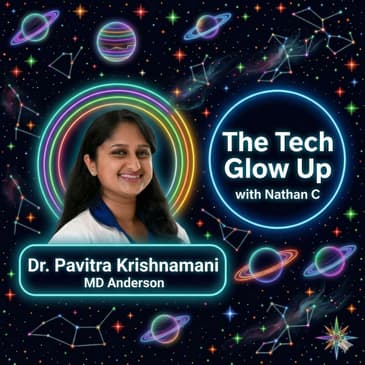

What if the biggest barrier to healthcare AI wasn't the technology, but it was the workforce not yet equipped to use it? Dr. Pavitra Krishnamani is the newly appointed Director of AI and Digital Health Education at MD Anderson Cancer Center and an emergency physician who's been at the intersection of clinical care and digital health innovation for nearly a decade. Her answer to that question is the job she was literally just handed.
Pavitra's path here started in a fellowship at Jefferson, where she was the clinical voice embedded in a team of designers and developers. That team built a VR code blue simulator that was later patented. In one year.
That origin story shaped everything: her belief that getting the right people at the table early, clinicians, developers, designers, (all of them) is what separates innovation that gets translated into real healthcare settings from the ideas that never make it out of the lab.
Episode Key Moment Highlights:
• [00:04:06] The AI and Digital Health Journal Club: how MD Anderson gets clinicians, technologists, and business leaders in the same room to dissect what's actually working — and what isn't.
• [00:05:21] Inside the hackathon: why MD Anderson opened it to residents, fellows, and trainees — because innovation comes from collaboration first, not seniority.
• [00:09:27] The VR patent story: how one fellowship produced a patented VR code blue simulator and a cardiac rehab virtual reality research program.
• [00:16:07] Where healthcare AI is actually delivering ROI today: predictive analytics, clinical decision support, and freeing up human capital to do what AI can't.
• [00:22:04] "Innovate with purpose": Pavitra's call for translational innovation — starting with a problem and a person, not a product.
Pavitra coined a phrase in this conversation I haven't been able to shake: translational innovation. Asking from day one how your solution will actually be adopted, not just whether it works in a lab.
Her work at MD Anderson is building the culture and curriculum to make that the norm.
Watch the full conversation on YouTube and like and subscribe so you never miss an episode of The Tech Glow Up.
Join the Tech Glow Up newsletter on Substack → https://substack.com/@mxnathanc
A "glow up" signifies a positive transformation, reflecting the journey of becoming a better, more successful version of oneself.
At The Tech Glow Up, we humanize the startup and innovation landscape by focusing on the essential aspects of the entrepreneurial journey. Groundbreaking ideas are often ahead of their time, making resilience and perseverance vital for founders and product leaders.
In our podcast, we engage with innovators to discuss their transformative ideas, the challenges they face, and how they create value for future success.
If you're a founder or product leader seeking your own glow up, or a seasoned entrepreneur with stories to share, we invite you to join our guest list via this link.
The Glow Up talks with innovators about their big ideas, how they stay resilient in the face of change and how they find and build the value that will drive their future success.
What is a glow up - you might ask?
Glow up is defined as "a positive transformation, often involving significant changes in appearance, confidence, or lifestyle.
We use "Glow up" to refer to the process of becoming a better version of oneself, more attractive, and more successful.
If you're a founder or a product leader who's looking to have a glow up of your own - or if you're a seasoned entrepreneur who's stories can support others, we'd love to hear from you. Please add you name to the guest list with the link in the show notes.
Each episode will also feature a community spotlight for innovative NGOs, non-proffits, and other organizations that are driving innovation and change in their communities. There's another link in our bio for community groups and sponsors to learn more!
Dr. Pavitra Krishnamani is an emergency physician and the newly minted Director of AI and digital Health Education at MD Anderson. Oh my gosh. She's The kind of person who develops a patent for a VR simulation in a one year fellowship program. She's proof that if you want healthcare innovation quickly, you better put a physician in there because Pavitra has been there and seen what it takes to break down silos and really drive true innovation. While we talk about innovation so much on the tech Glow Up, Dr. Krishnamani brings us back to a key insight that matters for innovators, no matter the industry: research based evidence backed innovation that's really solving problems that stand in the way of our customers today. When we solve these kinds of problems, this is how we know we can deliver transformative change. Transformative change isn't waiting on some great idea. It's waiting for ideas that are research backed and data driven that really solve the pain points that clinicians and patients are looking for help with. You will get a solid dose of patient-centric Doctor First Innovation in this lovely conversation with Dr. Pavitra Krishnamani of MD Anderson on the tech Glow Up. Do you want to go 4K? We can go 4K.
Pavitra KWhat happened to eight K? You got future proof?
Nathan CWe're talking healthcare communications. Friend. This isn't a bad Zoom connection. We're high def right now.
Pavitra KLord.
Nathan CSo, Dr. Pavitra the first thing that we do is we clap the microphones in to sync the sound. So we go toward the camera with alligator hands, and on the count of three, we clap it in. Are you ready? 1, 2, 3. Hello and welcome to the Tech Glow Up. I'm Nathan C Live from the Vive event, today I have the distinct pleasure of talking with Dr. Pavitra Krishnamani of MD Anderson. Thank you so much for joining me today.
Pavitra KGlad to be here
Nathan CYou doctor, wear so many hats in the work that you do. Could you please, start us off by introducing yourself and the work that you do in health tech innovation?
Pavitra Kso my name is Pavitra I am an emergency physician by training. I still practice clinically. one of the things that interests me most in healthcare is how we can break down silos and have different groups of individuals work together for the betterment of digital transformation. I'm very excited to be involved in that space. I, was just asked to be the Director for AI and digital health education at MD Anderson. I'm a strong believer in how education begets innovation, because really we need to be thinking about how we upskill our workforce, how we teach people to think in a flexible and adaptable way, to be able to really be ready for all of the, innovations that are coming down the pipeline, right? Mm-hmm. It's not just ai, but it's AI and a whole lot more
Nathan CI wanna dive a little bit deeper because when I first had like AI and medical strategy in my brain, that's one thing, but we're also talking about like future proof, like the education needed to future proof the workforce. So I wanna make sure that I'm like thinking in the right space. You said you've just been asked to join? Yes. So,
Pavitra Kbut I have been working on educational initiatives. Within the institution.
Nathan CTell me more.
Pavitra KWell, one of the very successful ones that we've implemented has been essentially an AI and digital health journal club, right? So we have gotten together people, from across different, walks of life within our institution who sit together and who take a look at research articles, industry articles, and we talk about them, right? and so having a group of people together to kind of talk about an innovation that we were already starting to implement in the hospital. and then at the same time talk about its relevancy. the studies around it, its pearls, its. It's pitfalls. a lot of lessons learned. Right. That, that I think is a really important discussion to have. It's a really important discussion to include multiple different people in. Very often I think these conversations are siloed, right. People will talk, within the tech team about it. People will talk within the clinical world about it, and there may be points of feedback, right? But what I really think we need to do is I think we need to break those silos wide open. Mm-hmm. And have people just talk to each other. That's such a huge part of creating a community and a culture of innovation at a place. That's one of the things. Yeah. We have a hackathon coming up kind of with the same exact, ethos in mind. Get together multidisciplinary groups of individuals.
Nathan CTell me about this hackathon.
Pavitra KYes. So we have a hackathon coming up with, kind of the same ethos in place, getting together multiple different people from different walks of life, sitting down at a table and coming up with, potential solutions or ideas for solutions. In this case, it's a mini hack. So ideas for solutions that we can then be able to, you know, pitch and see how it is. We can use these solutions to address systemic issues that we see in healthcare already.
Nathan CAnd who are those hackers? Are those like doctors and nurses? Are those other. Leaders at MD Anderson. Like who, where? Who are you hacking with?
Pavitra KSo we have purposefully actually left it open to. Everybody at MD Anderson. So we expect to have clinicians, we expect to have, data scientists or developers or folks with more of a technology bent. people with a little bit more experience on the business side, working together towards these, towards these solutions. we've kind of set it up so there's a bit of a pitch session at the end of it, and we'll have our own team of sharks, if you will, but they're very nice. They're not really sharks. to kind of help provide that feedback and see if, if some of these ideas are things that we could potentially even, think about implementing or think about having them influence the way we implement things that are at our institution.
Nathan CYeah, that sort of, that is right, like always. The idealistic goal is, can an internal project, a 10% exploration lead to something that might improve or add to the, the product line?
Pavitra Kand for me, it's something I'm particularly passionate about because my first exposure to digital health technologies was about nine years ago when I did a fellowship in Jefferson.
Nathan CMm-hmm.
Pavitra KWhere I was the clinical voice embedded in a team of designers and developers. We were talking about these issues, we were talking about how we could use virtual reality at that time. AI processes to kind of create solutions that are embeddable within a clinical setting. And so it was phenomenal. It's something I always wanted for my career in the future. So I'm excited to kind of be a part of not just doing that, but creating that opportunity for others. Right. Yeah. Even our hackathon, it's open to trainees, right? It's open to residents. It's open to fellows, right? I think innovation comes from. From any level of experience. Mm-hmm. But I think it comes from collaboration first and foremost.
Nathan CSo you've mentioned like at least three times this idea of innovation has to break down silos and we need to get people communicating a little bit better. I'm sensing that's an important theme in your work a little bit. and I'd love to know, I'd love to use it as a way to dive into your origin story. You mentioned a little bit, starting, you know, some of this work with a product team. But, the doctor who gets exposed, to product and, you know, catches that innovation bug is like a very interesting story I hear occasionally. yeah, I'm very curious. What was your origin story and like, yeah. Why, already? Yeah, why innovation?
Pavitra KWhy innovation? so I actually never grew up in a family of doctors. I'm the first doctor in my family, first person in healthcare, in my family, so it's kind of like I've always grown up with different perspectives and like none of them have been medical. Mm-hmm. Right. And so growing up kind of in that sort of a setting, I think I was probably primed to look at how different industries do things, right? I think there's a lot of parallels in the way we can. Take that and apply it to a healthcare setting. And obviously there are separate and specific considerations in a healthcare setting that we have to think about. but that doesn't mean we don't look to other places to see how they innovate, to figure out how we should innovate. And so going into medical school with that mindset probably really prime me to become a part of the design program at Jefferson. And then as a part of this fellowship. Really being that clinical voice. I liked working with people who were from different walks of life, and I liked seeing their perspectives on things and understanding where they're coming from. I mean, the problems that come from the development side are things that I probably never considered, right? Problems come from a design side are things that I learned to consider and the problems that come from a clinical side, like the clinical workflows are things that our developers and designers did not know about up until I was able to bring them up. Even as a medical student, I felt that I could bring such value to the team when we were having these conversations. It was mind blowing to me. Mm-hmm. Right. And I loved that. I loved being able to work with colleagues from different spaces
Nathan Cright?
Pavitra Kwe did create kind of a VR code blue simulator that was later patented. and went ahead and, developed an opportunity to bring virtual reality. Into our cardiac rehabilitation space for research purposes, which was phenomenal. It was a great experience working with startups locally for that latter project. Mm-hmm. And kind of, being able to collaborate in that space. So that's kind of how this, I haven't founded a startup, but that's how kind of the startup advisory bug probably bit me.
Nathan CYeah.
Pavitra KI like evaluating emerging technologies and things like that
Nathan Cdangerously close to being a founder soon, if you keep this up, the, ah. And also like, let's take a moment to celebrate developing a pilot within a one year fellowship that eventually becomes a patented AR application in the health space. Like, that's pretty awesome. I mean,
Pavitra KYeah. So I'm glad that we were all able to work together to do it, but I was very excited to be a part of it. Very excited to do the clinical stuff on it and be an inventor on it. So
Nathan COne of the things that you called out just a second ago, I think also deserves a little extra beat. And it's this idea that with the wrong people in the room, you can get a long way to innovating something, but when you get the right people in the room, the power of some of those small details, Perspectives that nobody else was thinking about can be the difference between like being on the same dartboard and being within like the 10% that matters. And it's, I think people often like overestimate how much time it takes to get alignment, how much effort it takes to get like research and feedback, how much work it takes to like. Start with a small, effective kernel of an idea and expand it. Right? And so I love that, your work is sort of founded in this, like, yo, if we talk together, this would be way better.
Pavitra KI think my current fascinations actually in the translational aspect of things to that. Yeah. to that end,
Nathan Csay are,
Pavitra KI think there are so many different initiatives for innovation, for product development. And unfortunately not a lot of them actually get translated into a healthcare setting. And I think the reason we see that disconnect is because we're not having people at the table very early on talking about what the problems might be. What to look for. we're not valuing guidance from an advisory team and that sort of thing. I think we're seeing that culture change more and more. Part of it is about connections. Part of it is about advice. When you think about having a physician advisory team for a company or for a startup, because. Yeah, like you can technically get advice from the internet, but there's a reason why we go through and we do the things we do, right? Like I have a certain bent of mind that helps me interpret what is in the research and like what is going on to be able to provide cohesive advice based on real world experience and what somebody can find on the internet.
Nathan CYeah.
Pavitra KI always say things I, this is my joke, I guess, is I, I sit here and I go, you know, sometimes I just feel like I say really obvious things, but then I realize that when other people say things that are obvious to them, it's non-obvious to me, and it's the same the other way around. Mm-hmm. And that's why it's so important to get people talking.
Nathan CYeah. Oh, I'm gonna have to leave it there. We've spent like most of our time on just your introduction. I, so I'm gonna, I have follows up and like you're pushing all the keywords that get me to wanna double down, but the name of the show is The Tech Glow Up and at Vibe I'm asking leaders in innovation about how they wanna see the healthcare industry improve. Have a, a notable transformation in the next year. So as you think about everything you've been seeing this week, everything that you're doing in your work, where does healthcare innovation need to Glow Up?
Pavitra KOkay, so I think that probably the greatest potential, in healthcare innovation Glow Up is really, considering. Interoperability between different digital health modalities. We think about all of these things.
Nathan CYes.
Pavitra Kmy book is about this, by the way.
Nathan CYes.
Pavitra KUh. If I may, the book is called, Home is Where the Health Is. It's coming out in the coming months. to be published by Springer. It's about giving people essentially a 10,000 foot view of what are these different digital health technologies. How can we have a cohesive and knowledgeable discussion around them? How can they work together to create truly transformative change? So we talk about VR, we talk about ai, we talk about mHealth, portable health devices. Obviously they are in depth multiplicities of books within each of these topics. But this is supposed to give someone just an overview of how do these things work? What are the policies around them, and how can we actually put them together to create something that creates transformational change in the healthcare space. That's what I would like to see.
Nathan CYo. Not an in, not a plant. This was not planned. This is, I, I what a happy, what a happy discovery. honestly. I love it. So books coming out, brand new role in
Pavitra Khealthcare education.
Nathan CHealthcare education. So like. What's next for you? Like what's the Glow Up you're taking to your work or the work that you're doing?
Pavitra KI think the Glow Up has started right? the role is big. The role is very new.
Nathan CWe caught it in flight.
Pavitra KI'm very excited to be a part of our division of education and training at MD Anderson. Excited to see what we can do as far as workforce upskilling goes. The UT system actually has, an initiative now to try to standardize how we do education, how we, create, Infrastructure for innovation around ai. So I'm excited to be a part of that initiative as well moving forward. So, we will learn more Dr.
Nathan CGlow,
Pavitra Kwe'll learn more in, in, you know, the coming months,
Nathan CWell hopefully, at a future health event, we can connect and catch up and, and see how it's been going. Yeah. But like, thank you for like. Bringing me to this moment with you, and thanks for bringing your Glow to the show.
Pavitra KI'll be at South by Southwest in HLTH Europe speaking as well.
Nathan CAmazing.
Pavitra KBecker is in the fall.
Nathan Chey, so you mentioned your excitement for ai. And making an impact, building some frameworks, and one of the questions that I've been asking anybody who name drops AI is to help me understand, right? A lot of the press releases are about future opportunities, potential solutions to problems, but what's real today when it comes to what is effective, responsible, and like revenue driving. AI Innovation in health or in health education?
Pavitra KYeah.
Nathan CWhere are we at?
Pavitra KI think a lot of people think about replacing humans with ai. They talk about it a lot. They say, Hey, you know, doctors can be replaced by ai. teachers, I, why, why are we trying to replace teachers and doctors with ai? Like, these are the times people, right? We want human interaction. It doesn't make any sense. But, I do think that as much as people have like futuristic ideas of human replacement with ai, where we see the greatest benefit today and where we probably will continue to see the greatest benefit is actually in predictive analytics. Like if I'm an organization and I'm thinking about what I can do more efficiently in my workflows, It's thinking about how do I free up human capital and human potential to do something more? Mm-hmm. And to move the organization forward in a way that AI can't, right?
Nathan CYep.
Pavitra KAnd so to be able to figure out what AI can do and what humans can do that AI can't, you have to think about where your inefficiencies are. And that's where I think predictive analytics plays a really big role. The other is in clinical care, obviously think about the power of predictive analytics when it comes to detecting certain illnesses, early clinical decision, support systems.
Nathan CYeah.
Pavitra KI think that we're gonna see a big transformation in that, in the very, very near future if we haven't already.
Nathan CAbsolutely. I love the focus on predictive analytics, right? Because as humans. We often have some confirmation bias about what we do and what makes a difference and what works.
Pavitra KMm-hmm.
Nathan CAnd it's hard to let go of the things either that like are our preferred modality or like the pattern that fits our workflow the most when. we're thinking about new things and so like using the data to actually point to where we're wasting, where we're growing, where we have these opportunities is like, oh, so important. Doctors and innovators alike work in a rarefied space and they're told to be domain experts in so many ways, which can be pretty lonely. And what I've learned in talking with the guests on the Glow Up is that the role of mentors and like guides and coaches is just crucial. For either one of these personalities as a doctor innovator, how have your mentors and guides helped you get to where you are today?
Pavitra KHonestly, I've been very lucky to find, people to help shepherd me down this journey. Every workplace that I've been at, I've had mentors along the way. and in every organization, whether it's ACEP or now increasingly the TMA I've met very, very, strong mentors in this space because there are so many physicians interested in this space, like you mentioned. Right. Even at MD Anderson, I think the role of a mentor is so important because they help you understand not just the space, but your organization and how you can fit within it.
Nathan CMm-hmm.
Pavitra KHow you can grow within it,
Nathan Cespecially a, a large like impactful organization, right? Like
Pavitra KMy mentors are the reason, like this Directorship and AI and digital health education, it didn't exist before it was offered to me. So the position was created in large part, because, of a need that the institution saw and, the work that I'd been doing on it, and the fact that my mentor did indeed point out that I was already working in this space. And there may be an opportunity to have me involved in this capacity, right? Like you have, you have your mentors, you have your sponsors, and and I've been very blessed and very thankful to have the, The team of people I've met throughout my lifetime helping me through this process.
Nathan Cyou said one of the things that I really think is so true, right? That often if you're early in your career, early on a journey, it's hard to necessarily know. What all the steps will be. But if you can share a vision with the people around you, with your stakeholders in your company, with your bosses, with your mentors, they will know when to put the right things in front of you or, or sort of help show you what, Hey, you know, that thing that you said looks like this opportunity and that, yeah. Really have, like one of the most impactful things you can do if you are like an inspired person with a vision is just to make sure that people around you know what you're trying to do.
Pavitra KAbsolutely.
Nathan CAnd that like you're open to their feedback, you're eager for their feedback, you know. To find the best path there.
yeah,
Nathan Cthank you for that Call out
Pavitra Kand I would say seek out your mentors. Like that's a really big part of it as well.
Nathan Cmeet your heroes, like meet'em, ask'em for their time. It's like the best use of both of your world.
Pavitra KMentors come to you, but sometimes it's just an email.
Nathan CYeah.
Pavitra KI can list mentors, even folks who've spoken here, right? Who I have just sent an email to and said, Hey, listen, I wanna pick your brain as to like your career path and like what that looked like, because mine will probably look different, but. To understand where you wanna go, you kind of have to understand how other people have gotten to where they've gotten. Right?
Nathan CYep.
Pavitra KYeah.
Nathan CYeah. It's a weird thing in innovation, right? That you're trying to blaze a trail that hasn't been made before. And so having many examples of like, what do different trails look like? Yeah.
Pavitra Kwhere's the opportunity in this space?
Nathan CYeah. How do you learn from it? Trust it.
Pavitra KYeah.
Nathan CYeah. Dive in.
Pavitra KWoo.
Nathan COkay.
Pavitra KGrowth is personal. Entrepreneurship growth is when you look at yourself as an idea, as something that you are able to offer, right? And think about where you're able to fill gaps, where your skills fit and what you can do to Make the world a better place.
Nathan CHow do we not end on that? I have one more question, Dr. Pavitra
Pavitra KOkay. The last one, I think
Nathan CGrowth is innovation at a personal scale or you can innovate any part of your life, your career, your current job, your future job. break it down into small pieces and just keep learning. Do you have a spicy hot take? maybe a soundbite about healthcare, ai, innovation, culture or otherwise.
Pavitra KHow short should this soundbite be?
Nathan CIt's the last day. What else you gotta do in
Pavitra KI would say innovate with purpose if you know what it is you want to do, not just like what product you wanna develop or what solution you wanna develop, but what problem you want to solve. If you apply that human-centered lens on things. And if you identify what issue in the world you're trying to fix, what thing you're trying to make better, Y you'll find a way to pivot until you figure out the right way of doing it. That's what we should all be aiming for.
Nathan CIf you start with a problem and a person at the beginning of your innovation, it will lead you to its answer.
Pavitra Kfind your purpose, innovate with purpose,
Nathan Cinnovate with purpose. It was so good. the, I think a lot of times, just to jump on this analogy innovation comes from passion. And possibility.
Pavitra KYeah.
Nathan CAnd those things are important in the founder's journey.
Pavitra KYes.
Nathan CTypically, it's hard to get out of your own experience if you're just in your own passions.
Pavitra Kthe founders that strike me most are sometimes folks with a personal story, but oftentimes folks who realize like, this is a problem, this is an evidence backed problem, we need to find a way to fix it. And like. I think I have an idea as to how, mm-hmm. This is the research I've done behind why it'll work and I'll ask questions saying like, how do you feel like this is gonna work? Like what are the practical implications of this? I think that idea, and this is a phrase that I like to, I think I coined right. translational innovation. I think the idea of translational innovation needs to become such a core element of how we innovate.'cause from the beginning, we should be thinking about how do I use this to create an impact? However that is. Sometimes that's what the healthcare organization, sometimes that's direct to consumer. Mm-hmm. Right. But how do I make this something that actually is adoptable, something that'll actually make the difference I hope it will have in the world.
Nathan CYeah. Like every founder wants to be successful and often we think about successful as the money side of things, but the delivering an impact with a customer is the thing that makes the business eventually. So I love Dr. Pavitra your, you're very human centered, very problem and purpose, driven take on education. And I hope you'll come back to The tech Glow, Up to, tell us what you've been up to in innovation and education. Yeah,
Pavitra Kabsolutely. I would love to.
Nathan CAmazing.
Pavitra KOkay.
Nathan CWe're gonna clap it back out like we clapped it in.
Pavitra KOkay.
Nathan CYou ready? One. Two, three. Thank you so much.
Pavitra KWas good.
Nathan COh my gosh. Can I ask you a favor? If you really enjoyed this episode, could you share it on your Instagram stories or maybe post the link with what you enjoyed on LinkedIn? The sort of sharing and engaging really helps small podcasters like me reach the audience that I know really cares about these kinds of conversations. If you've made it this far in the podcast, I really appreciate you. Thanks for listening. Please make sure to like and subscribe so that you never miss an episode of the Tech Glow Up. And hey, can I ask you a favor? If you really enjoyed this episode, could you share it on your Instagram stories or maybe post the link with what you enjoyed on LinkedIn? The sort of sharing and engaging really helps small podcasters like me reach the audience that I know really cares about these kinds of conversations.