
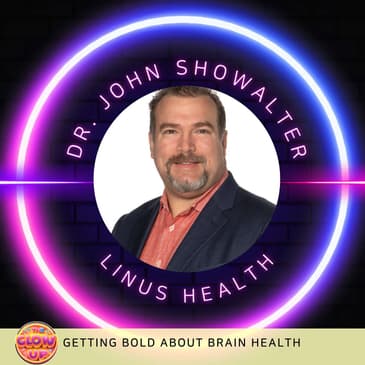

Dr. John Showalter is the Chief Strategy Officer at Linus Health, a company focused on early detection of cognitive impairment and dementia. They develop digital cognitive assessments and engagement tools to help people think about their brain health, get diagnosed, and receive lifestyle medicine suggestions.Key Takeaways:
- Linus Health modernized the Minicog test, making it more accurate and accessible for detecting mild cognitive impairment.
- Their digital assessment can be administered by medical assistants, making it easier to integrate into primary care visits.
- The company provides a Brain Health Action Plan to give patients agency over their brain health.
- Linus Health emphasizes the importance of early detection, as 30% of people over 65 have mild cognitive impairment.
- Their approach combines systematic inventive thinking with new technologies to address cognitive health.
Dr. Showalter's journey to Linus Health began with his background in internal medicine and informatics. He worked on various health IT projects, including predicting sepsis and detecting domestic violence in EHRs. His passion for dementia care was sparked by personal experience with his grandmother's rapid decline.
Linus Health's technology aims to catch cognitive issues early when interventions can be most effective. Their assessment tool is designed to be user-friendly and integrated into regular check-ups, potentially reducing the risk of dementia by up to 50% through early intervention.
The company faces the challenge of introducing new ideas about brain health and potential outcomes to both healthcare providers and patients. They focus on providing clear, actionable information and emphasize the importance of brain health alongside other routine health checks.
Looking ahead, Dr. Showalter envisions a future where brain health assessments are as common as blood pressure checks, and where early intervention can significantly impact cognitive health outcomes.
About Dr. John Showalter
John Showalter, MD, MSIS, is board-certified in internal medicine and informatics and serves as Chief Strategy Officer of Linus Health, a digital health company enabling early detection of Alzheimer’s and other dementias. Linus Health has won Time Magazine’s Best Inventions and Fast Company’s Innovation by Design awards for its work in bringing the power of digital cognitive assessments to PCPs. Dr. Showalter also practices medicine in Danville, Pa., with a focus on cognitive care and dementia prevention.
A "glow up" signifies a positive transformation, reflecting the journey of becoming a better, more successful version of oneself.
At The Tech Glow Up, we humanize the startup and innovation landscape by focusing on the essential aspects of the entrepreneurial journey. Groundbreaking ideas are often ahead of their time, making resilience and perseverance vital for founders and product leaders.
In our podcast, we engage with innovators to discuss their transformative ideas, the challenges they face, and how they create value for future success.
If you're a founder or product leader seeking your own glow up, or a seasoned entrepreneur with stories to share, we invite you to join our guest list via this link.
The Glow Up talks with innovators about their big ideas, how they stay resilient in the face of change and how they find and build the value that will drive their future success.
What is a glow up - you might ask?
Glow up is defined as "a positive transformation, often involving significant changes in appearance, confidence, or lifestyle.
We use "Glow up" to refer to the process of becoming a better version of oneself, more attractive, and more successful.
If you're a founder or a product leader who's looking to have a glow up of your own - or if you're a seasoned entrepreneur who's stories can support others, we'd love to hear from you. Please add you name to the guest list with the link in the show notes.
Each episode will also feature a community spotlight for innovative NGOs, non-proffits, and other organizations that are driving innovation and change in their communities. There's another link in our bio for community groups and sponsors to learn more!
[00:00:00] So, and one way to be bold, I really would be tell you to be bold about care of your brain health, get your baseline cognitive performance, know your brain, and then protect it.
[00:00:14] Hello, and welcome to The Glow Up. This is Fabulous Conversations with Innovative Minds. I'm Nathan C here from HLTH 2024 with Dr. John Showalter of Linus Health. Dr. John, thank you so much for joining me today.
[00:00:27] Nathan, thank you for having me.
[00:00:28] Oh my goodness. So this is our first time meeting, so I'd love it if you could introduce yourself a little bit and the work that you do as Chief Strategy Officer at Linus Health.
[00:00:39] Dr. John Showalter Thank you. So I'm an internal medicine physician by training. I still have some clinical practice. I work at my wife's practice.
[00:00:44] Nathan C Bowser Awesome.
[00:00:45] Dr. John Showalter So she's in charge at work and at home. And I work at Linus Health, where we're focused on early detection of cognitive impairment and dementia, and develop tools, digital cognitive assessments and engagement tools to get
[00:00:57] people thinking about their brain health, get them engaged in brain health, get them diagnosed by physicians and also provide lifestyle medicine and suggestions for how people can take care of their brains.
[00:01:09] Dr. John Showalter Amazing. Sounds like something all of us will need to know more about at some point. Can you describe a little bit of what one of the assessments or tools that you use in this work looks like?
[00:01:22] Dr. John Showalter Our bread and butter tool, the one that we're most known for is we took the standard tool that was used in primary care, which is called the Minicog.
[00:01:29] Dr. John Showalter And you've probably seen it or heard about it because it involved that clock drawing test. We asked people to remember three words. We have them draw two clocks. And then we said, hey, what were those three words that we asked you to remember?
[00:01:40] Dr. John Showalter It took like two minutes to give. And it was really good at finding people that had dementia. But 30% of people over 65 have what's called mild cognitive impairment, which is that they have trouble doing some of the most difficult tasks. I can kind of think about it as pre-dementia.
[00:01:56] And that's the stage where we can actually intervene really effectively and reduce up to 50% of people for becoming demented. So there's a big prevention piece that we can catch it early. But the test wasn't designed to do that.
[00:02:10] Dr. John Showalter So we actually worked with Dr. Sue Borson, who was the inventor of the Minicog, to modernize it. We put it on an iPad. We analyze it with artificial intelligence. And it's way more accurate. And it doesn't have to be done by a doctor anymore. A medical assistant can do it accurately.
[00:02:24] Dr. John Showalter So you can go into your primary care doc, you can get your blood pressure, your heart rate checked, and do the test. And we know how your mind's really working and give you a much clearer insight into whether or not you need to go down a diagnostic journey. Or if you can just skip out of the office, knowing that your brain's good.
[00:02:40] Dr. John Showalter Amazing. That's one of those diagnoses that seems like, in addition to creating a diagnostic or a tool to understand it, that you're introducing these new ideas, potentially, you know, these new future outcomes. How does your message, how do you approach the messaging? Is that part of the work that you have to supply at Linus?
[00:03:05] Dr. John Showalter So we also create what is called a brain health action plan, or we refer to as a brain health action plan. Because if you're going to tell somebody that they're struggling with their thinking, you've got to give them some agency back.
[00:03:15] Dr. John Showalter You can't just say, yeah, your brain's not working real great. Bye.
[00:03:20] Dr. John Showalter Yeah.
[00:03:20] Dr. John Showalter You know, that ends up with patients, you know, coming up with phrases like diagnose and adios. And we are not okay with that at Linus in any way, shape or form.
[00:03:28] Dr. John Showalter Yeah.
[00:03:29] Dr. John Showalter So everyone that gets our test also gets eight pillars of brain health education that gives them agency over their brain health, that tells them where they need to work. And is based upon randomized clinical trials that show 70% of people with cognitive impairment can stabilize or improve their thinking.
[00:03:48] Dr. John Showalter I've been through some healthcare scenarios with my parents. And recently, I'm a sandwich generation person who parenting up and down. And the clarity of being in a hospital system from doing tests, what are the three specific details I need to know about what's going to happen?
[00:04:08] Dr. John Showalter Often were so important to them, like, oh, 90% of people who do this are going to turn out the way I want to turn out. Having that peace of mind and that clarity within that space has been so important. So I love hearing that there's this whole diagnostic. Thank you for joining me on the sidebar. I want to back us up just a little bit. You talked about having some of these very unique kind of interesting skills that make you very apt, you know, very powerful in the work that you're doing now.
[00:04:35] Dr. John Showalter Can you tell me a little bit about the journey of becoming a chief strategy officer? And, you know, how does one sort of start in medicine and move into innovation and technology like you've done? Or how did you do that?
[00:04:51] Dr. John Showalter So I don't know that I would encourage anyone to follow exactly my journey because it was a little hiccupy. But I started off as a biomedical engineer and then decided to go to school to get my MD and my PhD. That was going well until I started doing my research for my PhD.
[00:05:05] Dr. John Showalter And it was slow. And it was like months to get one patient, one paper out. And it just wasn't me. So I didn't finish my PhD. I went back to medical school and then completed medical school and didn't really find that passion niche that you're supposed to find during medical school.
[00:05:25] Dr. John Showalter And it was like, you know, I was a medical student and I was working at my PhD. I was working at CERNA and was hiring medical students to be the elbow to elbow support for the nurses and the doctors.
[00:05:40] Dr. John Showalter And they hired me as one of these elbow to elbow supports. And of course, I was a medical student and they were paying me. So I was working like 16, 17 hour days. And then I found out I had overtime and then I just didn't sleep for a week.
[00:05:50] Dr. John Showalter And I loved it. I loved that you mesh of clinicians and technology and all the promise of it. And serendipitously, the CIO was a pathologist and said, Hey, I want to start a fellowship in this.
[00:06:05] Dr. John Showalter And I took a year off, worked in the IT department, was a Cerner command language programmer, physician informaticist working on order sets and clinical decision support rules.
[00:06:17] Dr. John Showalter And then we set up a five year program where I did internal medicine, got my master's in informatics and did research on predicting sepsis on how to detect domestic violence in the EHR and loved it and just fell in love with how technology enhances healthcare.
[00:06:35] Dr. John Showalter And then became the chief medical information officer at the University of Mississippi Medical Center and did a big old epic install.
[00:06:45] Dr. John Showalter And once that was complete, got pulled into all of the technologies that wanted to integrate with Epic, all of these great ideas and stepped into a chief health information officer role that was a really innovation.
[00:06:58] And once I began working with the vendors and saw the speed that they got to move at, I moved over to the digital health side about seven years ago, worked in clinical artificial intelligence, integrated it with EHRs, but always had a really big passion for dementia because I missed it in my grandmother.
[00:07:15] Dr. John Showalter So my grandmother went from living at home to a locked dementia unit in about two weeks from my grandfather passing away to us realizing how
[00:07:25] Dr. John Showalter How much support she was and what she really needed.
[00:07:29] Dr. John Showalter And my mom's an nurse who lives next door.
[00:07:32] I'm an internal medicine physician.
[00:07:34] And my grandfather was able to mask it from us, was able to never told us anything about her struggles.
[00:07:40] Dr. John Showalter Thank you.
[00:07:43] Dr. John Showalter When the chance came to work at Linus.
[00:07:48] Dr. John Showalter I don't know how to say that dementia touches my family.
[00:07:54] Nobody knew until there wasn't anything we could do.
[00:07:59] And the feeling like you lost somebody right in front of your own eyes and didn't know it was a really big thing for us to hand on.
[00:08:10] Dr. John Showalter I have a lot of ears to Jewish.
[00:08:12] Dr. John Showalter So on the mission we did it, out there, diagnosed, treated.
[00:08:17] Dr. John Showalter Yeah.
[00:08:18] Dr. John Showalter Yeah.
[00:08:18] Dr. John Showalter And now you're out there doing it.
[00:08:19] And so as a layperson, I have this, it's hard for me to imagine how far ahead in the body's systems and how far ahead in detection you have to be.
[00:08:35] Dr. John Showalter When you're talking about just the skill of the problem that you're working on and how you can define a future state early enough to be able to be helpful, seems like just such a big ball of data to unwind.
[00:08:50] And years of nature and nurture and all sorts of inputs.
[00:08:53] Dr. John Showalter How do you approach, as a strategy officer, right?
[00:08:57] Like how do you approach, you know, eating that elephant one bite at a time or unwinding that ball?
[00:09:03] And how do you help those who haven't been on such a journey to be patient with these long processes and innovation change?
[00:09:14] Dr. John Showalter Yeah.
[00:09:14] So, yeah, with dementia as an example, but there's diabetes as an example, breast cancer.
[00:09:19] Like healthcare has all of these examples where the earlier we intervene, the better the outcomes are, the better your health are.
[00:09:26] Like even cardiovascular disease, start controlling your blood pressure immediately, you're much less likely to have a heart attack.
[00:09:33] What I've seen over my career on the innovation side is you have to keep taking one step back, which drives anyone in innovation insane.
[00:09:43] Dr. John Showalter If you were to go tell somebody in the transportation industry, like we'd like you to take one step back.
[00:09:50] I would like my quantum leap and the technologies that are really impactful are the ones that make quantum leaps.
[00:09:56] Healthcare is very different in that way.
[00:09:58] We're incredibly risk averse as probably should be because we're risking people's lives and limbs.
[00:10:05] Dr. John Showalter Yeah, literally.
[00:10:06] So like you just can't say I've got, you know, the silver bullet and we're going to like mystically magically drive this forward.
[00:10:15] I just need generative AI or whatever.
[00:10:18] Right.
[00:10:18] So innovation in healthcare is slower.
[00:10:21] It's more cautious.
[00:10:23] It's incredible when it works.
[00:10:25] Dr. John Showalter When I was working with clinical AI on the health system side, we implemented a technology using AI to predict pressure injuries.
[00:10:34] And those are wounds in the skin from laying in bed.
[00:10:37] Something that you get because you're not able to be mobile while we're vision-ridden sick.
[00:10:41] And once they form, they're really hard to heal and they're really painful and can actually even lead to death.
[00:10:48] Dr. John Showalter Yeah.
[00:10:49] So we want to prevent them at all costs.
[00:10:50] And I was in Mississippi where all of the standard algorithms did work because they did not take into consideration the African-American population, the African-American problems, the social economic problems that were in Mississippi.
[00:11:04] Some of the unique obesity with protein malnutrition that was there.
[00:11:07] That's really common in that diet.
[00:11:10] That's not really common in the Northeast where the algorithms were developed.
[00:11:14] So they didn't work.
[00:11:15] We brought in AI, used it on our population, got the great predictions, and dropped the pressure injury rate by 60% the first month of real lives.
[00:11:25] Because we were bringing all of those resources to the right patients finally.
[00:11:29] And it's amazing when you get that right next step.
[00:11:32] In the world of cognitive impairment and dementia, it is about bringing one step forward our ability to identify that somebody is impaired.
[00:11:43] So we've shown in the research that the technology can detect changes in the brain, plaques in the brain, tangles in the brain, before patients even have symptoms.
[00:11:53] But if we go and tell an internal medicine physician right now that you should go treat somebody's underlying pathology with no symptoms, they're rightfully going to laugh us out of the room.
[00:12:05] I mean, that's just not where we're at.
[00:12:07] But where we are at is the clinical trials that show if you have mild caudal impairment or if you have early dementia, we can stabilize it with lifestyle, with exercise, correct treatment of mood disorders.
[00:12:20] And they're really into that.
[00:12:22] But what they don't have is a tool to find it that early.
[00:12:24] So when we give them that tool, they love it.
[00:12:27] We did a physician acceptance trial where we just said, hey, use this for 90 days and literally give us a grade at the end.
[00:12:36] And it was an IRB approved clinical trial.
[00:12:38] And 100% of the physicians said, I want to continue using this.
[00:12:43] It changed my practice.
[00:12:44] We got qualitative quotes like, I love it.
[00:12:47] My practice has completely changed.
[00:12:50] I had no idea I was doing things wrong.
[00:12:53] And it was amazing.
[00:12:54] And I've been doing this for 20 years now and never once had 100% of docs go, this is a tech.
[00:13:00] So I'm hopping on two things that you just said.
[00:13:03] You just talked about how doctors are risk adverse and very cautious to trust new technologies.
[00:13:10] And you also just discussed a moment where doctors were like, heck yes, 100% of us want this new technology.
[00:13:16] I come from a world where people, you know, from tech innovation, where they often are sort of missing that connection.
[00:13:25] Right.
[00:13:25] And even this idea of doing an acceptance study seems radical, like that you go to your customers and ask them like, right.
[00:13:31] So do you build trust with doctors to even get them right?
[00:13:38] It feels like the technology did the job, but your job is to get their tests, their trust enough to even give the technology a try.
[00:13:46] So what's your approach to getting doctors to trust technologies?
[00:13:51] So, so, so my answer to that's my book.
[00:13:54] So, so I wrote a book on, on, on mastery of physician engagement.
[00:13:57] Um, but the punchline is really that we think doctors are difficult, but they're really different.
[00:14:02] They are the only profession who exist in a learning quadrant called the convergent learners, which is they learn by doing themselves.
[00:14:10] And medical school and residency actually makes them that way because we're still training them to go hang a shingle and work independently and work by themselves.
[00:14:18] So we take a group that's already kind of like self-determination.
[00:14:22] I'm going to do this myself.
[00:14:24] And then we train them to lifelong learn on their own.
[00:14:27] And that causes them to only trust themselves.
[00:14:31] So if you want to get.
[00:14:32] And the way that they structure and think about data.
[00:14:35] Yeah.
[00:14:36] So like data in my way.
[00:14:38] Yes.
[00:14:38] So, so they're like, this is how I learn.
[00:14:40] I have, I am the Island.
[00:14:42] Yeah.
[00:14:42] Right.
[00:14:42] Um, and it's a problem for team-based care and there's a whole other discussion on like, what do you do about the fact that doctors think they're on this Island and they only learn by themselves.
[00:14:52] Um, but from a technology perspective, what it means is.
[00:14:55] They only trust your technology after they use it.
[00:14:59] And they see benefit.
[00:15:00] So you can't tell them it's fantastic.
[00:15:02] You can't have them have a friend tell them it's fantastic.
[00:15:05] You have to have them use it and go, Oh, this is fantastic.
[00:15:10] Uh, which is why user acceptance studies and peer reviewed studies are actually really important because at least they can go, Oh, those nine guys learned to trust it.
[00:15:20] Maybe I should give it a try.
[00:15:21] Yeah.
[00:15:22] But they don't trust it until they've actually used it.
[00:15:25] Whoa.
[00:15:26] That's such a, so from my like startup worlds, that means doctors are kind of like the CEOs where like they know it when they see it.
[00:15:34] But like, there's only a few people who know that code again.
[00:15:38] Oh my gosh.
[00:15:39] There's so many things I could rabbit hole on, but let's keep it focused a little bit on why we're here today at health.
[00:15:46] I hear you've been on a panel around brain and this initiative.
[00:15:51] Can you tell me more about what you've been up to at the conference?
[00:15:55] So two days ago, I was on a panel called brain X that was really focused on getting this word out about brain health.
[00:16:01] So it's just been a absolute explosion of dementia is not inevitable research that you can treat mild cognitive impairment.
[00:16:10] People have really been putting a lot of work in this area.
[00:16:12] The panel was all about getting people to think about brain health and elevating brain health to where heart health is, where we're all talking about it.
[00:16:22] We all know what heart healthy looks like, but no one knows what brain healthy looks like, you know, but if I have a heart attack, I can get a stent.
[00:16:29] If I have dementia, I lose who I am.
[00:16:32] Which one should we be talking about?
[00:16:34] Wow.
[00:16:35] What an amazing like convergence of events to bring this topic that you are so passionate about.
[00:16:42] To the forefront and like yay for teams riding that wave.
[00:16:46] The name of this show is called the glow up, right?
[00:16:49] And a glow up is a transformation, right?
[00:16:52] A notable rebirth or improvement.
[00:16:55] I've been asking people, what's the glow up they're looking for in the next six months or a year?
[00:17:01] What's your big goal or vision for the near future?
[00:17:04] So from the Linus perspective, I think the big glow up is the dissemination of this to primary care and outside of primary care.
[00:17:15] So the ability to get this assessment in people's hands, whether that's like through a remote assessment on their portal or to their phone that gets back to their doctor so that they can actually, you know, take this at their convenience and in a setting that's going to reflect their best performance as opposed to maybe rushing into a doctor's office and then having to take this test while you're getting your blood pressure done.
[00:17:39] My blood pressure hates the doctor's office.
[00:17:42] And if I take an electric scooter rather than driving, I can drop 20 just by the mode that I get there.
[00:17:49] Yeah, it depends on primary care, doctor.
[00:17:51] I think it's real that you might have like white coat cognitive impairment if we test everyone.
[00:17:56] It's possible.
[00:17:57] That's not really a diagnosis, but I definitely have white coat hypertension and my blood pressure is fine at home.
[00:18:04] Right?
[00:18:05] I don't know that it's the doctors, but navigating even the hospital just does not make me happy.
[00:18:10] Yeah.
[00:18:11] My blood pressure is on it.
[00:18:12] From the overall brain health world, I've got my fingers crossed that there's two trials, Evoke and Evoke Lust, that are oral medications.
[00:18:21] I'm looking at preventing dementia for people that have mild cognitive impairment or early dementia.
[00:18:27] So my big glow up for 2025 is that I want us to be able to say there's a pill that prevents dementia.
[00:18:33] Oh my gosh.
[00:18:33] I'm really hoping that those trials are positive because that is like a whole new ground shift in the problem.
[00:18:43] I'm old enough to remember when Alzheimer's is a disorder was the conversation.
[00:18:50] Like we had identified that Alzheimer's exists.
[00:18:53] And to be at the stage where we're now talking about the potential for multiple treatments of cognitive disorders on the market soon is what an amazing, like you said, application of all of these bright minds.
[00:19:09] Goodness.
[00:19:10] We're getting very close to time.
[00:19:12] If people want to learn more or connect with you, do you have a call to action for folks or where they can learn more?
[00:19:20] Yeah.
[00:19:20] So definitely go to LinusHealth.com to learn about all that Linus is doing in this space and all of the ability to get early detection done.
[00:19:28] Please tell your doctor that we exist and that you would love him or her to use it in their practice.
[00:19:34] And you can connect with me on LinkedIn.
[00:19:37] Amazing.
[00:19:38] I'm going to squeeze in one last question.
[00:19:40] Okay.
[00:19:40] The theme of this year's event is Be Bold.
[00:19:43] If the opportunity to get on the main stage and encourage this audience to be bold in one way, what would it be?
[00:19:49] So, and one way to be bold, I really would be tell you to be bold about care of your brain health, get your baseline cognitive performance, know your brain, and then protect it.
[00:20:02] Yes.
[00:20:02] Dr. John Showalter.