
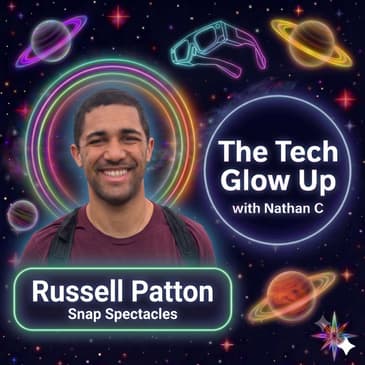
What does it take to stay committed to a vision when the technology is still developing? Russell Patton has been inside Snap working on camera glasses and AR smartglasses for over a decade.
He's a Staff Product Manager on Snap Spectacles, and we recorded this episode at Snap's Spectacles Developer Bootcamp in Santa Monica, where 50 of the world's top lens creators gathered to advance the path toward wearable AR.
Russell's through-line isn't hype — it's conviction built on evidence. Snap started making camera glasses in 2016 — not because the product was perfect, but because each generation taught the team something new about comfort, efficiency, and treating privacy as a first-class design principle.
When Evan Spiegel said around 2019 that consumer AR glasses were probably a decade away, skeptics balked. But that call came from a deep understanding of what the technology actually required.
- [00:01:39] Snap's AR vision: The challenge was never the idea — it was getting the technology to catch up, and what camera glasses since 2016 taught the team about the path forward.
- [00:04:01] Developers vs. consumers: Developers onboard themselves — but consumers need a working content ecosystem on day one and an experience that meets them where they are.
- [00:07:40] Spatial UX onboarding: Moving closer to content scales it, content stays anchored in 3D space — intuitive by nature, but people trained on flat screens need to rediscover that mode of thinking.
- [00:09:23] Specs 2024 in detail: Large field of view, electronic tint, 6DoF tracking, hand tracking, voice input, split computing architecture, and vapor chambers in each temple for thermal management.
- [00:17:27] Vision and conviction: "If the journey was easy, I think it's likely that the innovation would've already happened." On arriving at the right destination, even if it takes time.
AR glasses aren't a gadget — they're a new computing paradigm, a canvas for experiences that don't exist yet.
The most common reason developers give for their excitement says it best: get the screen out of the way so we can be in the real world more.
Watch on YouTube and subscribe so you never miss an episode of The Tech Glow Up. https://youtu.be/dUkxBmpL2uw
Join the Tech Glow Up newsletter on Substack → https://substack.com/@mxnathanc
A "glow up" signifies a positive transformation, reflecting the journey of becoming a better, more successful version of oneself.
At The Tech Glow Up, we humanize the startup and innovation landscape by focusing on the essential aspects of the entrepreneurial journey. Groundbreaking ideas are often ahead of their time, making resilience and perseverance vital for founders and product leaders.
In our podcast, we engage with innovators to discuss their transformative ideas, the challenges they face, and how they create value for future success.
If you're a founder or product leader seeking your own glow up, or a seasoned entrepreneur with stories to share, we invite you to join our guest list via this link.
The Glow Up talks with innovators about their big ideas, how they stay resilient in the face of change and how they find and build the value that will drive their future success.
What is a glow up - you might ask?
Glow up is defined as "a positive transformation, often involving significant changes in appearance, confidence, or lifestyle.
We use "Glow up" to refer to the process of becoming a better version of oneself, more attractive, and more successful.
If you're a founder or a product leader who's looking to have a glow up of your own - or if you're a seasoned entrepreneur who's stories can support others, we'd love to hear from you. Please add you name to the guest list with the link in the show notes.
Each episode will also feature a community spotlight for innovative NGOs, non-proffits, and other organizations that are driving innovation and change in their communities. There's another link in our bio for community groups and sponsors to learn more!
This episode is over a year in the making. I have to tell you, it was worth every moment Okay, so if you're in spatial computing at all, you know that 2026 has been a very interesting and active year for augmented reality and AI smart glasses. Recently, I had the opportunity to join over 50 global developers at Snap's Spectacles Builders Bootcamp to get an inside peek at where AI, AR smart glasses are going, some of the impressive new features, capabilities, and resources that lens builders will have at their disposals m- now and into the near future. And I really had a dream come true opportunity to talk with a product leader on the Spectacles team, Russell Patton. He's been at Snap for a decade or so, and has been working on camera glasses, AR smart glasses, and AI-enabled tools his entire time. We get geeky about the kinds of interactions, opportunities, and person-to-person value that all-day, lightweight, all-day wearable, lightweight, AR smart glasses can really drive. We don't get into any of the details about what's coming next for Specs, but we do really get to dive in to the culture of testing, learning, and growing that Snap professes, right? They're small, empowered teams that learn quickly and dream big into the future. Oh my goodness. We get into the challenges of building a device for developers and people who wanna get into the nuts and bolts, and the kinds of experiences that consumers expect. There's some pretty exciting things. Russell even gives us a tour of the specs and some of the cutting-edge engineering that is literally in every inch of these glasses. I hope you enjoy this episode with Russell Patton, staff product manager at Snap on the Spectacles team. This won't be the last I have from Snap, but I really hope you enjoy this episode of The Tech Glow Up with Russell Patton.
Nathan C BowserHey, it's Nathan C I am back at Snap. And today we are talking with Russell Patton, who is a staff product manager for Specs. So excited to be talking about Snap's premier AR glasses, and somebody who has been part of this mission. For quite a while. So I'm really excited to meet you, Russell.
Russell PattonYeah. More than a decade working on this. And it's very, I think this is the most exciting time by far.
Nathan C BowserOh my goodness. So to have a decade in thinking about working toward everyday wear, augmented reality, smart glasses for consumers. I have so many questions, but let's start easy and just break it down to the first one. Could you introduce yourself and the work that you do here? As a product manager at Specs.
Russell PattonYeah. And like you said, I'm a product manager here on the Specs team, so we're very closely with our design, our engineering departments to really make sure that we're delivering amazing products out for people. And then work with all of our cross-functional partners within Snap to make sure that we can get the word out, engage the community, and really build a, pretty amazing platform.
Nathan C BowserAmazing. With over a decade working in this space, working at Snap on these specific tools you've probably touched a lot of parts as a product manager today and as it pertains to the Specs and the futures or consumer Specs that are coming, what's the most, uh, inspiring part of the things that you get to do on a daily?
Russell PattonWhat I think has been really inspiring over the time that I've been here is I'd say that the vision of doing wearable AR and what that computing platform can bring to people, I think has been pretty clear to Snap for a very long time. The potential and the value.
Nathan C BowserYeah.
Russell PattonAnd it's been about getting the technology to catch up with what you need to be able to make a product that can deliver in the way that. First developers want, but then that ultimately a consumer audience wants. And I think to me, the really exciting part is actually seeing that we have gotten the technology there and it's been through a lot of investment. It's been through a lot of hard work and it's been through a lot of incremental learning. And I think that's something that's been really fun to be a part of is we launched our first camera glasses in 2016. And so 10
Nathan C Bowseryears ago,
Russell Pattonalmost 10 years ago, in each generation we've been learning more about what it takes to make the. AR vision that we have in mind come true. And develop the technology. Figure out how to make things efficient. Figure out how to make things comfortable. Learn how to make sure that privacy is always a first class design principle that's really gonna be at the forefront of everything we're doing and carrying that forward.
Nathan C BowserWe saw some of that today. That was really exciting. One of the things you mentioned is that we, a lot of this is the vision's been here, but waiting for technology and understanding how that incremental change sometimes we uncover new things that we need. How have you personally. Kept focus and excitement across this long time period of learning in order to be an OG who can say they've got more than a decade working on a single piece of hardware.
Russell PattonI think a big part of it for me, and you actually said it in what you were saying, which is the learning part of it is I love to learn new things. I love to work on hard problems. I think this has been, a perfect ground to do both of those things. I would say I know many things now that I didn't know five years ago. As we've continued to learn and then learn and it's always about the next thing. And then when you start thinking about bringing this first to developers, that's an entirely new step from having something that is more internally focused. When you start thinking about bringing it to consumers, that's an entire set of new, areas to think about so much. And so I think that's what's kind of kept me engaged.
Nathan C BowserFor those who maybe aren't product managers, I think this thing that you called out, right? Like understanding what an innovative technology needs for the developers who are gonna build on it, who are deep in the code and want to use all of its features and sensors and capabilities versus the consumers who just expect magic to happen, right? I, bought it, I take it out of the box. I can do everything that I ever imagined with it. What are the different challenges that you like, consider when you're thinking about consumers elevating this product to consumers?
Russell PattonYeah. One really important thing you hit on mm-hmm. Is I think for us it's really about you need to know both audiences well, and you need to understand that yes, they both have their own sets of problems. They don't both need their own sets of solutions and they may care about different things. Yeah. Like you said, consumer cares about what's the experience I get, in the end, developer cares about what did it take to build all those experiences along the way. And so I think when we're thinking about, uh, you know, consumer and what's important, there's a few different things. Mm-hmm. One is you really want to make sure that a consumer is, when they sort of get the glasses, they take them out of the box on the first day. Mm-hmm. They wanna make sure that they feel like there's a content ecosystem that they can connect with. Yes. That there's use cases that they can connect with. Some of that is probably things that they understand where it's not so much of a leap from, maybe I'm familiar with something and now I can do it on this platform. But you also wanna make sure that you're showing them this is where the technology can go and this is what really is unique and enabled by this type of, new computing paradigm. I think a lot of the developers they've been a lot of the people have been into AR XR for a long time and so that part of it, they understand, they know I understand the vision of where this is going. I understand the kind of things that we can build. I understand how this would bring value. Yeah. That's why I'm interested in developing for it. And so I think with the consumer, it's making sure that you need to understand that. Some consumers have that familiarity. But I think even when you look at products that people may be familiar with and what we're building with Specs, there's not really something where you'd say, oh, it's just like this other product that will give you a good idea of the thing that we're making. Because you have some people, maybe they've tried VR, that's something that's different. Some people, maybe they've tried camera glasses or something that has an audio capability that's also very different. and I think you need to know people come with that context of things that they've tried, but we're building something that really is almost for everyone different than what they know and maybe even what they've ever experienced. And so it's figuring out how to bring them along that journey. Hopefully that answer your question. Love this.
Nathan C BowserYeah. And, because I've spent some time in the trenches trying to market augmented reality and. This challenge of how do you explain to somebody something that like, until they try it, they may not be able to fully see and understand is like such a delicious difficult challenge. Yeah. To be, playing with. I feel that one a lot. I love the balance in your kind of model of onboarding. You wanna like tantalize just a little bit, but you want to also make sure that there is comfort and confidence, right? Like there will be content for me, right? Like that particular user statement I think is like so incredibly powerful when we're talking about mass adoption. Yeah. And you know, how do you find, how do you use, how do you download that
Russell PattonExactly. And so I think when, when you. Back to your question of like going from developer to consumer, that that's a huge part of
Nathan C Bowserit, the content and developers will kind of like onboard themselves to a certain degree. Like they know where it's going, like you said, but consumers and that first moment is so important, right? Yeah. They're less willing to try five or six times to get it right.
Russell PattonAnd I think even just sometimes it's even just like little micro things are interesting. And like when we're even in this generation, we have a very nice tutorial that teaches you how to onboard.
Nathan C BowserYeah.
Russell PattonBut if I gave you this and you had no tutorial, you could probably pick it up and use it. 'cause the idea of things being natively spatial
Nathan C BowserYes.
Russell PattonWould be intuitive. And so you'd say the fact that maybe I can actually get closer to something if I move close to it. Probably that comes naturally. If you look at any other product that people may have tried that isn't some sort of spatial computing device, there's not really something like that. It's maybe you can move the screen around but you don't walk and everything's staying in place and it's understanding the space. And so I think helping people like onboard into this new real paradigm. Yeah. Of interaction.
Nathan C BowserIt's so funny, right? Like we are spatial beings. We've trained ourselves to work on these two dimensional screens, and then we have to train ourselves back in to oh, what if data exists in the 3D workload? What
Russell Pattonif, what if everything wasn't just flat? Yeah. You know what if we could move around, have things
Nathan C Bowserand some of those givens like that the content will stay there. You may not know until you experience, and then that also can, drag, but
Russell Pattonthe content will stay there that it's 3D that you can just reach out and interact with something you can just reach you, grab something, you push something. Yeah. In response to that.
Nathan C BowserSo we're here at the Developer's Bootcamp. We're learning lots, we're getting great tips from your teammates at Snap. You've got these spectacles here. Can you talk a little bit about what we're seeing? I, this is the first time we've had Specs on any of the Glow Up properties,
Russell Pattonso Yeah. And so, uh, this is our, our spectacles that came out in 2024.
Nathan C BowserYes.
Russell PattonAnd so this is the developer version and it really was about, demonstrating a lot of the key parts of the vision that we have for AR and it's a large field of view. It's designed to be indoor and outside. It has electronic tent that will automatically adjust and darken when you go outside, but so it's comfortable for you. And also, so you can clearly be able to see the content. Yeah. And then like we mentioned, the spatial tracking. So six degree of freedom tracking, hand tracking, voice input. It was really about building something that has the key building blocks to really be able to create these great spatial experiences. And a lot of what went into that is designing a highly efficient, highly miniature optical design. We have a computing architecture that actually splits the computing between the left and the right side to able, I was learning
Nathan C Bowserthis today. Yeah.
Russell PattonTo be able to distribute the heat across the entire device and really be able to make sure that those experiences can run well. We actually have in each temple a vapor chamber. I dunno if you heard about that.
Nathan C BowserNo.
Russell PattonAnd so that's, yeah. Yeah. Get into some cool technology here. And so what that's doing is it's moving heat very efficiently throughout this entire area of the temple. And so instead of having a hotspot in one area, you're actually able to easily distribute that. So you don't feel all these without
Nathan C Bowserlike a radiator of aluminum wrinkles.
Russell PattonIt's a very, vapor chambers actually are very cool technology kind of phase change, technology happening inside of it. It's very cool stuff.
Nathan C BowserI did not need a new special interest, but I think
Russell PattonI might have you, you should go, on the Wikipedia rabbit hole. Yeah. Yeah. On that. Uh, and then they of course fold.
Nathan C BowserMm-hmm.
Russell PattonWouldn't be glasses if it didn't fold. and kind of like I was saying, it's really about getting, uh, all the ingredients that developers Yeah. You know, need to be able to cook up these great experiences. And then when we're looking forward to the, uh, the sort of consumer product. It's about, you know, shrinking things down, smaller size, lighter weight, continuing to double down on things like the display. Yeah. Are really important to the experience.
Nathan C BowserLast year, 2025, Snap announced that 2026 was going to be the year of consumer Specs. Uh, I'd be remiss if I didn't push on that a little bit. You mentioned things are getting smaller, faster, easier. Is there anything you can let us know or tell us what to expect?
Russell PattonMaking it smaller, lighter, more comfortable. That's been a huge focus of the team continuing to keep all of the things that really make it great. Like
Nathan C BowserYeah.
Russell PattonGreat hand tracking, great spatial capabilities, great audio, both for input and output. And then making sure that it's still a platform that's very easy for people to develop on. And so I'd say everything there. That's all carrying forward in terms of specifics. Can't necessarily get Yeah. Into more than that
Nathan C Bowseron the like easy to develop. For topic I, the sessions that we've been hearing today, there've been some amazing pieces of advice listening to Alessio talk about how. AI can be used in development environments with the kinds of like resources and repositories. Even just in some, places as simple as like a GitHub can really start to superpower those development pipelines for creators I'd always been so anxious about these are really complex ideas and all these services and layers go into building the best kind of AR Watching today, how a mindful organization of documents, the right bringing in AI at the right time to understand and build frameworks really seems kind of rocket that. The industry maturing and advances in AI and compute has really been perfectly timed for some of the things that you're doing.
Russell PattonAnd I think a big part of why we release this product to developers in 2024 is to be able to make sure that we could continue to iterate that developer experience, be responsive to the feedback within Sure. And make sure that we're able to get all those insights and be able to, build those into the tools, both now and going forward. And like you're saying, it's about making sure that things are documented, making sure that. There's a sample projects. If you want an idea for how to build something, you can go and say, I think this is a good place that I could
Nathan C BowserYeah.
Russell PattonUse a reference or get started from to be able to bring my idea to life. And
Nathan C Bowserand it seems like the Specs repo is like full of sample projects.
Russell PattonYeah. There, there's a lot of, there's a lot of stuff in there. Yeah.
Nathan C Bowseryou're one of the few people like possibly in the world, honestly, who's had such like an up close. Vision or like up close view into the last 10 years. I'm curious, I always like to talk about Glow Up and like how people wanna see this technology continue to evolve. Where do you see, or where would you like to see glasses worn, AR headed in the next year or two?
Russell PattonThat's a good question.
Nathan C BowserYeah. If you got to
Russell Pattonchoose. Yeah. So I mean, I, I think some of it is gonna be continuing to, to push on the things that we mm-hmm. We know matter. And so continuing to push on the wearability, continuing to push on, the display the ability to sense and understand the world really well. And so I think those are probably some of the obvious things. If you would ask what do I hope to really see with the technology that I think is really important to what Snap's doing? It's making sure that it is technology that people say, I'm happy with what this is doing to my life. Woo. Like I'd say that's a huge thing for Snap is we want people to say that this is helping me stay connected to people I care about, helping me do the things I want to do, helping me learn a new skill, uh, helping me be able to, to be productive, but in a way that is. You know, the way that I want it to be. Mm-hmm. You know, and so I think that's, that's something that I really wanna make sure that technology is doing and that's something that is very important to Snap, is making sure that end of the day Yeah. You know, the company was built around friendships originally.
Nathan C BowserYeah.
Russell PattonAnd that's continued through everything that we've done. And that really is still core to what Snapchat and Snap is all about, is bring you close to the people things. Friends that you care about.
Nathan C BowserI'm always really interested in how like culture permeates an organization when I ask developers like, why are they so excited about smart glasses? The get the screen out of the way so we can be in the real world more is probably the most common response that I've got. And I suspect that there's a reason why the founding story your journey in the company and the developer experience is so well aligned.
Russell PattonAnd I think it goes into a lot of the decisions that we've made with the product. 'cause it's why all in one glasses? Because we want it to be something you can just put on and you can just go and take it out. You know where you want to go. Why make it work indoor and outside? Because all of these things add a lot of technical complexity. And I think the pure sort of deliver to the requirement pm part of me is it would be, it would make our lives easier if we didn't have to have some of these. But I think to your point, to be able to make technology that can help you stay in the moment mm-hmm. And meet you where you want to be in life requires solving some of these very hard problems. And I think. The reason you're hear it with the developers is the developers. They understand that that's why they're mm-hmm. Excited about the product that we're making. And the vision for technology that we have is, it's a platform that's designed to do exactly what you're saying.
Nathan C BowserYeah. what is the best advice? That you've been given as somebody working sort of on the cutting edge in a very entrepreneurial, innovative space, it's incredibly hard to be the person who's supposed to know the roadmap to a thing where nobody has seen what the future's gonna bring. What's the best advice you've had on this journey?
Russell PattonAnd I would say, so I'll give you what I think is,
Nathan C Bowsermm-hmm.
Russell PattonNot a singular piece of advice, but I'd say a way of viewing a problem that I think has come that's a
Nathan C Bowservery developer
Russell Pattonanswer from e of Evan and, how we've really approached this. Yeah. And Snap, which is, I think it's very important that you have both a clear idea of what your vision is and you have a lot of conviction to stick with it. And I think that's something that's really helped us a lot along this journey is you can have one and you can. Not have the other, and you really need to have both together. To be able to, deliver something. That's great because I think, I could look back, most of my time at Snap and I could say we have an idea for what this AR future Looks like in our mind. But it's far away. Yeah, I think there was an interview and I wanna say it was maybe 2019 or something like that,
Nathan C Bowserthat was a big year for declarations
Russell PattonWhere, Evan was getting asked about when would this sort of be like a mass scale consumer technology and obviously mass scale can mean different things. And he said it's probably something that's like a decade and I think that probably would've gotten some much more optimistic views from certain people at that point in Time. I think the way that he was viewing it and the way that we view viewed it is really is grounded in a deep understanding of what it does take to actually make that vision come true. But also a willingness to stick with it, even if it is something. 'cause that was, I think 2019.
Nathan C BowserYeah.
Russell PattonNow, 2026, that's seven years and we're looking at having a consumer product come out. But it's been a lot of hard work between then and now. And so I guess. I guess the piece of advice out, out of that, this is great. At least what back what I took from that is I think it's important to have the, sort of conviction in the vision to be able to stick with it when the journey is, hard along the way. I think that's something that's been very true here, but I think that's true with pretty much any time. Yeah. You're trying to innovate because if the journey was easy. I think it's likely that the innovation would've already happened is a bit of the, reality, especially when it comes to things that have a lot of deep tech problems. Inherent in them. And so I think the benefit you get from being able to do that is you can really drive a lot of focus and make sure that you're focused on solving. The right problems that you need to be. And the right problems you need to be at any point in time. And like I mentioned here, having this as a developer product, we released it as a developer product 'cause we feel like that's where it really could shine. Is as a developer product, we could have, said we want to ship it to consumers or, or done something else, but it would've been not it would've been just trying to get to your destination earlier. To get there earlier. Not because you're actually taking the best path to, to what you want to to deliver.
Nathan C BowserYou, you got to an earlier destination, but it may not be like the beaches of Maui
Russell Pattonlike you did that. No that's a good way to say it. There's no you don't want to get to the wrong destination earlier. You want to get to the, correct destination, even if it takes a lot of, time and work and continued iteration.
Nathan C BowserI love, like for you, uh, in this particular instance how I remember those questions of like, when are they coming? Gosh, isn't it urgent? Wow. AR is so amazing. And so to have that patience and right, that conviction that yes, it's coming. Yes, it's possible, but also. And Right. Like the idea if you're like, just say, we're, inventing a whole new paradigm for how people wear and interact with computers that you might need 16 months or more to figure out how developers are gonna use that. is such a practical like statement when you break it down into like hardware development terms. When you're thinking about hype cycles, when you're thinking about you probably needed a little bit of
Russell Pattontime. Yeah. And I think it's something, I think, like you said, with Hype Cycles, I think it's something where you need to be willing to say, I'll stick to my vision. Hype cycles, they they ebb and they flow.
Nathan C BowserYeah.
Russell PattonAnd I need to not let that be the thing that is, overly controlling what I'm doing. I need to focus on getting the product I want, the experience I want.
Nathan C BowserYeah.
Russell PattonAnd shipping it, obviously as fast as you can. To bring that to people, but Yep. Making sure it's correct.
Nathan C BowserThere was one thing that you wanted people to know. About augmented reality. Smart glasses, AR ai powered smart glasses in the next year or two, or even people who haven't experienced them, might have some questions. What's the one thing you think people should know in 2026 about? AR smart
Russell Pattonglasses. I think the big thing, and I'll touch on something I mentioned a little bit earlier, which is that people really need to think of it as a, computing platform. And so that means it's not it's not. A single use case. It's really about a new paradigm that can unlock pretty amazing new ways to experience things that you're already familiar with. And then experiences that are totally new, totally novel, and some of which are not even, things that exist today. Yeah. So it's kind of like, it's a, a canvas that we can really create some amazing stuff in.
Nathan C BowserRussell, it has been such a fantastic chance to get to talk to you today and to learn a little bit more about the Specs and how this, like amazing front row seat to the, path of AR development. Thanks so much for joining me today. Yeah,
Russell Pattonno, of course. This, was great. If you can't tell, I'm very excited about this technology and so I, love to be able to talk about it.
Nathan C BowserRussell's been building it since I was interested in it. Well, thanks again for joining me. Yeah. Such a treat.
Russell PattonAbsolutely
Nathan CCan I ask you a favor? If you really enjoyed this episode, could you share it on your Instagram stories or maybe post the link with what you enjoyed on LinkedIn? The sort of sharing and engaging really helps small podcasters like me reach the audience that I know really cares about these kinds of conversations. If you've made it this far in the podcast, I really appreciate you. Thanks for listening. Please make sure to like and subscribe so that you never miss an episode of the Tech Glow Up. And hey, can I ask you a favor? If you really enjoyed this episode, could you share it on your Instagram stories or maybe post the link with what you enjoyed on LinkedIn? The sort of sharing and engaging really helps small podcasters like me reach the audience that I know really cares about these kinds of conversations.