

Get a front row seat to the conversations about AI, AR smartglasses, and the future of enterprise technology from Augmented World Expo 2026.
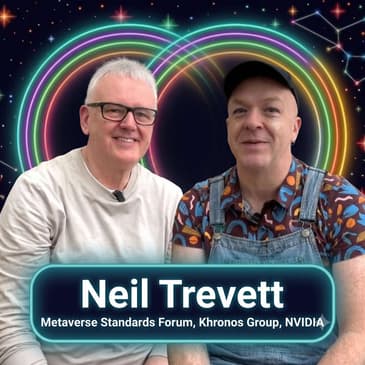
Neil Trevett has spent his career connecting software to silicon. As president of the Khronos Group — the organization behind OpenGL, Vulkan, OpenXR, and glTF — and president of the Metaverse Standards Forum, he works on the open interoperability standards that let developers build once and deploy across many devices. His day job is at NVIDIA, developing GPU developer ecosystems. His life's work is making sure the industry doesn't have to rebuild the same foundation six times.
At AWE 2026, Neil announced the Open Metaverse Browser Initiative: a spatial engine sitting alongside the existing browser stack so that services from multiple companies can be composited into a single scene without exposing anyone's proprietary data. Not a replacement for the 2D web — one new dimension added on top of the one that already exists.
Key Moments:
- [00:02:27] glTF's evolution: from 3D asset format to Gaussian splat support and semantic scene information that captures meaning, not just appearance.
- [00:08:21] The OpenXR timing lesson: standards set too early die by committee, too late and fragmentation wins — and how Khronos hit the window.
- [00:13:25] The metaverse redefined: multiple people doing spatial computing on smart glasses, connected, in the real world.
- [00:19:23] Why enterprise spatial computing is stalled: proprietary data can't flow through a third-party intermediary, and nothing in the current web stack fixes that.
- [00:20:53] Open Metaverse Browser Initiative: composition in the browser — open, private, multi-service.
The M-word has had a rough few years, but the vision — people connected to the world around them through spatial compute on wearable devices — is more achievable now than it has ever been.
Watch the full episode → https://youtu.be/MwJD8ZoEUMs
Like and subscribe if you want more conversations like this.
#SpatialWeb #KhronosGroup #TechGlowUp #AWE2026 #XR
About Neil Trevett
Neil Trevett is Vice President of Developer Ecosystems at NVIDIA, where he is responsible for enabling and encouraging advanced applications to use GPU acceleration. Neil is also serving as the elected President of the Khronos Group where he created and chaired the OpenGL ES working group that defined the industry standard for 3D graphics on mobile devices.
At Khronos he also chairs the OpenCL working group for portable, parallel heterogeneous computing, helped initiate the WebGL standard that is bringing interactive 3D graphics to the Web and is now working to help formulate standards for vision and neural network inferencing. Previously, as Vice President of 3Dlabs, Neil was at the forefront of the silicon revolution bringing interactive 3D to the PC, and he established the embedded graphics division of 3Dlabs to bring advanced visual processing to a wide-range of non-PC platforms.
Neil was elected President for eight consecutive years of the Web3D Consortium dedicated to creating open standards for communicating real-time 3D on the Internet. Neil graduated from Birmingham University in the UK with a First Class Joint Honors B.Sc. in electronic engineering and computer science and holds several patents in the area of graphics technology.
About the Metaverse Standards Forum
The Metaverse Standards Forum is a non-profit consortium dedicated to fostering metaverse interoperability. Open to all organizations of any size, including standards organizations, companies, and universities, the Forum is committed to promoting open standards, collaboration, and best practices to pave the way for an open, inclusive, and accessible metaverse. Metaverse Standards Forum members engage in building consensus on interoperability requirements, prototyping, plugfests, and open-source tool development. Learn more at metaverse-standards.org, and follow the Metaverse Standards Forum on Twitter @metaverse_forum.
About the Open Metaverse Browser Initiative
The Open Metaverse Browser Initiative (OMBI), created by the Metaverse Standards Forum in collaboration with RP1, brings standards organizations, technology companies, developers, and researchers together to build the spatial equivalent of the web browser: open, interoperable, and owned by no single company. RP1 is the lead architect and maintainer. Sneeze, the first open metaverse browser engine, is developed through OMBI and available on the Forum's GitHub repository under the Apache 2.0 license. Learn more at omb.wiki.
A "glow up" signifies a positive transformation, reflecting the journey of becoming a better, more successful version of oneself.
At The Tech Glow Up, we humanize the startup and innovation landscape by focusing on the essential aspects of the entrepreneurial journey. Groundbreaking ideas are often ahead of their time, making resilience and perseverance vital for founders and product leaders.
In our podcast, we engage with innovators to discuss their transformative ideas, the challenges they face, and how they create value for future success.
If you're a founder or product leader seeking your own glow up, or a seasoned entrepreneur with stories to share, we invite you to join our guest list via this link.
The Glow Up talks with innovators about their big ideas, how they stay resilient in the face of change and how they find and build the value that will drive their future success.
What is a glow up - you might ask?
Glow up is defined as "a positive transformation, often involving significant changes in appearance, confidence, or lifestyle.
We use "Glow up" to refer to the process of becoming a better version of oneself, more attractive, and more successful.
If you're a founder or a product leader who's looking to have a glow up of your own - or if you're a seasoned entrepreneur who's stories can support others, we'd love to hear from you. Please add you name to the guest list with the link in the show notes.
Each episode will also feature a community spotlight for innovative NGOs, non-proffits, and other organizations that are driving innovation and change in their communities. There's another link in our bio for community groups and sponsors to learn more!
Hello, and welcome to The Tech Glow Up live from Augmented World Expo 2026. Today, I'm talking with Neil Trevett, president of the Khronos Group and the Metaverse Standards Forum. I literally got goosebumps saying that. Neil, you don't know this, but in my first professional role in augmented reality-
Neil TrevettUh-huh
Nathan Cwe did a lot of events, and Khronos sponsored those events and was in a large campaign around glTF.
Neil TrevettYes.
Nathan CAnd I grabbed a shirt, and my colleague and I vowed that we were ride or die glTF fans- from that moment. And I know that they brought that shirt with them- to this conference. So, like, most of my career in XR, like, your work has literally been in the room with me on my journey.
Neil TrevettAw!
Nathan CSo this is a total treat to have you on The Tech Glow Up. Well,
Neil Trevettthank you for saying that. It makes it all worthwhile. Thank you. Well,
Nathan CFor those who maybe aren't as nerdy as I am about 3D standards, and file formats, and interoperability-
Neil TrevettYep.
Nathan CCan you introduce yourself and the many cool things that you do in spatial innovation?
Neil TrevettSure. My day job is at NVIDIA- Okay uh, where I help develop developer ecosystems, which is helping developers get to GPUs.
Nathan CMm-hmm.
Neil TrevettAnd a large part of that ecosystem that I particularly get involved with is open interoperability standards. Mm-hmm. So that's both APIs and file formats that anyone in the industry can implement. And so developers, if they use open standards to develop their, their assets and their content, or they program using open standard APIs, you know, their content and their applications run across m- multiple vendors. Mm-hmm. So it gives content developers bigger reach. And content is king, so everyone benefits, so. And some of the, um... You may know us for standards at Khronos- Mm-hmm such as, um- Vulkan, uh, which is the GPU programming API, the modern GPU programming API that's cross-platform. Uh, OpenXR, which is, like, particularly hot here at-
Nathan CSome really interesting examples out there.
Neil TrevettYes.
Nathan CYeah.
Neil TrevettYeah. And that's for accessing the hardware on XR devices, and it's pretty much, not on every device, but the vast majority of devices now support, uh, OpenXR. And glTF- Mm which is the 3D asset format. And glTF is on an interesting journey. Now, it started out by being a 3D asset format, so you can grab it and display it.
Nathan CMm-hmm.
Neil TrevettAnd with Gaussian splats now, which is coming, a hot term of, of, uh, AI- You, you're hitting on
Nathan Cone of my special interests. N-
Neil Trevettnow glTF has Gaussian splats. It's increasingly, of course, being used for scene acquisition- Mm uh, and, and display. And I think the next step with AI coming online is figuring out how to put scene semantic information into glTF so you can capture the meaning of glTF scenes- Mm-hmm as well as how they look.
Nathan COh, my goodness. You literally hit three topics that were not on our agenda today- that I would die to talk with Neil Trevett about. Oh, my gosh. but I'm gonna keep us to the script because- I love to introduce people, and one of the things that I look to do on the Tech Glow Up is learn from OGs who have been there and seen it and done the hard work to, like, m- make great products, and in your case, like, make standards orgs and global agreement about- Mm-hmm really complicated things. I see creators and developers as, like, a keystone to innovation because they are the ones who translate what is possible and what, like, users need and what a great experience is, and, like, they find that sweet spot-
Neil TrevettYes.
Nathan CThat, like, makes applications and content and stories that people actually wanna use. Absolutely.
Neil TrevettYes.
Nathan CI'm so interested to get into, like, how you are supporting developers with standards and, like, all of this interoperability. But, like, before we get into that, what is the origin story of your passion for supporting developers and hardware and the very, like, hard process of, like, building and maintaining standards?
Neil TrevettYeah. So, I can actually trace it back to, like, a origin event. So, ever since leaving college, I've been involved in 3D graphics. I was initially in a, a startup company in the UK called, you know, 3D Labs. As we were developing silicon to do 3D graphics processing, the industry was kinda searching for what the API would be, and a lot of the silicon vendors were creating proprietary APIs, which was creating a lot of problems for the developers. You'd have to, kind of rewriting- Mm. Your application, uh, many, many times. And then Silicon Graphics, uh, I don't know if you remember Silicon Graphics, of course. Mm-hmm. You know, kind of the, the granddaddy organization of 3D in many ways. They took a very, uh, I think, enlightened and bold decision. They took their proprietary library, which was called IrisGL- Mm-hmm back in the day, and they made it an open standard, OpenGL, and that was controlled by the OpenGL Architecture Review Board. So it was a number of companies, uh, came together to, uh, cooperatively create an interoperability standard that would ship on everyone's hardware, and that was back, I think back in '92.
Nathan CMm-hmm.
Neil TrevettAnd I saw firsthand the impact of- How that brought the industry together and how it enabled developers to develop once and deploy on many different, uh, pieces of hardware, and I was hooked. I was hooked. And, uh, I managed... I was in- involved at 3D Labs, but then eventually, you know, Silicon Graphics went away, and the Khronos Group kind of did a diving catch and caught OpenGL and, and made sure that it survives to this day. And OpenGL ES, which brought 3D to mobile phones-
Nathan CMm-hmm
Neil Trevettuh, was a derivative of- That of OpenGL.
Nathan CYeah.
Neil TrevettAnd then WebGL, which brought 3D graphics to the web, was another Khronos standard. Mm-hmm. And that was derived from OpenGL ES, so this b- kind this long history. And then, and now of course Vulkan is essentially the modern version of OpenGL, so.
Nathan Cstandards as a product process effectively, right? Like building, updating, I love it. So Neil, we're here at AWE Yes Where I've been talking with a- as many smart glasses manufacturers and brands as possible. And something that you just said really stands out, in that right now, with some exceptions, most smart glasses are developed in their own programming tools, in their own content distribution systems, in their own kind of walled gardens.
Neil TrevettMm-hmm.
Nathan CAnd part of that is because the hardware's all different, and part of that is because what they're trying to do is different. But it sounds a lot like this origin story moment of we got a lot of silos, we got a lot of things we're trying to do, and wouldn't it be easy if you didn't have to make it six times?
Neil TrevettYes. And the, the standard that the Khronos Group is working on that is the exact analogy to- Mm-hmm kind of OpenGL for th- for the driving the GPU. Yeah,
Nathan Cyeah. You
Neil Trevettknow, for driving the displays and the controllers and all the interactions that you have with an XR device. That standard is OpenXR.
Nathan CMm-hmm.
Neil TrevettAnd that's actually quite pervasive now. So but OpenXR, you know, is quite low down in the stack. It really- Mm-hmm it's like, like Vulkan, it's really close to the hardware. You know, the Khronos tagline is, "We connect software to silicon," you know? Yeah. So that's, that's kind of where we are in the stack typically.
Nathan CThat's very... Yeah.
Neil TrevettYeah. So, um, OpenXR, h- I think we were fortunate, 'cause making s- standards to get adopted, there's an element- Mm of luck in that you, you n- not only do you need, like, a well-designed spec, you need to do it at the right time. Mm-hmm. Not too early, 'cause if you do research by standards committee, that's death by a thousand cuts. Don't do that. We've learned the hard way, don't do that. Yeah. Uh, but if you're too late, the fragmentation has already set in. So the, there is a window, and we were fortunate, I think. We, we, we did, um, hit the window with OpenXR. So, uh, it's shipping on a bunch of XR devices. So developers, we avoided the, the, the fragmentation phase-
Nathan CYes w-
Neil Trevettwith XR devices. That, at that level.
Nathan CYep.
Neil TrevettAnd, and OpenXR continues to evolve. It's also evolving from just the hardware API now with kind of things like spatial entities. Mm-hmm. So bringing in kind of scene understanding and, you know, scene-
Nathan CThat's amazing
Neil Trevettum, you know, um, scanning and transmitting that kind of semantic information back to the application. So that's, that's its kind of evolutionary-
Nathan CMm-hmm
Neil Trevettpath. Um, but there is, there is much more that we can do. Um, now we need to th- think about higher levels in the stack. and we really need the, I think, the spatial evolution of the web.
Nathan CMm. And this is something that you've been working on The committees have been in process, and just this week you made some really big announcements-
Neil TrevettYes
Nathan Cabout the direction of the spatial web. Yes. Can you, uh, can you share a little bit about what th- a spatial web is, what an open spatial web is, and, uh, your announcements, uh- Yes this week?
Neil TrevettSo, so the announcement is, um, at the Metaverse Standards Forum. Yes. So maybe just a little bit of context about the Metaverse Standards Forum- Perfect. Absolutely 'cause the, um, Khronos is a standards organization, and it's, of course, it's not the only standards organization. Th- there's many standards organizations that, like the World Wide Web Consortium, the W3C. Mm-hmm. There is the Open Geospatial Consortium that does all the geolocation, uh, type stuff, and dozens and dozens more. You know, wireless standards, privacy standards, and y- you name it, there's, there's a standard for it. what we found when the metaverse first became a thing a few years ago- we quickly realized that no one standards organization could, could bring all of the pieces together that we were gonna need to build an interoperable open standards-based metaverse. And so the Metaverse Standards Forum was specifically set up to let all of the standards organizations come and cooperate, and to engage with industry to figure out how all the pieces are gonna come together to, you know, create this thing we call the metaverse. Mm-hmm. Now, the first question, of course, as soon as people hear the M word is, what is the metaverse? Yeah. Great question. And I think- the, the metaverse has gone through some ups and downs in terms of its, its public image.
Nathan CMm-hmm.
Neil TrevettOften when I talk metaverse, you know, people laugh. Mm-hmm. And I think it is actually, it goes back to the first en- envisioned form of the metaverse a few years ago. It actually took a wrong path, and the path was we're all going to be in virtual reality for 16 hours a day. Mm-hmm. Like, we're all gonna live in virtual spaces, but that means we're gonna be disconnected from our friends and family, you know? And that is actually quite a dystopian view of what the metaverse could be, and I think society in general got rightly rejected that- Mm-hmm dystopian view. But now I think with smart glasses, that use augmented reality rather than virtual reality, augmented reality brings us into the world rather than isolates us from the world. So my definition of the metaverse is you're using XR- Mm-hmm you know, ex- OpenXR for the sensors and the, the bits and bytes.
Nathan CMm-hmm.
Neil TrevettAnd then if you let your devices understand the environment, that's spatial computing. Mm-hmm. And if you have multiple users using things like smart glasses, augmented reality bringing them into the real world, but they are connecting together as users-
Nathan CMm-hmm
Neil Trevettthen that is the metaverse. So a, a metaverse is a connection of multiple people doing spatial computing on their smart glasses with the help of AI. Mm. And I think that we have a chance to rehabilitate the M-word. The, the metaverse doesn't need to be a joke anymore.
Nathan COh, my
Neil Trevettgosh. Um, we can actually make it, you know, the, the, this thing. And- If we're going to realize that vision of connecting anyone who wants to connect to the metaverse and all the spatial services that are gonna be available, then we need a platform to do it. Mm-hmm. And the only platform that possibly has the sufficient reach-
Nathan CMm-hmm
Neil Trevettand is, and is totally based on open standards is the web. And so our mission is to bring spatial, true spatial computing capabilities to the web.
Nathan CMm-hmm. Oh my goodness. So many things. I joke, Neil, that I've been in XR so much that, like, my least favorite conversation is the definitions, like continuum. but I actually really love, this posit that the metaverse is people basically connected to metadata about the world- Yes in their own personal compute devices that are very likely wearable. Yes. Right? Exactly. And like- Exactly that's way less dystopian than, "Hey, let's hang out in gigantic concert spaces in VR where there's no one there because you missed the event."
Neil TrevettRight. Right. We, um- And but, but to be clear, I mean- Yeah VR is- Yeah is cool. I'm not saying VR is bad. Yeah, yeah. And VR definitely has awesome use cases.
Nathan CAbsolutely.
Neil TrevettUm, uh, you know, and- No,
Nathan Cno,
Neil Trevettno but, but it's just not the thing we're gonna be wearing 16 hours a day.
Nathan CNo. You
Neil Trevettknow? Right.
Nathan CUh, not at this weight, right? Like, the, the, the rally toward 49 grams I think is, like, a, a real earnest pursuit- Yes that, like, this industry should really be-
Neil TrevettYes,
Nathan Cyes focused on.
Neil TrevettYes. So the- Yes the next step in this whole thread we're pulling on here is, okay, well, spatial web, that sounds cool. Mm-hmm. But what's the difference between spatial webbing-
Nathan CYes
Neil Trevettand today's There's a couple things. On the 2D web today, you know, you typically go to s- somewhere on the web by typing in a URL.
Nathan CMm-hmm.
Neil TrevettYou know, or clicking, you know, clicking the URL chain.
Nathan CYeah.
Neil TrevettIn, in the spatial web using your wearables, you're gonna be literally walking around.
Nathan CMm-hmm.
Neil TrevettAnd you're gonna want to be discovering services, by your location. and that's a, that's such a fundamental difference. Mm-hmm. Then the next difference is you are in- the real world, not staring at a 2D screen. And so very often you want the services, and it's by service, and what do you mean by service? Mm-hmm. Right. It can, it could be anything. Mm-hmm. It can be, you know, a, a menu that pops up when you w- wander into a coffee shop, right? Mm-hmm. It, it can be the navigation path to your gate at an airport when, you know, you, you're late for your flight and you're trying to select your seats- Mm-hmm as, as you go, you know? Oh, goodness. Can I get that upgrade? Yeah. Uh, it's any information very often graphically represented-
Nathan CMm-hmm
Neil Trevettin the space around you. And because you are in the space and things are being overlaid the real world, and you have all the space to place information, you have the chance to bring in multiple services at the same time. So-
Nathan CMm.
Neil TrevettYou know, some of the neat pictures we have for the OMVI launch is, you know, you're navigating to a particular place and your Uber arrives, you know, and so that's the navigation app and the, the, the rideshare app.
Nathan CMm-hmm.
Neil TrevettYou know, two different services, completely different companies in your view at the same time, in your little infosphere.
Nathan CI've encountered this idea, and I'm, I've been loving this idea of a spatial interface isn't locked to, like, a screen. Mm-hmm. And so you can... And if it's, like, relational to you as a user and what you're doing, right, having multiple different services, like providers, softwares in the world is, like, a lovely idea. It's the first time this idea of incredibly personalized, like, contextually aware, software and service has... Like, I've heard that idea-
Neil TrevettMm-hmm
Nathan Cin the last, like, three years without it being directly tied to an idea of an agent. Right. And this is, this is literally not focused on a technology, but what is a user doing as they move about their day-
Neil TrevettMm-hmm
Nathan Ctrying to accomplish tasks.
Neil TrevettYeah.
Nathan CThat feels really good.
Neil TrevettIt, it, it, it is good.
Nathan CIt's centered on the right things.
Neil TrevettYes. And, you know, AI-
Nathan CMm-hmm
Neil Trevettis gonna be- in this mix. Yeah. Absolutely. both on the, I call it, both on the input side and on the output side.
Nathan CYeah.
Neil TrevettOn the input side, it's gonna be kind of under the covers, you know, l- looking at the new Snapdragon announcements, you know, the, that lot of emphasis on how fast they can do inferencing on device.
Nathan CMm-hmm. Yeah.
Neil TrevettBecause that's gonna be the engine- That context that, that lets you understand where you are and what, what you're doing- Mm-hmm um, and your gestures and everything. I call it the magic pic- pixie dust, because it's really enabling stuff that wasn't possible three years ago. Mm-hmm. Right? It's kind of magic.
Nathan COh.
Neil TrevettKind of magic. So, but, but then on, on the output side, agents, yes. Mm-hmm. You know, so your own private agent that understands what you're trying to do today, your context, and can help you navigate all your devices and, you know, your interactions- Mm-hmm with, with people and the, the, the, the scene around you. But we need all this in the web. And I know I love the web.
Nathan CMm-hmm.
Neil TrevettAnd so we're not replacing the web. What we're trying to do is to find the minimum amount of work we can do to bring spatial computing into the existing web.
Nathan CMm-hmm.
Neil TrevettAnd the, the, the key thing that... And, and shout out to RP1, you know, because they've been, building this kind of concept as a kind of- Mm-hmm a prototype for several years. And, you know, they are the ones that have found the, kind of the bottlenecks. The current way of doing immersive, web is WebXR.
Nathan CMm-hmm.
Neil TrevettAnd I'm sure many people l- love WebXR. I love WebXR. And WebXR is not going away.
Nathan CNo.
Neil TrevettYou know, and for many types... So if you're doing a, an application and you want programming control, and you want just to do everything, WebXR is perfect.
Nathan CMm-hmm.
Neil TrevettAnd that, that will continue. But this extra new mode where you're wandering through the world and you want to have multiple services being composited- Mm-hmm into your scene from multiple different companies, that's not possible with WebXR in the general sense. You could imagine- Mm-hmm you know, someone coding a very nice WebXR app. and with permission, it brings data from one company and data from another company, and it puts it all together in kind of like an infosphere- Mm-hmm in a very nice way. But that means that the data from those two companies is being shared with the application developer or the platform in the middle. And if you talk to enterprises-
Nathan CMm-hmm
Neil Trevettwho want to use, spatial computing to engage both their internal employees and their ex- external customers, they do not want to share all their proprietary data. So we're blocked at step one, and that's why I think you're not seeing a lot of enterprise deployment of spatial computing yet.
Nathan CMm-hmm.
Neil TrevettThere's simply no way to do this without being locked into a proprietary platform. So being locked into a proprietary platform is bad, and being locked into not being able to do this composition is bad. So the way to solve it is to bring composition into the browser. So the browser does all the necessary composition. You don't have to go through any third-party intermediary. And that is what we're doing with the Open Metaverse Browser Initiative.
Nathan COh my gosh. My brain is so aflutter with this idea that the metaverse was, like, omnipresent and, like, imminent, And so much of the conversation was on technical capabilities and, like, platform level APIs, and, like, having spatial kits. And this data bottleneck that allows for a user-first spatial, understanding of, like, what somebody's trying to do, and to bring in, we're, two and three-screen humans now. Mm-hmm. Partly because, like, I need the big screen for certain things- Mm-hmm the pocket screen for others, and the mediums. Mm-hmm. Right? And so, um- Neil, I'm having too much fun with you. We're, we're running out of time. Uh, I just absolutely love, and there's, there's some- there's this gorgeous, like, elegance, uh, to the way that you talk about approaching problems. Like, you're like, "Hey, we have this 2D web, but, like, it needs another dimension." Right. And it's just, like, sort of taking where we are, the problems that we have, and just expanding one step further. Again, it's, like, connected so much to that product iteration- Right and growth.
Neil TrevettRight.
Nathan CAnd, like, solving the next most urgent-
Neil TrevettRight
Nathan Cproblem.
Neil TrevettRight.
Nathan CI'm curious. The show is called The Tech Glow Up.
Neil TrevettYeah.
Nathan CAnd I love to ask, people what their glow up is for the industry. So, like, a glow up is a notable transformation, a rebirth of sorts. In this, like, coming age of smart glasses, personalized agents, compute, et cetera, like, what do you wanna see the industry move toward with earnestness in the next six to 12 months? Where does this need, all need to be going?
Neil TrevettWell, I, I think the, the conversation that we've just had kind of, is kind of leads us to that- Yeah obvious kind of concl- So I think the... Well, there are a number of threads. I, I think, you know, the, the, the way that we can see to help the web upgrade to a spatial capability is not to reinvent the whole web stack, but just put a new spatial engine that sits alongside the current 2D engines that are already in the web stack. That's going to bring us the capability. We We'll be able to compose these services into a single scene graph, and that kind of opens up the whole world.
Nathan CMm-hmm.
Neil TrevettAnd AI is gonna be a vital part of that, you know, as we said, both on the input and the output side. But it, it all does come together. For better or for worse, we did make the decision to call the Metaverse Standards Forum, the Metaverse Standards Forum with the M word in. So I think it's, you know, it's our responsibility to own the M word, and we haven't come up with a better term yet. Mm-hmm. Uh, but if we need to, we need to make the Metaverse be a positive term- Mm-hmm uh, that people can under- actually understand what it is and what we're trying to achieve. And the spatial in- evolution of the web, I think is with smart glasses as the primary target device- Mm-hmm is, is the way forward. And I think we can actually make really rapid progress in the next 12 months to actually making that vision come true.
Nathan CI love it so much. Neil Trevett. leader of so many, uh, important initiatives in XR. I got anxious just trying to start to name them all. But president of the Khronos Group and Metaverse Standards Forum, leading the charge on the Open Metaverse Browser Initiative and advocating for spatial creators and developers by making it easy for them to build impactful tools, ship them once, and serve actual customers and real users' needs. such a treat. I've been a fan for over a decade. Thank you so much for joining me on the Tech Glow Up.
Neil TrevettOh, it's a pleasure.
Nathan CAmazing. Yeah. Until next time. Next time. I can't wait to see- Absolutely. uh, how we're doing in 27.