

Rural communities often face a grim choice: drive three hours for a specialist or wait nine months. This massive barrier to specialty care is one of the biggest drivers of health inequity.
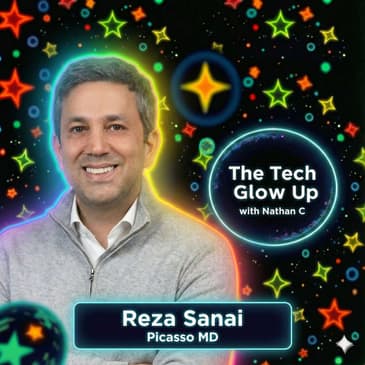
What if a primary care provider could get a specialist consult and a clear next step for their patient in a matter of seconds, right there in the exam room? Reza Sanai, a cardiologist and founder of Picasso MD, is on The Tech Glow Up to detail the curbside consult platform that’s transforming specialty access.
Picasso MD’s three-pronged approach is designed to reinforce the primary care office, the most critical space in the world, by eliminating a significant percentage of unnecessary referrals and optimizing care. Reza explains that the technology is designed for physician adoption: three clicks, and a provider is live-chatting with a specialist in an average of 17 seconds.
This ensures a patient walks out with an answer, not a phone number and a nine-month wait. The philosophy driving the company is simple: connect with your community and practice value-based care.
By making specialists more accessible, Picasso MD is not only improving patient outcomes but is also optimizing the patient before their in-person visit, which is a key value proposition for the entire healthcare system.
Episode Highlights
- Techquity Definition: Tech equity in healthcare means technology that drives better access, personalized care, and inclusion of marginalized populations.
- Specialty Access Gap: The Picasso MD platform was created to bridge the 9- to 12-month wait times often seen for specialty care in rural and underserved communities.
- Physician-Designed Workflow: The platform is engineered for speed, allowing a PCP to connect with a specialist in under 20 seconds for real-time clinical decision support during a normal 15-minute patient visit.
- Referral Optimization: A sophisticated algorithm prioritizes provider favorites and local networks for referrals before relying on the platform's network, ensuring local care is always first.
- Patient Navigation: The company believes the next major wave of health innovation is helping patients navigate their path from an initial AI/LLM inquiry to thoughtful, value-oriented specialist throughputs.
Reza’s origin story, rooted in giving out his mobile number to colleagues to build trust and cut down on unnecessary ER visits, proves that scaling impact begins with prioritizing the provider and patient experience.
Watch the full video on YouTube, and please like and subscribe to The Tech Glow Up!
A "glow up" signifies a positive transformation, reflecting the journey of becoming a better, more successful version of oneself.
At The Tech Glow Up, we humanize the startup and innovation landscape by focusing on the essential aspects of the entrepreneurial journey. Groundbreaking ideas are often ahead of their time, making resilience and perseverance vital for founders and product leaders.
In our podcast, we engage with innovators to discuss their transformative ideas, the challenges they face, and how they create value for future success.
If you're a founder or product leader seeking your own glow up, or a seasoned entrepreneur with stories to share, we invite you to join our guest list via this link.
The Glow Up talks with innovators about their big ideas, how they stay resilient in the face of change and how they find and build the value that will drive their future success.
What is a glow up - you might ask?
Glow up is defined as "a positive transformation, often involving significant changes in appearance, confidence, or lifestyle.
We use "Glow up" to refer to the process of becoming a better version of oneself, more attractive, and more successful.
If you're a founder or a product leader who's looking to have a glow up of your own - or if you're a seasoned entrepreneur who's stories can support others, we'd love to hear from you. Please add you name to the guest list with the link in the show notes.
Each episode will also feature a community spotlight for innovative NGOs, non-proffits, and other organizations that are driving innovation and change in their communities. There's another link in our bio for community groups and sponsors to learn more!
Welcome to the Tech Glow Up. This is our special techequity series, partnering with the HLTH Foundation to feature their three winners of the recent HLTH Techquity Impact case study awards that were just announced and celebrated at the Vive event, 2026 in Los Angeles, California. What is Techquity? It's tech equity. Tech Equity in healthcare means technology that drives better access, that drives better personalized care that drives inclusion of marginalized populations and every patient into the design of their own care and the technologies and tools that support it. Who are the health? Foundation Equity Award winners? They're Picasso MD, a platform that uses AI and specialist databases to help connect patients who need referrals and answers with specialty care often in as little as 23 seconds. I'm so excited to welcome you to this special health equity edition of the Tech Glow Up.
RezaYeah, for the next several months as we're working with many provider organizations throughout the country to help scale specially access, especially those in that are trying to execute on the Rural Health Transformation Program, which is a big initiative by CMS. Just highlighting that that's in our wheelhouse and if there's interest, we're happy to help.
Nathan CHello and welcome to this special episode of The Tech Glow Up. I'm here today with HLTH Foundation Techquity Award-winning founder, of Picasso MD Reza Sanai. Reza, thank you so much for joining me today.
RezaThank you
Nathan CLet's just jump right in. Can you introduce yourself and Share what you are building at Picasso MD? It sounds fascinating.
RezaI'm A cardiologist by training and we concentrate on scaling specialty access. for value-based organizations as well as rural and underserved communities. And we do that along three different paths. The first is ability for primary care providers to get connected with specialists in near real time. Generally speaking, under 20 seconds for real-time clinical decision support. Then we help automate referrals to value-oriented specialists through a somewhat complicated algorithm that we automate. Then finally, soon to be implemented is, and especially in many of our rural communities, where just the lead time to see specialists is nine to 12 months away, we'll be rolling out our own value oriented telehealth specialty clinic to help just provide bridge care while we're waiting to cement the local care in the community. So that's who we are in a nutshell.
Nathan CAmazing. Can you, said providing doctors with like connection to specialty care in near real time. Can you talk a little bit about. Out what that means. And since we're in a equity conversation, like how does that help patients with access to technology and, healthcare?
RezaI think the key for anything that's gonna scale or make an impact, is whether the end user will actually adopt what you're providing. even if we provide world-class specialty care, if it's difficult to access it, becomes a non-starter. So any provider can download the platform in five minutes, be live. It's a web and mobile based platform, three clicks of a button, and we just, they choose their specialty and we just match'em with a specialist. And like I said, last month, it was 17 seconds. at that point they're, live chatting with a specialist. They can attach images. All of it gets transcribed, but the goal is something that can be implemented within a normal patient visit. So a patient walks into a PCP office. They generally have 15 minutes to leave with a plan. our goal is to get you connected in real time, map out the best next steps within a handful of minutes so that you're not delayed for your next patient, and results in better patient outcomes and a, pretty satisfied PCP base.
Nathan CAre there, I'm imagining the old model. I grew up in the county seat of a rural Douglas rural southern Oregon city. a lot of my family still has to choose do they travel two hours or do they travel three hours when they need to see specialists? I'm imagining. The old model you go to an appointment with your primary care provider, they identify something beyond their scope and what they can research in that 15 minutes. And so they say will follow up. Later with a few recommendations of people that you could go get a second opinion. And then, so instead of the same day model, it might be two or three days later until you get a phone number or like a list of things that you might wanna go call. is that the, space you're really.
RezaYeah, I'm exactly right. You mean a, patient's walking to an. Office or nowadays, even virtually, what they're looking for is an answer or a clear path to an answer the questions you want answered. And if the answer is I'm not exactly sure what's wrong with you. I need you to go see X Specialists three hour drive away, nine months away, the likelihood of you following through on that recommendation is zero to none. And so if you can reinforce the value of the primary care office, which I think is the most important space in the world you need to reinforce that as much as possible. So the goal is to right size, fit care in the PCP office. And if we can eliminate. A significant percentage of those visits and just keep that care within the PCP office, that's better. And even if you're able to at least say yes, they probably should see a specialist, but while waiting, do X, y, and Z. And then if while waiting, we can have direct patient touch points to stabilize the patient while waiting for that in-person visit. All of that is better than good luck finding a cardiologist in nine months.
Nathan Cthe one place where my brain is a little bit. Where I've got some questions is the idea of automated matchmaking feels it might take some of the feeling of choice out of the loop or who are the doctors that I trust, or are in my network, but I'm, also imagining balanced against waiting nine months. might go with a specialist who's a little new or something that's a little different rather than wait Weeks and weeks how do you manage that idea of trust and, building those connections of referral through technology rather than the og you know, doctor's Rolodex kind of
RezaI couldn't agree with your sentiment more so let's for some clarity, the matching of the PCP, the specialist is a pretty sophisticated algorithm. We do have our own network, which is the last layer, six of that algorithm, as a, safety net. But layers one through five are all based on provider favorites, practice level, favorite local networks, all prioritized within that. the goal is to match you with a, local specialist if they're available. if they're not available, then we pinch hit. But when it comes time to refer, then it's gonna go back into the local network as well. And what, as a cardiologist. Or any specialist. What they care about, generally speaking is being, having the ability to prioritize higher acuity, higher risk patients versus lower intermediate acuity patients. And they also would love if a patient could be optimized as much as possible, medication started so that they're Less risky and less hot, as we say in the industry when they come to office. Those are all value propositions. So your initial sentiment is spot on. Best care when it comes to specialty is always local first. I think what we want to do is scale how that local specialist network is accessible. Provide some redundancy to them so that they don't feel overwhelmed. And then not only from a clinical decision making, but as well as as a throughput before formally seeing the patient. Couldn't agree with your sentiment. We just handled it in a little bit different way.
Nathan CThank you for that sidebar. It's
RezaThat's great.
Nathan Cexciting part of these kinds of conversations. I'm always so interested to hear what is that origin story? When does a cardiologist become also a tech founder? When does a doctor turn to AI and algorithms to, better manage a business and their care? Can you talk a little bit about. What started you on this path to building Equitable Health Technology? And maybe try to include a little bit about why Techquity is so important in this model.
RezaYeah I haven't built anything. It's our team who's does all the hard work. I've just maybe helped frame it. So shout out to my co-founder Sean and Sam and the entire team. the origin story kind of is, for me at least, there's different North Stars and what fulfills everyone. To each their own. For me, what fulfilled me was feeling connected with my community and practicing value-based care. So I enjoyed knowing that everything I was doing was always optimizing provider and patient experience And that was what fulfilled me personally. after there was a big large group, I can't really say,'cause they're now. I did a lecture series for them and I, what I wanted to concentrate on was decreasing ER visits, decreasing out outbound cardiology specialist referrals. And my early ways of intervening was literally just give my mobile number and say, listen, anytime you have a cardiology related question, just text me and I will. Map out best next steps. And what we found was the vast majority of the time they were texting me, I was like, this is a normal variant. You're fine. And I was eliminating a significant amount of referrals people would say, that's just bad business. I never thought of it that way. I just thought of it as a great way of building trust with the local community. And as a result of that, more and more providers would send me patients because they knew they could trust me. that direct communication with providers created this almost dopamine like effect where I was connecting with my community. So it made me feel good and I was like if this is gonna be, impactful for me, why? why am I any different than the vast majority of other doctors out there who are trying to do the right things? So let's try and take a step at scaling this. And pen to paper for about a year, and then was fortunate enough to meet my co-founder, Sam and Sean. And then we took that pen and paper, very rudimentary MVP, but eventually got to a point thankfully, where we were able to demonstrate its value and get funding and, develop it. And now I see patients on the weekends and have given up my day job,
Nathan CI could not be more excited about that answer. I always talk about go talk to the people you wanna help. If you have a question, if you wanna learn that's somebody who has an idea that they're trying to build and that's how they best
RezaCool.
Nathan CI love that. did so much of this research and empathy building getting to understand the problem space that people started saying, Hey, you should turn that into a solution. I just have to shout out the idea that when you can do the work that you know is making an impact. How that is the thing, right? It is not the money, it is not the degree, it's not the pedigree of the school that makes you happy, but when you know that you can be making an impact where the work that you're doing is helping other people. That's where so much joy and fulfillment comes to, have a relatively new company built on these pillars of customer insight and helping people make a difference. Your days have gotta be filled with a lot of joy.
RezaThat's very kind. Again, I think builds and work towards what fulfills you. We're not the biggest company in the world, but we are, as I tell the team every day, a real jewel. And so we're just. Hoping to scale that. Trying our best.
Nathan CYeah. I love it. So you've got some pretty impressive stats and some amazing ways that you've been able to, make a difference in these communities. The show is called. The Tech Glow Up. a Glow Up is a, rebirth, a reimagining, a dramatic transformation. I use this to talk about short midterm goals. after your victory lap from winning this tech equity award what is the next big goal that you're working on at Picasso MD?
RezaFor us you drop a pebble and how big that ripple effect. For me it's about scaling impact and being part of different organizations and helping facilitate, if that's something that they're looking to do and just trying to be a part of that solution. We've been fortunate enough to be involved with several state level organizations as well as throughout the country with this rural health transformation program announced by CMS. It's a big deal and we're not the whole solution, but when it comes to specialty access I, believe in, what we offer as a true value proposition. So I think for us over the next six months, it's continued to scale. Access and rural and underserved communities through our existing relationships. We work with dozens of FQs across the country, but taking that playbook if it's of value to different organizations and helping scale some of the impact that we've been able to do in other markets in their own home market. That's our priority.
Nathan CI love it. Amazing. Reza, I always like to
RezaYes, sir.
Nathan Cfounders the opportunity to share a spicy soundbite whether it's a hot take on technology, healthcare culture, or beyond. Do you have any spicy sound bites to share today?
RezaI think we were discussing this with the team. I'm a big believer in growing as a, individual organization and leveraging technology. I think AI technology has become a real valuable tool in the back office. helping streamline interoperability, et cetera. we are now seeing the advent of patient facing AI clinical care models, which I am super. Excited about in many ways. But I do think that it does change the paradigm as we were discussing how knowledge is now a commodity. the most important part of this next transformation is going to be patient navigation. helping patients when they go to their AI LLM model to get some initial answers it's gonna oftentimes result in more questions and helping map where to go from that initial inquiry and creating thoughtful, value oriented. Throughputs is gonna be the next major wave that I'm hopeful that we'll be part of. So that's my, that's not really a hot take, but I'm just thinking it's, this is actually gonna result in increasing utilization of, healthcare systems. So we gotta be prepared for that.
Nathan COh, the opportunity to provide some of that back office optimization for the patient experience. if I'm automating and making like. The phone trees that I have to navigate today, five times more lengthy or like to get really deep descriptions of things that I don't understand. I could see how that would be a challenge. I love it.
RezaYeah.
Nathan CReza, it has been so fascinating to chat with you and to learn about this strikingly human centered application of AI and how, you're able to take something that in my experience, felt like it would take weeks and months to connect with a new specialist and turning it into something that's just part of your 15 minutes in an office visit, has been just so fascinating. Congratulations on your health equity award. If people out there in the world wanna learn more about what you're up to, how can they connect and learn more?
RezaSure. They can just go to our website Picasso MD or they can just email me directly. My email's pretty ubiquitous. It's just my first name, whereas at picasso md.com and I'll Help lead the initial discussions and drive conversation where it's most appropriate for the organization. And I do appreciate very much your willingness to connect today and highlight some great work that's being done by many companies Thank you.
Nathan COh, fantastic. Thank you so much. It's been lovely getting to know about your work.
RezaThank you so much.
Nathan Ccan I ask you a favor? If you really enjoyed this episode, could you share it on your Instagram stories or maybe post the link with what you enjoyed on LinkedIn? The sort of sharing and engaging really helps small podcasters like me reach the audience that I know really cares about these kinds of conversations. If you've made it this far in the podcast, I really appreciate you. Thanks for listening. Please make sure to like and subscribe so that you never miss an episode of the Tech Glow Up. And hey, can I ask you a favor? If you really enjoyed this episode, could you share it on your Instagram stories or maybe post the link with what you enjoyed on LinkedIn? The sort of sharing and engaging really helps small podcasters like me reach the audience that I know really cares about these kinds of conversations.