
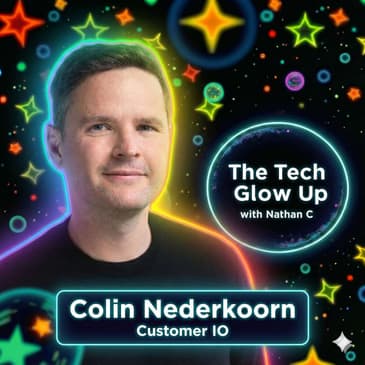

14 years ago, before the AI boom, marketers were stuck in "batch and blast" and data-overwhelmed. I talk with Colin Nederkoorn, CEO and co-founder of Customer IO, about his company’s journey from convincing people to use behavioral data for deterministic paths to becoming critical infrastructure for the new era of AI-driven, real-time customer communication that has fueled the company to over $100 million in ARR.
Colin shares a profound philosophy for early-stage founders: not every company needs to "blitz scale." His methodical approach was about building the machine for compound growth, raising "a little bit of money" only to buy time to reach the next milestone, rather than a big venture round that forces speed.
This patience allowed Customer IO to build a powerful platform that could "complete the loop" by measuring if a user's behavior changed inside their product.
Episode Highlights
- Behavioral Data: The critical shift from list-based "batch and blast" to using real-time behavioral data to influence user actions and complete the feedback loop.
- Compound Growth: The mathematical insight that a steady 20% month-over-month growth, consistently applied, creates an outsize business over the long run because of the power of compounding.
- AI's Role: Customer IO's six-month "Glow Up" is a commitment to use AI to remove all the "drudgery" for marketers in setting up complex, sophisticated campaigns.
- Leadership Fuel: A blunt piece of feedback from an investor—that Colin "wasn't a good enough CEO"—became the motivation to hire a coach and accelerate the company’s trajectory.
- Incumbent Advantage: Colin’s spicy hot take is that traditional SaaS businesses positioned as "critical infrastructure" will figure out AI and thrive, avoiding massive displacement.
Colin’s story is a masterclass in strategic product-led innovation: learning from customers, making a crucial pivot, and maintaining a level-headed, long-term approach to business growth.
His focus on unlocking the power of a robust, data-rich platform for the new age of LLMs is a clear roadmap for any founder in the B2B space.
Watch the full episode on YouTube and make sure to like and subscribe to The Tech Glow Up.
About Colin Nederkoorn
Colin Nederkoorn is the founder and CEO of Customer.io. Since starting the company in 2012, he has focused on creating products that help brands connect meaningfully with their users.
Drawing from his passion for entrepreneurship and experience in product leadership, including his time as Head of Product at ChallengePost, he leads the executive team, drives innovation, and manages the company’s growth.
Based in Portland, Oregon, when he's not building Customer.io, he enjoys sailing, coaching youth soccer, and cooking.
A "glow up" signifies a positive transformation, reflecting the journey of becoming a better, more successful version of oneself.
At The Tech Glow Up, we humanize the startup and innovation landscape by focusing on the essential aspects of the entrepreneurial journey. Groundbreaking ideas are often ahead of their time, making resilience and perseverance vital for founders and product leaders.
In our podcast, we engage with innovators to discuss their transformative ideas, the challenges they face, and how they create value for future success.
If you're a founder or product leader seeking your own glow up, or a seasoned entrepreneur with stories to share, we invite you to join our guest list via this link.
The Glow Up talks with innovators about their big ideas, how they stay resilient in the face of change and how they find and build the value that will drive their future success.
What is a glow up - you might ask?
Glow up is defined as "a positive transformation, often involving significant changes in appearance, confidence, or lifestyle.
We use "Glow up" to refer to the process of becoming a better version of oneself, more attractive, and more successful.
If you're a founder or a product leader who's looking to have a glow up of your own - or if you're a seasoned entrepreneur who's stories can support others, we'd love to hear from you. Please add you name to the guest list with the link in the show notes.
Each episode will also feature a community spotlight for innovative NGOs, non-proffits, and other organizations that are driving innovation and change in their communities. There's another link in our bio for community groups and sponsors to learn more!
This CEO grew slowly and it's totally paying off now. Colin Nederkoorn CEO, and founder of Customer IO really brought an A game to the podcast. Deliberate, slow growth is not sexy, but the results it can deliver sure are. I knew this was gonna be a great episode for the startups that I work with as well as the graduate students that I'm teaching at U of O. Colin brings a great perspective, a dedicated focus to research and data. And shares how some patience, persistence, and some good advice from a coach can really pay off in the career trajectory of A CEO and in their business success. This is really a fantastic story about listening to your customers becoming a vital part of the infrastructure that brings value to their businesses. And how protecting your idea until it's time comes can really pay off in the long run. I think you'll really appreciate the mindful data-driven approach that Colin brings to this episode. Thanks for listening. this conversation had me inspired all the way through. I hope you enjoy. Hello and welcome to the Tech Glow Up. I'm Nathan c and today it's a very Portland episode of The Tech Glow Up. I'm talking with Colin Nederkoorn of Customer IO. Colin, thank you so much for joining me on the Tech Glow Up.
Colin NederkoornHi Nathan.
Nathan COh my goodness. You've built a bit of a reputation as the person who, hosts the most interesting marketing networking events in the Portland area. But for those who haven't had the chance to meet you at your fantastic event marketing, can you introduce yourself and the work that you do at Customer IO?
Colin NederkoornSure. So I'm the CEO and co-founder. I, started the company in 2012 and we help companies better communicate with their customers. Primarily our customers have web or mobile applications. They've got people signing up for those and all of this data about what people are doing. We help them use that data to send more targeted and personal SMS messages, push notifications, emails. And really any, channel you wanna communicate with your customers on in-app notifications, all of these different channels, Customer IO can help you manage all of the customer comms that you have.
Nathan CI'm very interested in this journey of a, there's there's a component, to AI in the work that you do if I understand correct, the platform correctly and while now is like the moment for AI driven data, customer insights, kinda real time activation on some of these e-commerce and customer communication steps. 14 years ago, it was a very different landscape and like we were still convincing people that they might need a, mobile app or a mobile website. Can you talk a little bit about that journey from origin to now and, some of the learnings you've had on the way.
Colin NederkoornYeah, I mean at a high level when we started what we were building was a little bit early. People were still primarily thinking in lists and batch and blast. And Customer IO came along and said, actually, send us the behavioral data. Send us the things that people are doing inside of your product and we think we can use that give you this. And, at the time pre ai, it was like, build we, we can give you this canvas to set up your rules. That are, that behave very deterministically so you can create a path and if the data matches, people will go down this very specific path every time. And our customers loved it because it gave them a lot of flexibility and a lot of freedom to build these very complex but deterministic paths for their customers to go down. And, these messaging journeys that they could create. And so that, that was like what we were building towards, 14 years ago. I think what's exciting about today is that our hope was that we, could build a product that would give our customers the ability to better connect with their audience. You can only do so much in a deterministic way. You can only add so much personalization when it's you're having to write, create conditional statements. I think AI essentially gives you like infinite segmentation and infinite personalization. And the better it gets, the better you're able to do those things. And so we're really excited about. How AI is transforming what we can do for our customers.
Nathan Cthat idea of if you're building deterministic. Workflow flows for how your customers interact with your brand, your website or your app. The challenge that you called out, is right that you have to define what that customer or user is doing ahead of time and. Lay out the path of what's happening next for them, and often marketers or app developers, I've seen this from the inside a little bit, are so overwhelmed by the amount of data. And the kinds of data that they have, that finding the right model to understand it can be really hard. And then how to build a path that actually matches what your customer really is doing or what they're trying to do. I remember working for a mobile app where we thought like somebody pressing all of the buttons in the interface was a sign that they were a power user because they were trying all the features. And we did some user testing to validate it and it turned out that they were confused as heck and they were pressing all of the buttons to figure out what to do. And that's my personal anecdote to your, point. How do you balance that? I think a lot of startups feel this pain, A lot of innovative technologies feel this pain where the idea can be so early you can see it so clearly where the value is, how it works, where it can go. But there's something the, market isn't ready, the technology isn't ready. There aren't enough websites and apps out there. So how do you, Set the tone for the vision, like where you're going in the vision, while also working in the trenches month after month. In those early phases how do you, balance that short and long term? And I'm really thinking like from a leader's perspective, like not just how you see it, but like how do you share that with the team? How do you share a vision, like a complex vision like that With a team?
Colin Nederkoorna couple of parts of that. One is idea validation. How do you know if the thing you're working on is gonna, is gonna be a hit in, in the market? And I think for us. Customer IOS that exists today was not our original idea for what we would do. originally there was no messaging component. It was just let's consume all of your data send us all of the data about what's happening inside of your product and we'll help you better understand your users. And when we started talking to prospective customers about that. They felt like that was a reasonably Well, solved problem for them. Maybe they didn't understand the nuanced approach we were taking, but when we told them about it, they said, not interesting. What I need help with is I need something to help me influence their behavior. And so that was like our first piece of validation that. Hey if we maybe sent a message, if we sent an email and nudged them to accomplish a task or connect their Facebook account or whatever people were trying to do encourage their users to do at the time. If we nudged them that way, we could, and we were connected to their application. We could know if the user did that or not, there were a lot of products that could an email that could know if you opened it, they could know if you clicked it, but they couldn't complete the loop. They couldn't infer that the loop was completed. You had to explicitly tell them the person converted or the person did what we hoped they would do. And by Customer IO being integrated into the product, we saw this path where they could have a hypothesis, create a message that would change behavior and they could measure, did the behavior change. And that felt really powerful as just a, simple idea. so that was the new path that we started going down. And we, saw people talking about this on social media there was a, blog post by he was then CEO of this company, pic Plum. this designer Paul Statu I hope so. and he, wrote about user retention as a service, and the idea was, wouldn't it be great if there was a SaaS product that you could plug into your application that would help you send messages to retain your users and bring them back to your, product. and then I would reach out to people. On social media and say, Hey I don't, have anything to sell you right now, but this is the problem area we're working on. Is that interesting to you? And people would reply and say, oh yeah that's a big problem we have. Sometimes I would be replying to them talking about the problem. Sometimes it was like a little adjacent or it was just a company that I wanted to connect with. I, respected the company, thought they should be a buyer of our product. I had a lot of these early conversations that helped me validate that was, if we built this, there would be a market for it. And we felt this was just an underserved need. And over time we, that the need has remained right. It did, it wasn't a flash in the pan. this core need that every. web and mobile product has that need to communicate with their customers. It's not typically core. They're focused on what is the experience once you're inside of the product. what we focused on is everything outside of the product, we're gonna help you with that. And I forget there was a second part of your your question there.
Nathan CI, was hoping. To get a sense of what are the inputs and decision making approaches to, sharing that kind of vision with a team.
Colin Nederkoornthe team.
Nathan CBut you also did a really great job of talking through, like a fantastic example of how you don't need a big audience to go find the signals. I talk a lot and I'm teaching an XR marketing class right now and one of the things that I am imparting on the students on a regular basis is that marketing really needs to be right. Testing more so you can learn more. So you can like, improve and iterate more quickly. And I love that kind of was this genesis of what you saw you could do with your, tool and. And it building out that framework, which I would argue is now like a core component of how most musicians, how most fashion brands how most like D two C retailers or like online brands, I prefer to talk with their customers, right? Like I have multiple artists and like consumable brands that text me because that is a positive relationship. And I love that like you've enabled, especially in this area of like siloed channels. Where customers go that like you're enabling almost anybody with a website or an app to have that like real time action based relationship. Just bravo. I love it.
Colin NederkoornCool.
Nathan CSo call it you actually did a really great job of talking about, like learning from your customers. IM. Have you, I often ask this as an open-ended question, but I think you have actually, What I actually. Think I wanna ask about is your approach to, could you talk a little bit more about your approach to building the company and how you went about funding those early years and. The patients that you had with finding product market fit, or maybe it wasn't patients can you, talk about'cause you took a unique, kind of long-term approach to, funding and I think it goes counterintuitive to the way a lot of urgent founders approach some of the same ideas of validation and investment. can you talk about your funding journey?
Colin Nederkoornso a lot of the conventional knowledge around how fast to go and how you should think about fundraising is really based on people entering winner take all markets. And so you get a lot of founders who are like I gotta go as fast as I can. The opportunity will disappear. And if we don't go now then we'll we won't be able to go after it. think there are absolutely cases where that is true in our market and with a lot of the especially niche, products and vertical markets, that's not the case. You have, businesses that there's been no innovation in those markets in, 20 years. And if you're entering that market, you do not need to blitz scale your company. so for us when email marketing, which was the category that existed as the time was an extremely crowded market. Our flavor of it didn't exist as a category today. It's called customer engagement platform. And even that, there's enough companies that call themselves that, that are similar to what we do. But there's also ones that call themselves that, that are not similar to what we do. The, which market you slop in is definitely a challenging question. But I, I felt like in the broader marketing automation, email marketing. We had it. What was more important for us is taking the time to build the right thing. And customer who, or every company who became our customer gave us fuel to continue. it, unlike a social network, it didn't matter if we had a million customers on day one they don't benefit from each other. our whole approach initially was like, be very methodical and deliberate and build the machine that keeps growing, it doesn't really matter how fast initially, you wanna make sure you're growing. Month after month, you wanna make sure your customers are happy, your retention is good, you're serving the need in the market. the market you enter matters a lot. You wanna have room to grow. But I got advice from someone who's become a really good friend of mine, Chris Savage, the CEO of Wistia, when you're an early stage founder, have lots of time typically not a lot of money, but if you go and raise a venture round, you have all this money and you no longer have any time. you've gotta deliver, You've gotta grow gangbusters. You, need to be in execution mode once you raise a big venture round because it's all about speed to the next milestone. what we needed early on, and I think what a lot of companies need early on is a little bit of money in order to extend the length of time that you have to work on the idea and build those customer relationships and, continue to build the product. I think there's obviously extremes on both sides, for us it was, we're seeing progress in the company. it's compound growth Every month we have more in monthly recurring revenue. When I forecast it out will be at a million in a RR in 18 months. I don't have the money to get me there. So how do I get a little more money to reach that milestone? Than raise a venture round, which like has the, slop of the curve be much, higher than what we're growing at now. And so we just did that. one of the exercises I did early on is if you have a growth rate in your business, even if you're growing from a hundred dollars a month and you're growing. 20% month over month, can pull that formula across Google Sheets or Excel and it becomes very big after 62 months or 84 months. That's the power of compound growth. if you're an entrepreneur and you have a business that's growing. Pretty steadily month after month, you can figure out how big it'll be in the future. You just have to be patient and wait for it to get there and figure out how to keep the growth continuing.
Nathan CI, love that this is, such a master class answering like the kinds of questions that I hear all the time. thank you so much for that. As you as you think about this journey that you're on at. I'm, I'd love to dive in to the, what the, six month Glow Up that you've got planned for the work that you're doing at Customer IO. A Glow Up is a transformation, a rebirth, a notable update. What's the Glow Up that you're working on these days?
Colin NederkoornYeah, I mean we talked How Customer IO originally helped marketers build these very deterministic workflows. And there's a lot of effort and friction and grunt work. And we internally we use the term drudgery that goes into setting these up so that they're reliable and they represent the ideas that you have in your head. What we are working on now is reimagining the marketer experience in Customer IO that removes all the drudgery of the setup so that you can go from this idea for this very sophisticated experience you wanna deliver into having your campaign set up and working. And that's the six month Glow Up. I think over a slightly longer time horizon. We're working on our marketers being able to come in with the number they're trying to move, and we will help them move the number. That's what people really want. I think the path to that, if we can get there in six months, that will be amazing. I think it's. Less likely we'll be there in six months in a way that will, serve all of our customers. But certainly we can remove a ton of the effort that it takes to set up the ideas in your head over that Period.
Nathan CSo you actually signaled my follow up question, so I'm just right, like this idea. I, hear it. I'm, unfortunately on like ads, TikTok, and there's a lot of hype about some of the programmatic tools out there that aren't just doing, bid optimization, but you can throw in a pile of documents and your, website and a bunch of images, and the promise is, you know that Facebook will make the perfect campaign for you and like just deliver on your goals and you won't have to do anything about it. Most of the conversation around marketers and AI is. That ideally that drudgery is being taken care of, but that the strategic creative human is still really important in this concept for this future direction. How do you balance, right? Making marketers way more effective and reducing drudgery by giving them, like enough of the cake mix so that they feel like they're involved or that they've got a hand in the strategic parts or the creative parts.
Colin NederkoornYeah I think it's really about what parts people wanna do if we have a system that can do all of the parts. You get to choose which parts you love and enjoy, and where you wanna add differentiated value and creativity. And then we can do a lot of the heavy lifting in the other parts. I think that's the goal. And nobody that I talk to thinks that human creativity is, a dead end. Even supported by LLMs and ai, it's about what we're focused on. And I think what is most exciting is about enhancing human creativity unlocking it, not replacing it.
Nathan CI feel. Yeah. And apologies. I, made this like association to programmatic ads and your platform is so much more than like an ads platform, right? Like you're. Creating opportunities to Cate, yeah. Communicate.
Colin NederkoornYeah. I'd say the way that we connect with ad platforms is. Our customers can send their segments and audiences to those ad platforms, but we don't show ads, place ads. Do any of the orchestration on the ad platform side?
Nathan CBut you can learn from those signals. Colin, I have way too many questions for you. This is such a delight. Thank you. You've been quite successful in understanding the value of incremental growth and this compound growth. If. There were one thing that you could wave a magic wand and remove something from the path that you're on today. What would you take out of the way for your team? What would you give your team superpowers to go out and tackle?
Colin NederkoornI, think it's this, so our platform is extremely powerful. That's a massive benefit coming into this age because an LLM can. Accomplish all, or the, it gives them the tools to do a lot. We are not at the point yet where the customer can come in and leverage an LLM to do all of the things in our product. And I would love to get our team to the point where that's all. Figured out and available. We're going as fast as we can, but I think it's like the most exciting and critical thing for our business is to unlock the value and power of what we've built over 14 years for, AI and, LLMs. there's a lot of skepticism, in public markets and in private markets over traditional SaaS businesses and who's gonna thrive in this new era? To, thrive in this new era, you really have to be critical infrastructure for someone. You need to be a system of record. or you have to have unique and differentiated data that LLMs can use that enhance their ability to perform a task. And we are all of those things for our customers. We just have to unlock the ability to do that. I'm optimistic that if we move fast enough and. Transform our business fast enough we can be even more relevant in the new era than we were in the one we left.
Nathan COh my. Gosh, I love that so much. the being a source of like data and infrastructure. being in the tools where your customers already are and helping them understand the power of the data that they already have are like outstandingly robust values that you can bring to a customer. And if I were imagining what kind of team could learn about the behavior of their users and rapidly adapt their product with AI tools to make it so easy for them to get things done a team like yours seems like they're really well suited.
Colin NederkoornThanks.
Nathan CYeah.
Colin Nederkoornreally positive, early, early progress.
Nathan Cyeah, it is so fast. speaking of fast, There's a question that I love to ask Colin, and I, would be remiss if I didn't take a, second with it. In talking with hundreds of CEOs and go to market leaders in the last few years. It's become just so apparent that for embarking on a hard, tiresome, lonely journey in innovation the, role of a mentor or a coach advisor who can just come in and help you understand where you are in the journey and Be in the moment with the process just a little bit longer. Can you share at all how a mentor or an advisor has helped shape your trajectory at customer?
Colin NederkoornYeah I am, I'm someone I use like a chip on my shoulder as fuel and. I have a fun story to share on this one. So we were trying to raise a round of funding and I was talking to an investment firm Decided to pass on investing in customer? io and. One of the things that he said to me was, I or that they, thought I wasn't a good enough CEO. And I was one super surprised to get feedback like that from an investor. Nobody had I was the reason they wouldn't invest. And they, he said i, I think if, we found a different CEO than maybe that would make the company more investible or strengthen the position of the company. And they he, mentioned. Somebody knew Dave Hirsch, who was the CEO of Jive, which was a Portland company. And I asked for an intro to Dave then Dave became my CEO coach for a while. And I was like if, this person sees something in Dave, I wanna understand what that is and I wanna figure out how I can make myself better. And what do I need to do to level up so that I can continue to be the person leading this company? and so I worked with, Dave as my CEO coach for a while, and I, think like that, was a tremendously helpful relationship for, me. And I think we worked together for about a year. The advice or the feedback, like I, it's very rare that an investor will be honest with what they think. And even though it was I didn't want to hear, I really appreciated that they said it. I disagreed of course, and busted my butt to prove them wrong. And now we're like over a hundred million dollars in a RR as a company. I'm like, yeah, take that. But like at the time I just really valued, I wanted to learn and understand and figure out what I could be doing differently or that could lead to success for the company. And that's been the, feedback that sort of helped me understand gaps or blind spots or given me reasons to dive deeper on something I've really valued from people.
Nathan CI was not expecting that direction from that question, but it's maybe one of my favorite answers. Bravo on the mic. Drop moment there. Alright, we have made it to the speed round. You ready?
Colin NederkoornI think so.
Nathan CFirst off, if there was one takeaway that our listeners should take from our chat today, what should it be?
Colin NederkoornIt's the power of compound growth and if you can get momentum on something, whether it's building your business or learning a new thing, getting up every morning and doing it is what really gives you the outsize impact over the long run.
Nathan COoh, you're learning momentum. I love it. A bit of a nerd on strategic planning. We're like smack at the beginning of February. Which quarter is your strategic brain currently in?
Colin NederkoornI think I'm probably in Q3, Q4 next year at this point. Obviously, operationally we're executing on the current quarter and that's where we've gotta deliver on the commitments that we've made and the plans that we put into place at the end of last year. I'm living in the future.
Nathan CI love that I, you've given me too many soundbites to put at the top. Speaking of soundbites, do you have a spicy, hot take to share on technology trends, AI culture, or beyond?
Colin NederkoornI, think that LLMs, have made running a tech company really exciting again. And I think while it seems like. all of these new AI companies that disrupt all of the incumbents. I. think what we're gonna see, and I'm betting on it myself, is a lot of the incumbents will figure it out and you won't have the sort of massive displacement of Salesforce and Adobe and like all of these big existing companies aren't gonna disappear in the next 10 years.
Nathan CPeople's opinions about Gemini AI have changed dramatically in the last 18 months.
Colin NederkoornYeah Google went from dead to King of the world.
Nathan CAmazing. how can people follow up or learn more?
Colin NederkoornSo I'm on X or Twitter at Alpha Colin, and I'm on LinkedIn at Colin check out the product. Get in touch with us, attend an event. I might be at one in your city. I'm usually at the ones in Portland and, but I try to get to some of the ones elsewhere in the world too.
Nathan COh my goodness, Colin it has been like a masterclass in strategic product led innovation learning from your customers about how you can support them and like listening. To the data or the feedback that you may not want to hear, but can accelerate the growth of both your personal and your company's trajectory. I feel like I wanna share this conversation with all the early stage founders that I advise, as well as the marketing students that I'm teaching. So many great lessons and, such a present and level-headed approach to working in an industry that can be so confounding. It's been such a treat. Thanks for joining me on the Tech blowup.
Colin Nederkoornwith you, Nathan.
Nathan CAmazing. can I ask you a favor? If you really enjoyed this episode, could you share it on your Instagram stories or maybe post the link with what you enjoyed on LinkedIn? The sort of sharing and engaging really helps small podcasters like me reach the audience that I know really cares about these kinds of conversations. If you've made it this far in the podcast, I really appreciate you. Thanks for listening. Please make sure to like and subscribe so that you never miss an episode of the Tech Glow Up. And hey, can I ask you a favor? If you really enjoyed this episode, could you share it on your Instagram stories or maybe post the link with what you enjoyed on LinkedIn? The sort of sharing and engaging really helps small podcasters like me reach the audience that I know really cares about these kinds of conversations.