
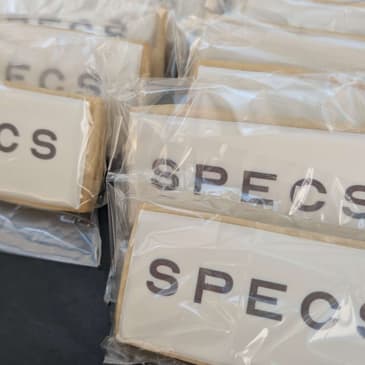
This is a special episode of The Tech Glow Up from SPECS launch day. I'm at the Beverly Wilshire for the SPECS smart glasses media preview, sharing first thoughts on the day of the public launch — September 16th.
I want to be upfront: I haven't tried every demo. This is about 30 minutes in the glasses from media day, not the full reveal. But the thing that stood out most was something that was missing. There's no hard line between the display and the world.
The screen feels blended with the world, not a picture-in-picture overlay. That's what makes the whole SPECS wearable computer experience feel integrated and contextual — not like you're looking through a device.
The field of view is clean, content is bright and readable, and you can anchor it in place or let it follow you. Fast streaming, clear picture, even in a bright room.
- [00:00:25] Why SPECS exists: technology that makes you more present, not less
- [00:01:32] Enterprise partnerships announced: Salesforce, AWS, NVIDIA, Hololight
- [00:02:54] SPECS Intelligence — the AI layer across glasses, Mac, and iPhone
- [00:03:40] First-person: what it feels like to see through the SPECS
- [00:05:28] The weight question — why fit mattered more than heaviness
- [00:06:15] Multiplayer consumer AR: the moment we've never had before
- [00:09:54] Open questions: battery life, connectivity, and what developers build next
I noticed the fit before the weight. The enterprise announcements were significant — heads-up retail, AI-powered work instructions, 3D spatial workstation workflows. SPECS Intelligence is the piece I'm watching most carefully.
More than anything, I'm excited to see what designers and developers build for multiplayer consumer AR — apps that help people connect and be more present. We've never had a moment where there were enough high-powered devices to see what these interactions could be.
Join the Tech Glow Up newsletter on Substack → https://substack.com/@mxnathanc
A "glow up" signifies a positive transformation, reflecting the journey of becoming a better, more successful version of oneself.
At The Tech Glow Up, we humanize the startup and innovation landscape by focusing on the essential aspects of the entrepreneurial journey. Groundbreaking ideas are often ahead of their time, making resilience and perseverance vital for founders and product leaders.
In our podcast, we engage with innovators to discuss their transformative ideas, the challenges they face, and how they create value for future success.
If you're a founder or product leader seeking your own glow up, or a seasoned entrepreneur with stories to share, we invite you to join our guest list via this link.
The Glow Up talks with innovators about their big ideas, how they stay resilient in the face of change and how they find and build the value that will drive their future success.
What is a glow up - you might ask?
Glow up is defined as "a positive transformation, often involving significant changes in appearance, confidence, or lifestyle.
We use "Glow up" to refer to the process of becoming a better version of oneself, more attractive, and more successful.
If you're a founder or a product leader who's looking to have a glow up of your own - or if you're a seasoned entrepreneur who's stories can support others, we'd love to hear from you. Please add you name to the guest list with the link in the show notes.
Each episode will also feature a community spotlight for innovative NGOs, non-proffits, and other organizations that are driving innovation and change in their communities. There's another link in our bio for community groups and sponsors to learn more!
One of the things I love about these glasses is how they don't feel, like there is too much technology between me and the real world. today is it. today is September 16. SPECS has launched SPECS and SPECS Intelligence today, September 16th. Technology should make people more capable, more present, and more connected with the world around them. That's the core message that we've been hearing this week and it's a message that I've heard top to bottom, from this organization in prior interviews and in my series with spatial creators. Everyone that I have talked to is excited for this new modality of heads-up digital experiences that layer and interact with our world and help us break the addiction and disruptive relationship that we have with mobile phones. I got to try on these AI-powered AR smart glasses, and there's some things that I think you should know, from, a user and content perspective. In addition to celebrating the release of this pretty impressive and fine-looking AR wearable hardware, we heard a lot of enterprise use cases and business applications of how, AI-assisted workflows, how heads-up work instruction, how connected experiences are providing value for business applications. let's check out a couple of them. there was an announcement of a partnership with Salesforce activating the agent force within the Spectacles environment The AWS partnership allows for retailers to stay heads up with customers while they look up and search for answers. And AI agents from NVIDIA are powering real time heads up work instructions, so people who work in high pressure, highly technical scenarios don't ever have to look away from the very important workspace that they're engaged in. A partnership with Hololight, using SPECS as a spatial workstation, allowing for 3D workflows, content, and others that I'm excited to see more of A lot of news and a lot of the conversation will be about SPECS Intelligence, the onboard AI that, not only works on your SPECS wearables, but also can live in your Mac, and in your iPhone, giving users, the promise of a contextually aware real-time assistant who can help you organize and manage your life. this is one of those areas, where integrations, where connectivity, where user preferences and privacy, will all come into play. So I'm very eager to see, how this particular part, goes to launch. One of the things I love about these glasses is how they don't feel, like there is too much technology between me and the real world. I have a clear field of view, and there's no lines or hard barriers to the screen as I'm looking through the SPECS. And so I have this really lovely ability, to sense the content that I'm looking at, in space. I have abilities to move it and adjust it and change how I see it, whether it follows me, whether it stays put. and then those interactions with that content is all very seamless. And so I found that, I w- I wasn't really feeling limited or that I was like too disguised, in a headset, and that the, the full field of view really made, for bright, vibrant, content, whether it was text that I needed to read, whether it was UI for different applications, whether it was watching HBO in a black car as we drove down the street. the picture was clear. The streaming was speedy connectivity, absolutely internet and connectivity, app connectivity, app streaming and Bluetooth tethering, how the browser works with WebXR and other spatial tech I'm very eager to see. and I think a lot of, the success will come from ideas around connectivity, around how people can engage with the content and how they can consume the things that they always want to, in a way that it is meaningful enough to put SPECS on their face to do it. The headless computer I think is a no-brainer use case for what I saw. And honestly, I'm eager to spend more time with them, but, one of the challenges or one of the things that people are very concerned about, especially, XR glasses for work is how heavy are they? Do they cause pain or discomfort from long-term use? And I have to say in the, roughly half-hour demo that I had, I noticed, that they were tight on my face more than I noticed the weight on my head. And in some regards, that was pretty comfortable. I was curious to see how much longer, I might be comfortable or if I would get a headache, with prolonged use, but weight was not something that I was distracted by. Additionally, the consumer launch of such gorgeous high-powered devices like the SPECS, gives us the opportunity, especially those that are built for multiplayer experiences, those that are built to seamlessly recognize when other devices are nearby, to connect with them, and to share content, games, tasks, in a shared, viewable AR space. This is an interaction that we really haven't seen yet in, wild adoption, and this is really partly due to the fact that we haven't been in a world where this kind of high-powered, real-time smart glasses are able to stream and display this kind of shared content. And so while the premise and the thing that's drawn us all here is this idea of AR content that knows about the world, that understands our context and what we are trying to do and helps us be more present and capable in that moment I am so excited to see how devices like this, like SPECS out in the wild, is going to enable us to explore these kinds of interactions, explore the kinds of applications that thrive on having multiple users in a shared space, that, thrive on shared 3D workflows, how people start to, change their relationship with certain kinds of data and tasks as they're able to anchor or engage with them in spatial ways. I am very excited to see. how do the artists, the designers, the makers, the creators who take these powerful tools and translate them into real apps, real user experiences; the new interaction flows and, ideas that help take us into, a world of embodied 3D spatial computing. There's some, very interesting, questions to be addressed It's very early. I am so excited to see, what a wide, range of developers and users and folks who are leveraging these agentic, development workflows like CLAD, are going to build for these devices once people have them in their houses and in their hands on a daily basis. The time that it takes to build and develop new software ideas, new interaction patterns, new modalities is really quite quick, and I think SPECS are incredibly well-positioned to take advantage of this. And if people, whether through SPECS Intelligence or their own apps and systems lenses that they build for themselves, I think they're well-poised to take advantage of this idea of your personal, software stack or your personal AI-enabled, action stack. so very cool to see. absolutely excited to get some more time in with the demos, see some of the apps the visionaries have made, and, really can't wait, to see how this market responds over the next three to six months, what sorts of apps, what sorts of, no-brainer, low-friction, modalities, multiplayer games, and business apps continue to be developed. is this gonna be a competitor for HoloLens in terms of, heads-up AI-assisted work? what other, devices and capabilities can, such a robust form factor go after? How long is that battery really gonna last? How do these things work without, big city Wi-Fi? Some things we need to learn more of. But, pretty incredible day. congrats to everybody on the SPECS team, all the developers who have been working to build out such a, a dynamic ecosystem, of lenses. And, here's to a major step in the maturation of spatial computing. Nathan C, The Tech Glow Up, signing out.