
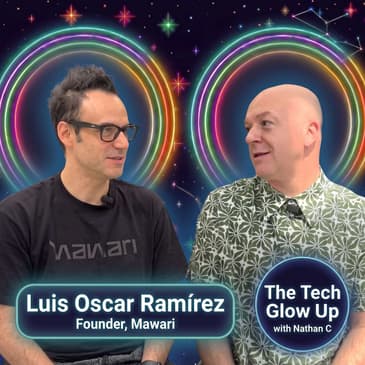
This first international episode of The Tech Glow Up was recorded live in Harajuku, Japan at the offices of Mawari — a company building the streaming infrastructure for the next generation of smart glasses and immersive experiences since 2017.
Luis Oscar Ramírez is the co-founder and CEO. He started Mawari in Shibuya with a straightforward premise: if the world is three-dimensional, the internet shouldn't be flat. Nine years later, the company is one of the select few in XR that has earned more in licensing revenue than what they've raised from VC. Despite having an early innovation in a slow developing space, Mawari has adapted and grown; surviving when many of their peers have not.
They also built a distributed compute network backed by a real community in Japan. These are people who show up on Sundays to work on the mission, who sent handwritten congratulations notes to the company's virtual artist at her debut, who see participation in the network as something they actually care about.
This conversation covers what it takes to stay building when a market isn't ready. Luis talks about the moment that reframed everything for him: watching people with no connection to the tech industry spend 60 minutes in headsets at a concert, crying, holding hands. Not because the hardware was impressive. Because the content made them forget the hardware entirely. That's his definition of market fit.
We also get into the Techno Satoyama — his five-layer model for a self-sustaining ecosystem — and why Mawari moved to Harajuku to send a message: they're building culture, not just software.
Key Moments
- [00:00:51] What Mawari does and where the idea came from
- [00:09:50] Earning more in licensing than you've raised
- [00:11:11] What building in Japan teaches you about accountability
- [00:21:38] VTubers and why emotional presence beats impressive graphics
- [00:27:29] The five-layer Techno Satoyama model
- [00:34:44] Six-month milestones: platform launch, community event, 200,000 nodes
Watch the full Harajuku episode on YouTube → https://youtu.be/syDOFUIt6uE
Join the Tech Glow Up newsletter on Substack → https://substack.com/@mxnathanc
About Luis Oscar Ramirez
Luis is the Founder and CEO of Mawari. In this role, his mission is to enable Synthetic Reality for everyone. He is committed to experimenting and developing with emerging technologies such as XR, 5G, cloud rendering and streaming, and has designed a patent pending 3D Streaming CODEC and split rendering technology that runs in the Mawari Network, a decentralized 3D & XR content delivery platform that breaks the bottlenecks of infrastructure supply for real-time rendering, and the lack of local compute power on XR Devices.
Mawari’s proprietary CODEC enables the highest visual quality to be streamed to mobile XR Devices by substantially lowering the heavy processing requirements of rich interactive and ultra-realistic 3D content like real-time digital humans, reducing cost, data size and battery consumption while unlocking scalability.
Prior to Mawari, he spearheaded and co-founded the Japanese version of MUTEK, a world-renowned festival dedicated to the dissemination and development of digital creativity in sound, music, and audio-visual art.
He also served as a Global Head of Marketing at MUSIC Tribe, one of the world’s largest holding companies for pro audio and music instruments.
A "glow up" signifies a positive transformation, reflecting the journey of becoming a better, more successful version of oneself.
At The Tech Glow Up, we humanize the startup and innovation landscape by focusing on the essential aspects of the entrepreneurial journey. Groundbreaking ideas are often ahead of their time, making resilience and perseverance vital for founders and product leaders.
In our podcast, we engage with innovators to discuss their transformative ideas, the challenges they face, and how they create value for future success.
If you're a founder or product leader seeking your own glow up, or a seasoned entrepreneur with stories to share, we invite you to join our guest list via this link.
The Glow Up talks with innovators about their big ideas, how they stay resilient in the face of change and how they find and build the value that will drive their future success.
What is a glow up - you might ask?
Glow up is defined as "a positive transformation, often involving significant changes in appearance, confidence, or lifestyle.
We use "Glow up" to refer to the process of becoming a better version of oneself, more attractive, and more successful.
If you're a founder or a product leader who's looking to have a glow up of your own - or if you're a seasoned entrepreneur who's stories can support others, we'd love to hear from you. Please add you name to the guest list with the link in the show notes.
Each episode will also feature a community spotlight for innovative NGOs, non-proffits, and other organizations that are driving innovation and change in their communities. There's another link in our bio for community groups and sponsors to learn more!
Hello, and welcome to a special edition of The Tech Glow Up, live from Japan at the Mawari offices. I'm Nathan C., and today I'm talking with Luis Oscar Ramírez, who is the co-founder and CEO. Luis, it's so great to see you. Thanks for having me at your offices today.
Luis Oscar RamírezWell, thanks for coming. Like, you took up of the offer when I was at AWE.
Nathan CI saw you talking about some really interesting things and some successes, that not many XR companies, get to brag about. And so when you, gave the offer of, like, "If you're in Japan, come visit," I knew I had to take you up on it. So thanks again.
Luis Oscar RamírezThat's cool. Nice. Welcome.
Nathan CIt's gorgeous here. for those who may not know Mawari, could you, introduce yourself and the work that you do here?
Luis Oscar RamírezSo, yeah, I'm Luis, as you say, founder, CEO. I started Mawari in 2017 here in Shibuya in, in Japan. Now we're in Harajuku, but our first office was, like, maybe five minutes away from here. So, we like to stay here, 'cause part of what we want to show is that "this is from, Shibuya to the world, this new, b- breed of, startups in, Japan." So what Mawari does. Okay so, we, Takeo and I, Takeo is my, co-founder, started as any other XR entrepreneur with the vision that the world is not flat, so obviously the internet shouldn't be flat either, Right? But okay, so we started with, okay, so media, will be in 3D, and it will be highly immersive and interactive. So, so where do we go here? So back in 2016, yeah, it was 2016, Takeo and I and another, partner called Shu, we brought, Mutek, the digital arts festival, to, to Japan. And that was slightly after Oculus was bought by Facebook then, and there was this, one of the first waves of investment into XR, like the, big ones. So, all artists of, Mutek were, starting to experiment with VR. But it was it was when it was still with the with the cord and, all that. so that's when we were like, "Okay, so there's something here. First, we need to cut, the cord, Quick be free roaming." And, second is without good content, without an experience that is not going to change your life, people are, never going to jump into this, media. So how do we go about it? So, that's when the idea of Mawari was, born with the objective really... It, the mission has been always the same, so how to disseminate and accelerate, delivery and creation of content for XR- in the end. So we started with, an SDK.
Nathan Ceverybody does.
Luis Oscar Ramírezthe technology that we created is, it's cloud rendering and streaming, which, it has a very different, pipeline than the traditional rendering pipeline of game engines, et cetera, et cetera. Mm-hmm. So the SDK was only us knew how to use it. XR developers didn't monetize at the time and are not really monetizing just, just yet, so there's no market fit in, in, in the end.
Nathan CMm-hmm.
Luis Oscar RamírezSo we went from, from that to, okay, so net- what if we wrapped SDK into full platform? And that's when we came up with, okay, so the first name that we call it is the Maori Network, it's an experience delivery network. Mm-hmm but then, yeah, when we work with investors, they were always challenging. "So, okay, so how are you going to compete with the data centers and with Google, Amazon, et cetera, et cetera?" there, there's no way.
Nathan CYeah.
Luis Oscar RamírezAnd in the end, yeah, we went deep and looking into working with telcos, that helped us a lot to understand that, okay, so that, doing re- remote rendering, it really, the low latency is non-tradable even if you do magical tricks on, on the rendering pipeline. So it's, it's, it's non-negotiable. so that means you need edge processing, and that's what the data centers don't have. So- That was one of the aha moments. the first aha moment is we actually collaborated with AWS and Wavelength. I remember it was also announced at AWE, like it was like the killer solution for XR. Eh, but the, reality is that they didn't have scale. So when we started, actually having some interest, for, okay, let's scale this location-based experience with a, with Wavelength, it was impossible. And, this is also more of a business problem because obviously hyperscalers don't want to give in into having infrastructure inside telcos- Because that means they need to pay right? So obviously the whole business model is to cut, all corners possible so that you own the entire, delivery chain or, supply chain in for, that matter. So having your rack inside the data center of the telco means is less, profit. So it's- So that was always really a chicken and the egg. So we started from that. Then that was in 2020, 2021. that was our first, the first AWE was online actually 'cause it was, Mm-hmm COVID. Yeah. And it was our second AWE, but the first one in person. So since it was still in Silicon Valley per se I went around and I started wondering, okay, so what's out there besides XR? And that was the second wave of Crypto. It was very interesting because, yeah, it was a super mega hype, NFTs, everything. But I was like, okay, there needs to be something behind all this smoke and mirrors, that has, value. and so as I went deeper and there was Render Network, which it was a company that had similar to us, like... And at the time, I think they were eight years old, and they had their own rendering software for distributed compute. And the way they, scaled is like, okay, so we cannot compete against the big rendering firms of, Hollywood studios, so let's crowdsource the available compute. and they created a token economy, and they were highly successful. So that one, and the second one is, Helium. Helium is the other inspiration that we had in which it was the decentralized, wireless person. And they showed that if a well-coordinated effort between people and, a company is done right, they were able to scale, I think, to more than a million hotspots, and an- antennas of Helium probably in less than a year. So that, to me was like, okay, so the idea of, okay, distributing the compute, but at the same time crowdsourcing the compute, is not that crazy. And, you met, Yuri. Yeah. which is one of our core members now. He's the one that really told me it's possible because, you know, when I started, talking to industry experts, investors, it's first of all, blockchain decentralization is very s- is very slow in the end- so and you need low latency. How are you going, to really, a- achieve this? And so the first, challenge that we had is like, okay, so let's prove that actually without AWS We can stream the experience that you saw- with low latency and actually give a really good quality of service. So we built that. We, demonstrated, and then that's when I met Jurij, and he's "Yeah, I was a Bitcoin miner, and yeah, of course, you can build data centers in an indie way." So that was also an, an inspiration, and that's when we decided, okay, so this is com- complementary. We have a patented s- streaming technology, and, but we need that delivery network, so it's the yin and yang in, in, in the end. And that's when we finally, it sticked for us, and we were able to, raise. Okay, so let's, prove, that this works at a certain scale and market fit. So we raised, our first round, 6.5, million, and, that was in 2022. So then after we built and orchestrated the, the entire network, now investors started seeing the, the business potential, and that's when we raised our second round. And the mission then, yeah, was to make it, yeah, a fully production-ready blockchain network that, can... that is specifically for XR use cases. So that is something that as I saw passing the XR companies, crypto blockchain companies, nobody really tried to do, and we're still probably the only one doing, this, today. So yeah, it's now 2022, so it's, it's four years now.
Nathan CYeah. So how- I wanna just take, like, a moment and celebrate the idea that you picked possibly two of the hardest areas to get investors interested in, in having These were things that had great booms, and there, there are, there's a lot of skepticism around. But there was something about the way that you found market fit with your customers, and the way that you engaged with the community to, prove out and build distributed networks, that's allowed you to stay in the game in both of those areas longer than a lot of people have. You've raised a fair amount of money. But at AWE, you were talking about you actually have more clients and more customers using the network, th- th- that you've actually earned more money through, through licenses than you have, in your raise. So you're, I'm just Wow. What allows you and MAWARI to k- to, to notice those changes or to notice those changes that you need to make, and, so that you can keep meeting the market or even being a little bit ahead of where the market's going, on this journey?
Luis Oscar Ramírezit is a combination of, of things. some of them might, will be, slightly controversial. So let's start with the controversial- Yeah ones first.
Nathan Cthat's the best way.
Luis Oscar RamírezSo we are a Japanese company. it is, a multicultural company, but in the end it's founded in Japan, and building a startup in Japan is not easy. so in a way it's not as easy as just being in, in, in the Valley and raising money. and again, while it is amazing the, the culture of Silicon Valley that it is okay to fail- Mm-hmm sometimes this gets abused, with zero a- accountability in the end. It's like, "Okay, I'm just gonna burn investors' money and, and go to the next one."
Nathan CWhere's that value? Yeah.
Luis Oscar Ramírezif you do that in Japan, you are phased out of society.
Nathan CYou don't get many chances
Luis Oscar RamírezSo that's thanks to our co-founder Takeo is like we should never give up. So that's, part of it. So it's just the geography influence a lot that the spirit of, let's call it like rebirth and always ev- evolving and, and f- ad- adopting to, to the market. But in the end it's also, yeah, the cultural background of the three founders. I mean, Takeo lived in New York for so many years, so obviously it was not easy for him, one, make it in New York and then come back in Japan and start his own company- Yeah So that's outside of the box, box thinking. I'm from Mexico and I've lived in now in five countries, I come from a humble background. It's not something that, I just had everything set up there for me. so that makes you creative and resilient. Like, what is the one thing that you can do if you have six months or three months of runway that could really move the needle? So that it is that discipline in, in, the end that every quarter we review and it's okay, so we have a lot of in- initiatives, but what will really move m- the needle to- towards the next? Because, you can be very stubborn, about your vision, and that works when you have a lot of funding or when the market is There. but un- unfortunately for the XR industry, it's been very tough. There are some people that been waiting 20 years Now. It's, sad but true. With XR, you need to be very creative to, to survive. It's not just, If we just have a stuck into, okay, so we need to just focus on the streaming technology, make the streaming technology better, even if, we have done that way, probably even an acquisition would be out of the question because there was no customers at the time, Right? so how much can you value a technology that nobody's using?
Nathan CYeah.
Luis Oscar RamírezThat's the bottom line. so now we have the technology. We need to create the market, and this is what we're focusing right now, which, yeah, it's a lot of a- adjacent things that we're building, like, the VTuber platform. I mean, it's not... it was not our core competency per se, but to actually get the VTubers interested in XR, there needs to be a platform, there needs to be a movement, so we're working on that right now. Yeah.
Nathan CSo- My brain... You do, you did this thing where you got me excited about too many ideas, and I'm having a hard time picking which one to go with. Can you talk a little bit I've been able to, have some really fantastic interactions with different VTubers. sometimes they're full-sized anime characters, sometimes they're tiny little cats. can you describe w- that sort of journey of understanding th- this market with VTubers and, how you sort of met the, your audience an- with the technology that you're building? Like- Sure. Yeah.
Luis Oscar RamírezAnd talk
Nathan Ca little bit about, the solution, if you will.
Luis Oscar RamírezSo okay, so how did we decide as MAWRI to focus or to create cloud rendering and streaming technology? That came, in 2018 or '19, that KDDI, the telco- wanted to stream digital humans for customer service- into smartphones and smart glasses. That was a while ago.
Nathan CI've been hearing about this for a minute.
Luis Oscar RamírezBut it was impossible because it was an, Unreal Engine digital human. at the time actually, the pixel streaming of Unreal Engine was, I think, in the very, very early versions, which is not compatible anyways for XR, et cetera, et cetera. so we took the, challenge per- per se, and on top of that, again, one of the extra challenges is, and at the time and still valid is that, s- to, to make for glasses on smartphones, XR applications, the engine to go is Unity. It's not, Unreal, right?
Nathan CMm-hmm.
Luis Oscar RamírezSo this cross-engine streaming obviously needed a very interesting approach per- per se. It needed to be actually our own rendering pipeline that we send through the network so that it can be reconstructed on, on Unity and is being captured in Unreal Engine. So, so that's, we, we designed this, streaming framework, but that's when we... First of all, we realized, okay, so one pixel streaming is never going to scale to the level that, that we need because it's one computer, one, one device. And we need to distribute the compute much differently so that actually you can achieve the same scale as a, of a normal use case. And again, this has been always like the chicken and the egg for cloud rendering and, streaming. We have found a middle way now, or mi- not middle way, middle ground of that balance because, yeah, of course, super high resolution, high quality experiences will still need the, powerful RTX. We can do that with remote rendering, but it has limited sc- scalability. But now we have AI and other things that will allow us to get There. but bottom line is that we understood, okay, this is not going to scale. the current solutions, really don't work. And second, and at the very basic level, okay, so- Delivering this scale is not just like a, a traditional CDN which is distributing, video and images.
Nathan CMm-hmm.
Luis Oscar RamírezThis is distributing an interactive application-
Nathan CYeah
Luis Oscar RamírezWhich distributing an interactive application, it has many stages. It distribute actually the application itself as a normal CDN, then you need to distribute the compute so that it runs, and it, and this compute needs to be low latency. Like the graphics rendering. You had, at the time we were doing it with Dialogflow The, there was no ChatGPT, there was no, Mm Claude or anything the likes. Our first POC actually was with, this IBM, what was the name? Watson.
Nathan CYeah.
Luis Oscar RamírezBut see, you, on, on one side you have the, compute of the AI. On another hand you have the compute of the rendering, and another have you, okay, you have the, you are talking to the digital human, right? So you have the speech-to-text conversion, the understanding, the AI needs to get the answer out in text, it needs to be converted into audio, then synchronized with the rendering, lip sync, et cetera, et cetera, and all that needs to happen within 32 milliseconds or less, and it needs to be re- rendered remotely.
Nathan COh my gosh.
Luis Oscar Ramírezthat's the problem what we solved.
Nathan CYeah.
Luis Oscar RamírezOkay. So it's n- it's not just a streaming XR. Yeah.
Nathan CNot just a Zoom call.
Luis Oscar RamírezIt's not, it's not a 3D Zoom call. Yeah it's not volumetric video in, in, in the end, because volumetric video is just capture. This is just really truly interactive distributed, compute. That's our new name, like in immersive compute network in, in, in the end. From experience delivering network in immersive compute network. So that's what we built and that's how it started the, challenge. So okay, so but okay, so to demonstrate cloud rendering in the end you need high-quality humans. But also as we started testing other use cases for cloud rendering, and, and this will be funny because even our current investors, we would put the headset on for them to test the demo, and it's like, "Oh yeah, this is high quality, it's cool." But within less than 30 seconds they would take the headset out.
Nathan CMm-hmm.
Luis Oscar RamírezLike every, like every single person that is not in the XR industry, they seem to be allergic to, to the headset.
Nathan CYeah
Luis Oscar RamírezBut why is that? It's because the content is not good. You are just demonstrating technology, but you are not doing emotional connection. You are not doing anything that will bring you to come back and, use it again
Nathan CYeah
Luis Oscar RamírezSo what we learned is that, okay, the- Of course, the end goal is having these autonomous, now called agents that are in 3D assisting you every day. But to get there, first we need to really understand human interaction in, in, in the end. So that's where the VTubing comes. When we started experimenting with, VTubers, because of course it's a human, the interaction is real time and it's intelligent. It's not just ask a question and when- wait for the server to give you the answer. It's through emotional connection. So that's when I understood, okay, so having Not sure, have you watched A- Altered Carbon?
Nathan CA little bit,
Luis Oscar Ramírezyeah. It's exactly the same. So with the VTubing, we're streaming the soul of a person into an avatar, and you are having that presence into you, the sense of presence.
Nathan CYeah.
Luis Oscar RamírezMore than XR, more than the technology, more than pretty 3D graphics, is the sense of presence, and once you get that, people get Engaged. and then that was the next part is like to partners, investors, it's like, "Do you realize that it's the first time that you've been using the headset for 10, 15 minutes and you forgot about it?"
Nathan CYeah, I was kind of late to this interview
Luis Oscar Ramírezso this is why we're focusing right now with, virtual YouTubers because natively they are virtual. Okay? And they need to be in... They are confined to, the screen, to YouTube. But if we can bring them in, XR, that's when we found immediate market fit because as we started doing these VTubing gatherings with our fans, they were paying top dollar just to have two minutes of, experience with them. Because there's no other way you can meet with them in in, in, the world. I give, a lot of kudos to, to, to Tindrum. Mm-hmm. I'm a fan and I know them personally as well. We tried to do something together and it didn't work out, with Kagami. 'Cause now Kagami is in Osaka, so I'm happy 'cause I'm gonna go see it again. This, to me, was also like the one of the first breakthroughs in the XR industry. Many people in XR don't even know about it, but... And which is sad. But when I experienced, Kagami at the shed, it was the first time I saw people that had nothing to do with the XR industry- be 60 minutes wearing the Magic Leap, crying, holding hands, hugging each other And I was like, "Okay, that's the key." But it is- It's goosebumps. S- seriously.
Nathan CYeah.
Luis Oscar RamírezBut it is not a replicable experience because it was a very specific set of conditions. Ryuichi Sakamoto was sick. He ask, "Okay, let's record this in volumetric video," and it was his goodbye concert.
Nathan CMm-hmm.
Luis Oscar RamírezSo there's a lot of emotional connection there, but it's not something that you can replicate. It's not only the quality of the content, but it's, it's the, the quality and the graphics of the content. Mm-hmm. But the, that emotional connection, what gets XR to that next, stage. And since then we've just been exploring all these types of, interactions. And so for example, while Japan is very specific to VTUBER, you were playing with the cat. Mm-hmm. And now we're seeing that m- people that are not from Japan love the cat. Mm-hmm. So think about now Tamagotchi.
Nathan CAbsolutely.
Luis Oscar RamírezYeah.
Nathan CMy, my kid w- has been collecting gachapon of these tiny little house models, and The idea that like, they would no longer be a static environment that she could imagine, but that that could be the place setting for a connection, a conversation, or even how she goes and connects with her friends and her community, like all just became very clear,
Luis Oscar RamírezAnd it's not a hyperrealistic digital human that is- next to you. It's gonna be your pet, or it's gonna be something that, yes, will know a lot about you because AI is getting more intelligent now per- per se, but that's the start- For getting to that future where we see, yeah, these autonomous robots and virtual humans that will be interacting with us.
Nathan CSo I love that like, almost a decade ago you had this idea for virtual content and for streaming, and that like, you went to partners with like, KDDI, who are literally like, network providers. And the, state of streaming for them didn't meet what their standards or their vision was. And so time and time again, you've had to like- run into the limits of the industry, and not just find ways around them, but find solutions, find these different components to build. And now you have a stacked- y- you have a stack of different layers that you're building in this distributed network, right? Th- there's, the XR part, there's the AI part, there's the community part. Where, how many parts, how many different layers do you think you're gonna need to be at to get, this network to the level that both the, customers, the enterprises, and that, that heart feeling of presence really needs to be, to get us all to this, this version of XR that we've been dreaming about for so long?
Luis Oscar RamírezThat's a
Nathan Cbig question.
Luis Oscar RamírezThat's a big question, but
Nathan Cit seems like you have a, a pretty good view on it
Luis Oscar Ramírezlu- luckily- Yeah yes, I actually if you go to my X, I posted about that, so Okay. And it has a name. Hmm. It's called the Techno Satoyama. Okay. Satoyama is a concept of, Japan that is the self-sustainable village. Where, yeah, it is the full ecosystem cycle that, where nature provides the, and the mountain provides the food, people harvest the food, and it's... there's no money per se. It's just self-sustainable in the end. But it also is not anarchy. It has a set of rules and it, had a certain order of things so that it could grow into a self-sustainable ecosystem. So we, w- we put it a name, and it's has five layers. So the... Let's start with the top layer, which is the fifth, which is, content, which is, we- we're calling it IP because we're in Japan.
Nathan CYeah.
Luis Oscar Ramírezthe fourth layer is the platform per se- Mm-hmm which is the B2B platform for now, but it could be a different platform in, in, in the future. So it's, it's like the, it's the interface where users will, actually experience this. Then the third one, is our streaming technology. It's the core that, unifies both sides, so in, in the end. So it, it goes upstream because it touches the content and the consumer through, the UI, the platform. And it goes downstream because it needs to be created by the infrastructure. So the, then the second layer is the network per se, which the network is not the infrastructure. It's just the orchestrating layer.
Nathan COkay.
Luis Oscar RamírezSo it's more software in- in the End. more than software. It's also the economic model, the community, all that part that makes the network actually be a network.
Nathan CYeah.
Luis Oscar RamírezAnd then the bottom layer, the number one is just the infrastructure itself, the physical hardware that powers the, network. So those are the five layers. But, going more to your, question, yeah, the, the community is very important as, as well. And this is something that I think the XR community could do because something that I do see a- about the XR community, especially in AWE, is that even though, yeah, most of us we are 10 years or more in, in the game, we're still there. And we're still dedicated, we're still passionate, about it. so instead of, competing, if we join hands in, in a way like you've seen it, it could grow a, lot more because in the end, for example, our current community here in Japan, they are our biggest fans. They understand XR. They understand that the future is gonna get there and they're our first Users. now talking about the IP we launched, Yunai, which is, our, digital ar- artist per se, le- let's call her a virtual artist. they are actually not just, like, because they're part of the community, "Oh, I follow her on Instagram," and that's it. They're engaging with her. See, all this is created by the Community. congratulations for the debut message, handwritten. Mm-hmm. Like, all this we n- in... We didn't even give them any materials. This is all UCG. They are genuinely supporting her, genuinely excited, about this new generation of content. and you know, like, it just starts with a small group, and little by little it starts just s- s- snowballing. in the startups, there's always this, the crossing the chasm- Yeah video, that there's the crazy guy just dancing, and then the second one joins. Then after a while, there's kind of like a group of five, and then it becomes a movement.
Nathan CYeah.
Luis Oscar RamírezSo that's what is needed for XR as well because- how we get, I mean, Meta's doing an interesting thing trying to get these glasses to everyone. Mm-hmm. getting the glasses into everybody's heads is step one. But then it's okay, so how do we pull them into this movement? And that's what we're doing right now, like trying with the VTuber platform and this community to create culture. This is also one of the reasons why we move our, office to Harajuku, 'cause Harajuku is a mecca of culture. Yeah. It's all mixed, in here. So this, is kind of like a message for everybody that works in my way. It's like we're not just building technology, but we're, we're actually building culture.
Nathan CThat's off camera.
Luis Oscar Ramírezso if we build culture and we build that emotional connection, then technology comes. It's something also that I explained at Super AI. So especially for XR, the only way that you know when you, found market fit is when the user forgot that they're wearing a headset. That's it.
Nathan CYeah. So Having built all of these layers, seeing this vision for so many years, it seems like it keeps getting clearer and clearer. What are the, changes or the growth that you'd like to see in XR, in the sort of networked smart glasses, in, in these spaces of content, of streaming, in real-time interaction, that you think the industry needs to be moving toward, to really realize all of the potential th- that we've been seeing or dreaming of
Luis Oscar RamírezOne of the milestones is getting people to use the glasses every Day. even if it, if they are the simplest, glasses. And, and this is maybe, probably very aligned with how Meta s- sees, their strategy now. Because, of course, we want to have these, life-changing experiences like Kagami, but they are technically very difficult and, the time to market is very slow, right? But if just like the Tamagotchi or Angry Birds, like it was the simplest thing and get people hooked. So th- this is what we need now, like something that these glasses will, get you come back every day, and then gradually you can start feeding more- more complex experiences per se. we've been in this for so long that for us it's natural- Mm-hmm native hand tracking, eye tracking, all this. But for the new users it's completely new. So it has to be even the most stupid or more mundane application, but that's to me the killer application of XR- Mm that will help everyone else.
Nathan CYeah I, let my sister-in-law try my Meta Ray-Bans, for the first time, just, like, last week, and, some of the really basic functions around the, open-ear headphones and the sort of hands-off awareness, were huge for her, because of, like, safety rules and regulations about, like, how you ride bikes or how you work and interact in, in busy environments. so things that I might take for granted as just, my, my favorite headphones or my M- Meta Ray-Bans for the most part, were groundbreaking for her. everywhere all at once, and it's way too much to explain or get anybody hooked. And, like, sometimes you need, like, just a really good interaction to get you come back and try again rather than something that just completely, consumes you. So taking it in a little bit of a step closer, I saw you working on some very interesting things this weekend, and I'm curious what are the, six-month goals that you have for MAWARI and the network that you're working on now?
Luis Oscar RamírezIn the next six months is getting, from alpha to probably beta or, or just launching with, XREAL the, VTuber platform. So yeah, within six months we want to launch, this application. Right now we're building, We have a VTuber creator program, just like the YouTubers creator program. So all the VTubers come to the studio. We learn about what they need, et cetera, et cetera. So, we're getting there. so that's, one of the big, milestones. in the next six months, if you are in October, that's another big milestone. We're doing- the Mawari only event here in Japan. This will be, of course, compared to AWE small, probably 1,000 people, but still, a, a, a good start. so that's a s- second milestone. the third milestone is really to start monetizing the, the network. Since now we have the network, up and running, the license holders are starting to set up their, servers. By the end of the year, I think we will have more than 200,000 nodes, operating. So now is find, besides X-, XR adjacent, use cases to start monetizing the network, and one of them obviously is, AI.
Nathan CSo when you talk about those 200,000 nodes, that's primarily here in Japan, or is that a global audience at the moment?
Luis Oscar RamírezIt's, I would say, more than half is Japan, but it's also- Okay distributed a- across the globe. Now, le- let me be very clear. Also, is, these nodes are not, for rendering, per se. These are more nodes for validating the, blockchain network, but they do s- have some compute power. So again- not all compute needs to be heavy rendering, right? So there are edge use cases that need certain level of compute where we can leverage these, these, these devices and start monetizing the network. And we've seen, again, with Helium, now there are other, DePIN networks, per se, that have been successful into getting this flywheel going. So once we achieve that, of course, the network will become self-sustainable, which in the... It will allow us to grow the use cases, and become, in the end, like the Satoyama, self-sustainable.
Nathan CYeah.
Luis Oscar RamírezSo within this next six months, those are kind of like the three ma- major miles- milestones. Finish the platform, launch it. Second is grow the community, so that's the bigger, event. And the third one is start monetizing the network in something adjacent to XR.
Nathan CThe idea of a network built by the community, distributed amongst people who are contributing to an idea that they believe in is d- it's easy to feel good about. And I talk to so many XR creators who have been burnt by big platforms promising to be, like, a single solution for every problem that they have, and then changing their mind about things. And the idea that you could participate in a distributed network, that you could, in some regards, own part of the infrastructure that you're working on, and that by participating you're also helping to drive the future of these tools that you're i- interested in just feels like it speaks to so many parts of what creators are looking for, right? They wanna have control of their IP, they wanna trust that the tools that they're building on will be there for them in the future. And both enterprises and creators are very curious, are very cautious even, about how they engage with AI because if it's just in some corporate pocket the benefits to working with AI have a short-term gain, but there's a lot of long-term risk. And when you're a part of that network, when you're supplying compute, when you're getting benefits from the network's success it feels like moving into a DePIN space, into that de- decentralized infrastructure, just starts to make a lot of those concerns that both creators and businesses have about one single solution, starts to make that a lot more trustworthy, and it, makes the buy-in, m- mean something rather than just being about hype. W- for folks who aren't as familiar with DePIN I'm curious, what... How do you like to, tell that story of decentralized infrastructure, and how do you, get people excited about distributed networks, when maybe tech isn't their thing?
Luis Oscar RamírezIn Japan it's easy because it's a very community-based Country. there are many examples. Like for example, the first one that I always told them is the vending machine. It's, they're everywhere, and they're hyper-mega decentralized, right? They are, the, it's you own your own house, and if you want, you can put your vending machine there. And then you start ear- earning, out of it. So that's the that's the easiest way to explain- In, in, the end. But also maybe it's just okay, so- So the, way Takeo explained is, is, a new way of work in- in the end. Like you're contributing to a cause that, that you believe in, but at the same time you're working, your, your way towards it. So actually in the end it's rewarding. And this to me is very, very, very, very, very, yeah, rewarding in the end 'cause for example, on Sunday I did have dinner with some of the community members, and how dedicated they are on their Sunday, and they see this as part of their life now is so touching. I, cannot, express it in, in, in, in words.
Nathan CYeah.
Luis Oscar Ramírezwe don't go with the technology. It's more about yeah, the social gathering for a common mission, and the way that they actually, yeah can, work and make a difference in, in, the end. Which is, this is in the end ideally as a wish list in my milestones- is to bring the actually XR community of developers to be part of the network. Because, what you say is, has been always my vision, is like, okay, instead of, yeah, just creating and paying to someone that, is always leeching off because they just provided the tools, what if actually I'm paying for a network that in the end I'm also part owner of or, or- Mm-hmm well, I wouldn't say part owner, but I'm contributing to it. Yeah. so my... the other developer that is next to me is contributing to that, and I'm also benefiting from that, so.
Nathan CLuis, you have been so generous with your time and space today. the last question that I'll leave you with is, I always like to give, the opportunity to, share a spicy hot take, maybe a sharp opinion about XR, deep tech, culture or otherwise. do you have a, spicy soundbite to share with us?
Luis Oscar Ramírezwe have a big opportunity in, AI because we know a lot more. We have been using AI, like computer vision and other things. and we have a headstart, but this is all about, like- Finding the, the right niche and being flexible, like you say, on, on where to navigate to find the product market fit. More spicier is if you're an XR developer, join Magmi Network. In the end, y- you'll see the difference. Come to Japan.
Nathan CIt's kind of unfair that the number of things that you've answered with, "Well, by being in Japan, we just had to do it this way." But, if it's gonna find you market fit, if it's gonna find, help you see, where the connection meets the technology, if you're going to have to be focused on profitable and showing investors that you're actually moving the needle those are all lessons that any business, XR, deep tech or otherwise, should be glad to be learning. So, Yes maybe there's more of us that should come on over to Japan and take some lessons.
Luis Oscar RamírezWell, yeah, I mean, Japan is a good place for XR. But in the end, it is about focus. If, we cannot make this work here, then it's not going to work anywhere. And that's, I mean, we just happened to live here in Japan and understand the culture, so we found that niche within Japan, and this is why we're staying here. But maybe in another place in the world, there's a different niche that can work.
Nathan CWell, thank you so much for joining me on The Tech Glow Up. It's been such a delight to get a view into how you've seen so many problems and just run right to them and instead of building a, a single XR solution, you're kind of building the infrastructure for AI, streaming, that, like, everybody who's gonna be wearing smart glasses in the future seems like they can benefit from. Thank you.
Luis Oscar RamírezSo yeah, We'll get there. You'll see. Thank you. Amazing.
Nathan CSo good.