
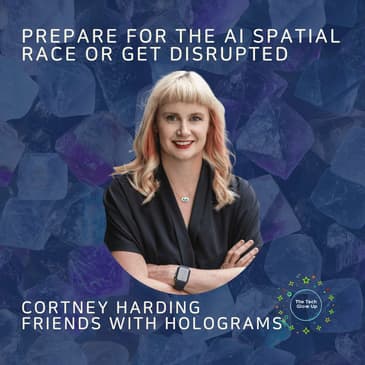

Cortney Harding thinks the Spatial Race has already started, but most companies are lookiing 10 years ahead. As founder of Friends with Holograms and author of The Spatial Race, she works with Fortune 100 companies to build strategies in spatial computing and artificial intelligence before they get disrupted.
Cortney's real focus is solving the actual business problem first. She built an Amazon training where warehouse workers promoted to management roles could practice difficult conversations with AI-powered virtual humans at scale.
It worked because it started with a real problem: managers felt unprepared, team members felt disconnected, and in-person training couldn't scale. Most companies skip that step and start with "we need to do AI." That's why 95% of corporate AI pilots fail.
Episode Highlights:
- Amazon's management training challenge became a VR solution powered by AI, where employees built customized virtual humans to practice conversations at scale, resulting in a 92% improvement in outcomes across Irish warehouses.
- Companies fail at AI pilots because they reverse-engineer from the technology instead of starting with the business problem, and she's built her practice on helping teams think problem-first rather than technology-first.
- Enterprise adoption lags behind the hype because VR headsets are now simple to deploy—the real blocker is bad content.
- In 10 years, people will experience the world through head-mounted devices powered by AI, and companies that start building for that future now will survive the disruption while incumbents get left behind.
Cortney approaches immersive tech like a strategist, not a technologist. She teaches at Caltech, Barnard, and New Mexico State. She writes for Forbes. She's speaking on stages worldwide. Her core message: the spatial race is happening right now, and preparation beats disruption.
Watch the full conversation on YouTube https://youtu.be/w_bG57HBP6U.
About Cortney Harding
Cortney Harding is an in-demand expert in helping businesses harness the power of artificial intelligence, spatial computing, and virtual reality. She has created AI-powered conversational avatars for companies like Amazon, the NIH, and Verizon, and virtual reality training scenarios around topics like child abuse, workplace exclusion, mental health, Black maternal mortality, and racial bias for companies like Lowe’s, Walmart, PWC, Target, and more. She leads workshops for Fortune 100 companies and universities on how to use AI and VR in education and training.
Her work has been honored on numerous occasions. As an executive producer on JFK Memento, she was nominated for an Emmy and the piece won the audience award for best XR at SXSW and Best in the World at the QLD XR Festival. Her work has also been honored as the Best VR/AR of 2019 at Mobile World Congress, a SXSW Innovation Award Finalist, and a Top HR Product by HR Executive.
A "glow up" signifies a positive transformation, reflecting the journey of becoming a better, more successful version of oneself.
At The Tech Glow Up, we humanize the startup and innovation landscape by focusing on the essential aspects of the entrepreneurial journey. Groundbreaking ideas are often ahead of their time, making resilience and perseverance vital for founders and product leaders.
In our podcast, we engage with innovators to discuss their transformative ideas, the challenges they face, and how they create value for future success.
If you're a founder or product leader seeking your own glow up, or a seasoned entrepreneur with stories to share, we invite you to join our guest list via this link.
The Glow Up talks with innovators about their big ideas, how they stay resilient in the face of change and how they find and build the value that will drive their future success.
What is a glow up - you might ask?
Glow up is defined as "a positive transformation, often involving significant changes in appearance, confidence, or lifestyle.
We use "Glow up" to refer to the process of becoming a better version of oneself, more attractive, and more successful.
If you're a founder or a product leader who's looking to have a glow up of your own - or if you're a seasoned entrepreneur who's stories can support others, we'd love to hear from you. Please add you name to the guest list with the link in the show notes.
Each episode will also feature a community spotlight for innovative NGOs, non-proffits, and other organizations that are driving innovation and change in their communities. There's another link in our bio for community groups and sponsors to learn more!
Welcome to the Tech Glow Up. It's Thursday, January 8th, 2026. Welcome. Are you friends with Ho Holograms? Do you have friends that are holograms? I don't know that I do yet, but Cortney Harding. Sure does. Cortney is the strategist and founder of Friends with Holograms. She is a trusted technology speaker. She is an educator. She is the author of the book, the Spatial Race. And she's out here on the front lines helping Fortune 100 companies learn about how to get real value out of cutting edge technologies like virtual reality and ai. And she's got the case studies and the stats to show why her methodology makes a difference. What about reducing employee turnover with better training in VR? What about using AI in a way that actually supports your company's goals, not just throwing some keywords on your quarterly reports. Super deep dive into what makes great spatial content and great cutting edge business strategies with Cortney Harding. Friends with holograms, author of the Spatial Race, I think you'll enjoy.
Cortney Harding:The book and the work that I do lays out the next 10 years of technology and specifically focused on spatial computing and artificial intelligence. And so I think really hitting the fact that these two technologies, while there's a lot of buzz about topics right now, are both very much going to be happening in the future, and folks really need to start preparing right now to avoid being disrupted.
Nathan C:Hello and welcome to the Tech Glow Up. I'm Nathan C, and today I have the distinct pleasure of talking with Cortney Harding, author of the Spatial Race and founder of Friends with Holograms. Cortney, it's so great to meet you.
Cortney Harding:Thanks for having me. It's great to meet you.
Nathan C:If you're Friends with Holograms, I wanna learn a lot more. Can you please, introduce yourself and the work that you do in innovation?
Cortney Harding:Sure. I'm Cortney. I'm the founder and CEO of friends with Holograms and Friends with Holograms is kind of this ever evolving company slash practice. But the core of what we do is we work with our clients to help them. Develop strategies and products specifically in the spatial computing and artificial intelligence space. So we've worked with a lot of Fortune one hundreds, a lot of large consultancies. Our work has won a lot of awards, which is fantastic, and we have really strong results in terms of creating transformation. I also have a book called The Spatial Race. Just came out a couple weeks ago and it's really focused on the next 10 years of innovation specific to artificial intelligence and spatial computing and head-mounted devices. So that book is available now. I teach in a lot of places, so I teach at Caltech. I've taught at Barnard. I have classes up right now at New Mexico State University. and I teach as part of a program called the Fast Future Executive, and I write for Forbes and I do a lot of public speaking. I'm trying to do more public speaking in the next year. I just got back from Azerbaijan speaking at a conference there, so yeah, really just all over the place.
Nathan C:Goodness engaged in setting the stage for, this next wave of computing tools, uh, some driving innovative product development and spatial computing projects with pretty big brands. Are there maybe a couple examples that you might be able to describe?
Cortney Harding:Absolutely. Yeah. So the most recent one I did was with Amazon, and that was fantastic. So Amazon's central problem one of their problems was that their warehouse workers. Were getting promoted to management roles, but weren't being trained to do the actual management work. So what was happening was managers were not able to have difficult conversations with their team members. Team members were not happy because they felt like they couldn't talk to their managers. And managers were not happy'cause they felt like they couldn't really talk to their team members. doing that sort of training at scale is very difficult. And in-person training, while it has a lot of upsides, it has a lot of downsides. It doesn't scale well. the trainer only has a certain amount of time. They can only cover a certain amount of topics and you can't do the sort of one-on-one practice in real time at scale. So the solution was to use, VR headsets and an artificial intelligence platform that allowed people to basically use prompts to create, virtual humans. So you would. Build this virtual human and then have a conversation with them. And every conversation would be different because it was all powered by ai. So the end result was that these employees were having these conversations, having them at scale, and able to build their own and customize their own. And it was great. It rolled out in Ireland and the result was a 92%, improvement. Huge numbers. Very exciting. So that's kind of one good example of using this technology to solve a real problem. So that's one. I worked with a large consultancy in the past. We were doing training for, workers who, I have to be a little, not super specific about this because of NDAs, but large consultancy. Working with workers who work in a very high stress environment where they have to ask a lot of the right questions, get comfortable being in that type of environment. So we built, again, a training in VR. This one was not AI powered because it was too early in the technology. But again, you had the opportunity to practice these difficult conversations, try different tactics, and get comfortable in a very challenging situation. And the piece was really emotional. We had people go through it and cry. We had people go through it and. get very invested in the characters and their story. And the end result of that was when groups start to deploy it. we saw a 31% decrease in employee turnover within the space of six months. So these are the types of things that we can really do at scale with this technology to make really profound change.
Nathan C:I'm glad that you reminded me vrs ability to scale workforce training I think this idea about VR can help you scale access to expertise, help you scale workforce training can help you scale. Like that second training almost sounded like there's some key onboarding steps that you're able to cover, right? So because you're addressing this turnover rate, Can you dive into how VR allows scale? I think for folks who maybe aren't super familiar or aren't as friendly with holograms as you and I are, may have this, belief that VR is a little hard to get set up. How does VR allow you, to see some of that scale and performance?
Cortney Harding:Yeah, so it's not hard to set up. I think a lot of people might have an old idea of what VR headsets are. So VR headsets 5, 6, 7 years ago were big and clunky and you had to have a full room setup, right? And special computers and on. Now you can get one out of the box for a couple hundred dollars, Turn it on, set up an account and go. It's basically just like getting a new phone or a new laptop. It's that simple. So the ease at which it can be deployed has gotten a lot better. there are also a lot of collaborative tools in VR. you can have group settings, group practices, group work sessions, so that exists as well. It really depends on what the goal and the outcome of the training is or what you're working on. People can share the devices, The challenge now is not the technical aspect of it, because it has gotten a lot easier. It's the content aspect of it. So I wind up seeing so much bad VR content. it is painful how much bad VR content is out there. And I think that one thing that we as an industry have not done well is train people how to make content. So a lot of what I do in addition to kind of creating content is I teach other people how to create content. So I have like a workshop series. I have a lot of consulting work that I do, which is basically. My trustee 360 camera, and I go to, you know, wherever the location is, whether it's, I've worked in hospitals, I've worked on construction sites, I've worked in offices, I've worked in hockey stadiums, like basically anywhere and. I will teach you how to make high quality VR. It's gonna be well shot, well framed, and a well told story. And I think people, when they build trainings, they tend to forget about the story aspect of it, but story is extremely important, and I am really starting to see more and more use cases around ai, when it comes to building VR. And I think that's gonna be a really critical kind of marriage between these two technologies.
Nathan C:Absolutely. The AI does so many things like VR developers would take forever to like hard code by themselves, right? Like when you talk about AI as a great tool for taking complex tasks and making them more efficient, like developing in 3D takes a whole lot. You mentioned building great instructional content. And you led with a 360 camera. I love this idea and I hope that you can can you share a little bit more about how you approach that?
Cortney Harding:Yeah, absolutely. So there's no one way to approach this type of content creation. So in some cases, these AI powered human avatars work great, especially for some conversations or for things that are static, right? It's hard to get them to move around. In a way that feels realistic, but 360º content still has a lot of value because you can make the interactions more realistic and more dynamic. you can actually show people things, you can draw them into a storyline. it's really about, again, solving the problem, using the technology to solve the problem. I think one thing that's really happening a lot these days is people sort of start with the technology and they reverse engineer it. there's a statistic that's been floating around for a couple months now about how 95% of AI pilots on a corporate level fail. I think where a lot of that stems from is people not understanding the technology and the capabilities. I think people either over underestimate or, underestimate like what the technology can do. But I think also people don't come at it from a problem first perspective. They come at it from like, we have to do ai, we have to make this happen. let's kind of back into that. An example is, I was at an event a couple months ago and this woman was on stage and she was from a big company and I won't name them because I don't wanna make them angry. but she was talking on and on about AI and innovation and we're this AI first and dah dah, and this really big, you know. Big, exciting pronouncements and, but she didn't mention what exactly they'd done. And so finally during Q and a, I said to her, Hey, if you can talk about this, like what exactly did you build? And she explained and it was basically a wiki. Now corporate wikis are, are useful and good. I'm not saying they're not. But it's not an innovation. It's a slight improvement at best. Because I think they probably, they didn't think like, oh, our wiki needs to be 10% better. When they started this, they thought, we need to do ai. How can we back back into this and do something that's, you know, fine. And so I think that's where people are really struggling these days is to not just race into doing something and say, oh, here's our AI thing, right? It's to be really thoughtful about it. And I think that's a lot of the work that I do now is helping people be thoughtful and measured about it and come out with projects that actually, make a big difference.
Nathan C:I love that the is trending. We need to do something in AI is so many thousand feet above that problem space that you were describing, As you were talking, I couldn't help but remember like just this fantastic, talk that I heard at AWE, I think in, Vienna in 23 where there's like a paint and materials company named Jotun
Cortney Harding:No.
Nathan C:That has like global offices and they initially set out to build a, like 3D developed VR world to do training. And what they realized very early on is that their training is so specific to the places the, global warehouses that they're working in and those local workforces that they wanted to see their real employees doing the real work. They wanted to see the real environments. And so while they like were totally sold on like hyper immersive VR, what they decided on what they went what was actually solving their problem and pushing their team forward was the 360º video, only because it showed the real. It was like they needed that level of like specificity and reality, and their team talked about how it added this whole additional layer of value for the management layer. At that team. They described how the middle managers became the biggest fans of this project because in the VR trainings, they could see their global teams, could visit the global locations, and so there was this whole. Like layer of value where executives who had to maybe travel half of the year to visit all of their teams could now just put on the headsets and see how they were working, see how they were training each other, understand who their top performers were just from this training. So thanks for going deep on that a little bit. Cortney you, couldn't have started as an author, a teacher, a consultant, a founder a, builder. What's your origin story? What sparked this journey for you working in, deep technology and, entrepreneurism?
Cortney Harding:Yeah, so my villain origin story such that it is, is, long and winding. So I started as a journalist and I was a staff writer and then the music editor at Billboard Magazine. So I was a rock critic and I was having a ton of fun. that was my late twenties and early thirties, and it was amazing, right? But around 2012. I looked at the sort of market and I realized, oh, I don't think magazine journalism is long for this world. And that was kind of the height of people pivoting to tech and going into tech. And I thought, okay there's, something here. Also, Spotify had just launched in the US so I was really fascinated with the ecosystem that had grown up around that. So I left Billboard and I started a consulting firm where I was working with music tech startups to help them launch in the us. So I did that for a couple years, and then in 2015, I went to a concert and an art exhibit by a musician I liked. And the invite might have said something about VR, but I didn't pay attention. I just wanted to see her perform at this art gallery. And she had a VR headset as part of her performance so I got in the headset and that three minute piece on the Oculus DK one literally changed my life. Like I walked out of there and I was like, this is it. I was completely lit up in a way that I hadn't been before. So, I spent a year learning about VR, writing about VR, still doing the music tech work as I transitioned. And then south by 2016, I met somebody who was starting a VR production company. I went to work with him. We worked together for about a year and a half, and then I started my company Friends with Holograms. worked on some amazing projects, went to Meta for two years, worked on the Meta immersive learning fund, and then came back to doing friends with holograms. And we have. Pivoted so many times in terms of, what we are working on, the technologies we're working with, the type of projects we're working on. so we do as Wayne Gretzky says, we follow the puck, but our focus has always been on helping people create really high quality work, helping them use this technology to solve real problems. And now we're really focused on how do we teach people to do that at scale, whether that's through speaking. University work, workshops, whatever it is, how do we make sure that many, many people have a fundamental understanding of this technology? Because that, whether it's ai, VR, whatever it is, the greatest blocker for any of this technology is people not knowing how to use it at scale.
Nathan C:That about 40% of people in the immersive space that I asked this question to mention a, experience with a DK one as that origin. I feel like Palmer probably, like there's a little Palmer angel that gets its wings every time somebody mentions the DK one. The why? it so important for people to understand concepts of spatial computing and artificial intelligence? These have been trends that have been right, like they're not new trends. I was talking to, AI startups who had, started in 2016, just last week. AI's not new. VR is not new. Why do we need to know about it now?
Cortney Harding:You can buy and read a copy of the spatial race and you'll get the whole thing. But I'll give you the quicker answer, the top level view, which is these technologies are an inflection point right now. So people have been building in the space for many years, but we are now hitting a point where these are becoming very main. So what will happen over the next 10 years is the way that we consume digital content is gonna change radically on numerous fronts. But the two that I focus on are how AI powers everything and how we view everything. So meta just recently released the display glasses. they have gotten mixed reviews. I think they're a really interesting starting place. But no matter what happens with those specific glasses, more and more people are gonna bring those to market Improve, right? So eventually, we will be viewing the world for these head-mounted devices versus through our phones, which is what we do now. AI will power that because AI will make everything immediate and contextual and personalized. So in 10 years, I will not see ads anymore. Like ads will be dead, billboards will be dead. TV ads probably dead. What I will see is hyper-personalized, contextual ads that are specific to me. So here's an example. I don't drink soda. I gave soda many years ago. So every time Pepsi or Coke or Mountain Dew or Red Bull or whatever, release an ad and I see it, I'm a wasted impression. I'm never gonna consume their product. However, there are a lot of other things I consume. Some of them healthy, some of them not but those companies are often too small. To compete with the big companies so they wind up losing, whereas the big companies are wasting impressions. So now AI will know exactly what I like and it will contextually tell me, okay, it's 6:00 PM you just got off a long day at work. You're tired. Maybe you'd like a glass of wine. Here's a really good wine you might like based on everything else we know about you. Now, it's not gonna hit a hundred percent of the time. But it'll hit a lot of the time. So what we're gonna see is everything become like hyper personalized, really contextualized and experienced through these glasses. So it's gonna be a heads up first view of the world with all of this data that is continually being refined. Serving us, hopefully stuff that we want and need. So that's the basic premise of the book is then how do you prepare for that? How do you as a company. Start now so that in 10 years you are not left behind. I am looking around today and I am constantly reminded of Clayton Christensen's book, the Innovator's Dilemma, which has been out for 30 years, roughly. It's been taught in every business school on earth for that many years, and yet. People just ignore it. So there are so many companies in the market that are, legacy players and incumbents, and they don't think they need to change anything and they're about to be wildly disrupted. So how do companies who want to stick around, which presumably most of them do survive and thrive in the next wave of computing.
Nathan C:Cortney, you mentioned right, that working in innovative technologies, working on cutting edge tech, is not a straight path. Innovation is not a straight path, but working in deep technology teaching. Very fickle enterprises, how to follow trends and find value in them is not an easy task. I'm curious, can you talk about one of those moments where you learned something new, whether it was a challenge or an opportunity, and how you, refocused your work?
Cortney Harding:Yeah, I'll share two things actually. So the first is when I started Friends with Holograms, I did it with a co-founder and we were just getting off the ground. Things were just starting out and we together pitched, a really big company on a project and it was a huge project, very exciting. And they came back to us and said, okay, you guys have got it. We'll send you the next steps. So we're thrilled. Then a week goes by, then another week goes by and they're just ghosting us completely. We cannot get ahold of them. And then my co-founder unfortunately had a family emergency and had to step back. So I was now by myself. The big project I thought was gonna launch the company had gone radio silent, and I was just heartbroken. And I really thought, oh No. What am I gonna do And I was really at this incredibly low point. And then out of nowhere, like three months after they told us that we had the project, and then gone radio silent, I get a phone call from the person who had given us the project and she said, oh my God, I'm so sorry. It's been crazy over here. We finally got the budget. you have three months to do this. Giant project, right? And I just sort of said, okay, sure, why not? And I called a producer that I knew who I love very much, and I asked her what she was doing that summer. She said she didn't have any plans. And I said, you do now. we'll talk on Monday and we made it happen. We almost died a couple of times. I was in Japan for part of this project. I had booked a vacation long before, so I'm up at 3:00 AM every morning Japan time doing calls from the hotel business center. I'm watching the sunrise over Tokyo as I'm working. I got so sick on that trip that I had to go to the emergency room and I was doing calls. From a Japanese emergency room to keep the project on track. but you know what? We did it, we won a bunch of awards. We kicked off the company in a really amazing way. That all goes, but then we had like nothing for a few months. So it's always this kind of constant cycle of like flux. And I'll just be very honest, right now, this year has been probably the slowest year that we've had. the market conditions are really adverse. People are being very cautious. We've had some good work this year, but it has been very, very tough and I often think like, what else could I do? You know, at this point I'm so far down this rabbit hole that I'm like, I dunno what else I could do. I worked at Starbucks in high school, maybe they'd take me back. But I think a lot of it is just keep going, keep pushing, and keep slogging, and keep building incrementally, brick, by brick, because eventually market conditions. Turn around and eventually things come back around and that people that have stuck it out, I think benefit in the end. So, yeah, this has been a really rough year, I think, for a lot of people, not just myself, but I do think that as long as people kind of keep going, and I, I'm saying this as much for myself as for anyone watching, right? I mean, been really rough. I will be very honest. What am I gonna do if this doesn't work? Right? I'm trying to build all these new things. I'm trying to make this happen, and I've just this week run into some resistance and I'm just like, Ugh. But I think, you know, this is for me and for everyone. You just have to keep putting one foot in front of the other, because I've done that numerous times now and it does wind up working out.
Nathan C:Yeah, I love that your approach to innovation which is actually solve real problems, right? Don't just put some AI on it, but actually, address a business problem is in a moment like this, probably one of the easiest ways to differentiate, right? if. Half of the executives that I know, if you just walked into their room and be like, here's the tech trend, we should do it. They would just like, the complexity that they are dealing with is. 10 times anything that we're dealing with. And understanding those timelines understanding that random, quarter delay is part of working at this level and this cutting edge space you have to get people's time and attention and focus to go build and do interesting things. How do you like to stay connected to your customers? How do you learn about the impact of your work and how it resonates with customers? what's your approach for really getting in your ICPs brain?
Cortney Harding:Yeah I really stay in touch with everyone and the challenge is there's a lot of churn in those roles too, right? I was doing some work recently and I was like, oh, I should go back through and chat with this person, that person. And I was like, oh, most of these people are not. In their roles anymore, and a lot of them, unfortunately, are on the market, right? There has been a huge amount of churn and layoffs in these companies that we've been working with recently. So it's tough. I do just keep in touch with people. I do a lot on LinkedIn, which everyone I know rolls their eyes, but just taking your medicine every day. and yeah, just really keeping in touch with folks. I do a lot of writing, I do a lot of speaking. I'm at a lot of events and I think it's really just kind of this touching base all the time. because that is, at the end of the day how a lot of people get referred in. It's these internal referrals. It's people recommending you, it's people seeing your work, reading the book, being in a class that I've taught. So I think for me it's always just kind of like I'm AB testing constantly, right? I am changing what I do, tweaking what I do, whether it's what I, the content I'm producing, the format I'm producing it in, how I'm speaking about different topics. Like I have my core central belief system, which will not change, but the way that I actually then voice that. Can change. So I'm working on a lot more video assets now. I launched a substack. I have put more work into sort of content production than I maybe had before. So I think it's constantly about not pivoting necessarily, but just keeping up and trying new things and being open to trying new things. And if those things don't work, like there's a learning there, right? And how can you take that learning and go on to the next thing.
Nathan C:You, you've mentioned this, like there's no failures. There's only learning like twice and. I believe it wholeheartedly, but I wanna hear how do you get enterprise clients like AWS or some of these that you've mentioned to like how do you get leaders and companies that are that big, have that kind of momentum in a similar space of learning.
Cortney Harding:There are often internal champions that you can work with. I've been lucky to be able to find the internal champions in a lot of spaces. they're not maybe the leaders and I think that's one thing that honestly is challenging, right? So when you are doing this type of stuff, it's finding who the internal champion is, and that person often does not have virtual reality or artificial intelligence in their job title. It's very hard to do prospecting in this space because you're not selling to just one type of customer. And I've had people who were, heads of innovation, heads of this, heads of that. I've also had people from learning and development. I've also had people who were just more junior, but very passionate and could bring me in and elevate my company in a way that made sense. So it's identifying those internal champions. It's demonstrating real value. It's getting a pilot started. We are getting people to change incrementally to try one or two things. so there is a little bit of a fixed cost associated, so it's easier to get people to buy into that Okay, tomorrow everyone has a headset. so that's really it. It's not glamorous or sexy. It's really just kind of starting small and building and coming in with a plan, right? Because one thing I've seen, and I talk about this in the book, is the idea of pilot purgatory. So I've worked with a couple companies who, we do an amazing pilot and it's great and everyone loves it, and then it just kind of sits there. And sometimes that's just gonna happen. I built something really amazing for meta, and I guess two days after we delivered it, the entire team we built it for were laid off. So sometimes you just can't help it, it's gonna happen, right? But I think a lot of the time people don't. Plan for how do we do this at scale? So that's why a big part of what we do is not just, we're gonna come in here and make this for you and piece out. It's like we're gonna make this first one with you and teach you how to do it so that then when it succeeds, because it almost always does, then you can say, okay, great. We're gonna do these next ones in house and we'll talk to Cortney and we'll get her guidance and she can consult and she can help us. But eventually. They don't need me anymore. That's a huge part of it for me, is like there's enough work to go around where I just wanna be teaching people and training them.
Nathan C:I love this idea of being that guide who can help people build those internal capabilities to understand, to test and learn, but then to hand it back and say this is yours. Go use it. Go get the value out of it. The show is called The Tech Glow Up. I use glow ups, notable transformations, if you will, to talk about short term goals. What's a big goal that you're working on in the next six months for your work?
Cortney Harding:So I think honestly it's just continuing to grow the business and. I'm focused on growing the speaking business because I think that's a great way to reach people at scale and help them understand this at scale. Growing the consulting side of the business, so working with different clients to help them, again, understand this at scale and build at scale and just get back to where we were a couple years ago. Again, this 2025 has been a rough year for a lot of folks, and so really understanding how do we get back. Up on those stages in those big offices and get people moving forward. Again, I think the market is just so stuck right now, that it's gonna be breaking out of that stuckness and helping people sort of break up the log jam and understand how do we actually start building again.
Nathan C:You may have just answered my next question. But if you had a magic wand and could wave it, to remove one blocker from your path forward, what would it be?
Cortney Harding:well, it's the stuckness of the market right now, and I think also. The lack of adoption among big companies, particularly of certain technologies. So AI is being, at least people say it's being widely adopted. I don't actually know how true that is, but on the VR side of the house. Companies just are kind of lagging. And I think unfortunately the big headset providers are maybe not doing as much as they could, some more than others. I think it's tough right now. I think people are just so scattered and all over the place that getting them to focus can often be challenging. And you know, the other magic wand that I would take away is quarterly reports. The problem with being so hyper-focused on three months, three months, three months, is that it doesn't allow for innovation and growth, right? Because all you need to do is meet those next quarters numbers. So you can't think long term. It creates this sense of short-termism, And I think that is hugely challenging for people who wanna do transformation and innovation because why would you rock the boat? We can just keep meeting our numbers and then we're good to go. And so I think really the biggest thing for me is how do we create spaces where people can innovate and change and make those things happen? and yeah, take those risks and feel free to fail and learn and try again versus like this real sense of like quarterly earnings are live and die.
Nathan C:I could spend a whole podcast riffing with you on this specific topic. I've been asking go to market teams lately, like what's their launch cadence and on. This, like everybody's focused on quarterly metrics. You know what? A lot of go to market teams, you know what their cadence for quarterly launches is?
Cortney Harding:What?
Nathan C:a quarter. So they've got one shot, one campaign, one launch, that everything for the whole quarter relies on. And like the amount of stuck perfectionism that, that kind of high stakes launch, drives is just maddening. And like I'm over here, like we need to launch more. Like gimme 10% to learn with. Cortney, I'm super curious. Almost every founder. That I talk with has a really personal decision making process or framework. I'm curious, how do you like tackle hard choices and do you have a frame or a methodology that you bring to those decisions?
Cortney Harding:I don't, because I think my brain sometimes just shuts off. In moments where it's is this possible to do? You know, the first project we did, I said yes because I was so excited, even though the deadline was insane, right? Again, I was working from an emergency room just to keep it on track, and I have said yes to all sorts of things that I probably shouldn't have, but they have pretty much always worked out. So I think if anything, it's. Say yes to stuff and take the leap, take the risk. Now obviously there are instances where I will say no, and the budget is completely unfeasible. I've said no to plenty of those. and my least favorite thing ever is when people say, we want something like what you did. And I said, great. Here's how much it costs. And they said, oh, no, no, we want it for like a 10th of that. And I'm like that's not how math works. I'm sorry. Like you get one or the other. you can either have cheap or good quality. Doesn't count both. Pushing myself a little bit harder, right? And, and having that mindset of like, oh yeah, I can do this. And just kind of that steadfast belief in like, ah, yeah, I can, I'll pull this off somehow. There will be magic involved. There will be insanity involved, there will be sleepless nights involved, but I will like. Pull it off, come hell or high water. there's a great old clip from Sesame Street from like the 1970s, I believe, and Tina Fay wrote about it in her book. So it's children. Climbing on a construction site, which just pause. and the children are climbing, around things and the concept they're teaching is over, under, or through. And I really love that because I'm just like, okay, can I go over? No. Can I go under no? Can I go through? And sometimes I just have to go through people and whatever. It's like, try 10 things. If those don't work, try 10 more. If that doesn't work, try 10 more and just keep trying and eventually you might have to like break a few little rules here and there, but like you'll get it done.
Nathan C:I might. Contest this perspective, if it weren't in
Cortney Harding:Yeah.
Nathan C:we're trying to do cutting edge things on the edge of what is possible, and sometimes you have to say yes and just go try. I like to advocate for a lot of founder balance and like you need to rest and recharge. So always saying yes is not like a thing that, but this idea that if you're on the front lines, go learn. Go try, go take it out. Cortney, let's hop into the speed round super quick. If there was one key takeaway that you want our listeners to walk away from, our episode today, in one sentence, what would it be?
Cortney Harding:Spatial, the spatial race is starting right now, and if you do not win the spatial race in the next 10 years, you are toast.
Nathan C:I love it. what quarter are you currently focused on?
Cortney Harding:So I'm currently focused on Q1 of 26. we do have work for QQ four of 25, and I am focused on getting that work completed and making all that happen. But I'm planning for booking speaking engagements, booking book events, booking consulting work, booking workshops for Q1 of next year.
Nathan C:Amazing. you have a spicy soundbite to share? Maybe a hot take on trends, technology, culture,
Cortney Harding:In 10 years, we will all be viewing the world through head-mounted devices powered by ai, and that is. Unless something crazy happens, that's the future. or you can start preparing for it and building for it now, and that while not a guarantee of success, will probably put you in a better position.
Nathan C:Love it. And finally, Cortney. How can people follow up to learn more about what you're up To?
Cortney Harding:back when I was born, my parents did me a great, service by giving me an SEO friendly name. my name is Cortney, C-O-R-T-N-E-Y. There is no U in Cortney. So Cortney Harding. so pretty easy to find. I am on LinkedIn. I am on Instagram. I have a website that is Cortney harding.com. That's my personal site for speaking and teaching. My company site is friends with holograms.com. There's a lot of overlap between the two, but I differentiated out that way. I'm pretty findable. I'm always happy to chat with folks, answer questions. You can follow me on LinkedIn and send me a message. I'm pretty available.
Nathan C:Amazing. Cortney, thank you so much for joining me on the Tech Glow Up today. I can really appreciate this idea of hey, a whole paradigm shift coming and it's really time to get started. The idea that you have 10 years to make a significant change. Makes it seem like forever for now, but also speaks a very interesting volume to how big of a change this actually could be. I'm so thankful that you're out there speaking, writing, consulting, and building, with these enterprise companies and others who are looking to, Get future proof and understand how they can use these kinds of tools like VR and ai, to train their workforces and get future proof. thanks so much for sharing your entrepreneurial journey
Cortney Harding:Thank you.
Nathan C:tech glow.
Cortney Harding:Thank you
Nathan C:Amazing. If you've made it this far in the podcast, I really appreciate you. Thanks for listening. Please make sure to like and subscribe so that you never miss an episode of the Tech Glow Up. And hey, can I ask you a favor? If you really enjoyed this episode, could you share it on your Instagram stories or maybe post the link with what you enjoyed on LinkedIn? The sort of sharing and engaging really helps small podcasters like me reach the audience that I know really cares about these kinds of conversations.