
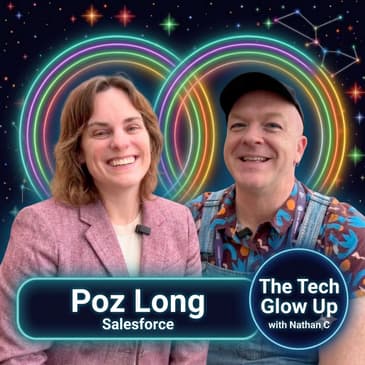

Get a front row seat to the conversations about AI, AR smartglasses, and the future of enterprise technology from Augmented World Expo 2026.
Poz Long is Director of Creative Technology for Sports, Media, and Entertainment at Salesforce. Their job is to help people understand complex products through experiences — not documentation or demos, but through things that move people and actually solve something.
Poz's background runs from a theater degree through reality TV post-production, America's Test Kitchen, Bay Area music videos, and eventually into XR at Meta and Apple, where they built a VR synoptophore for pediatric eye alignment testing.
A synoptophore is the heavy, aging machine eye doctors use to measure strabismus — eye misalignment — in children. Poz proved it could be done with eye tracking in VR, with a lot more fun involved.
At AWE 2026, Poz walked me through the activations they've been building and what they're looking for next. The marquee story: a Super Bowl activation with MrBeast, a 27-day puzzle that could only be solved using a custom Slackbot, and a winner named Colin who used it exactly as designed. 96% of players who used puzzle cards used the Slackbot the same way they'd use Slack Canvas. First-time LLM users, learning through necessity.
Key Moments
- [00:05:07] Why Poz is at AWE: bringing spatial into large-scale activations and finding the right enterprise fit.
- [00:05:49] The MrBeast Super Bowl puzzle: 27 days, a Slackbot, and Lone Shark Games designing the hardest puzzle imaginable.
- [00:13:42] Boring problems are the move: why the most useful spatial applications aren't the flashiest ones.
- [00:20:02] Their Glow Ups for the next 6 months: FIFA, Rayneos hardware, and Headless 360 unlocking Salesforce data on any form factor.
- [00:23:02] Hot take: career goals are stupid, titles are summaries, and the real job is staying close to what fascinates you.
Watch the full episode → https://youtu.be/LYTfmDfrVok
Like and subscribe if you want more conversations like this.
#SpatialComputing #Salesforce #TechGlowUp #AWE2026 #XR
About Poz Long
Poz Long is Director of Creative Technology working across AI, data, and emerging interfaces. Prior to Salesforce, they worked as a Creative Technologist at Apple (contract), designing and prototyping internal creative systems used in live production environments under strict confidentiality.
Before that, they spent seven years at Meta/Facebook across creative strategy and technology roles, working on immersive initiatives and large-scale platform storytelling. Alongside this work, Poz created the VR Synoptophore, a clinical VR diagnostic tool developed in collaboration with medical professionals.
Poz began their career editing and animating Emmy-winning broadcast television at America’s Test Kitchen, before moving into interactive entertainment at Electronic Arts.
A "glow up" signifies a positive transformation, reflecting the journey of becoming a better, more successful version of oneself.
At The Tech Glow Up, we humanize the startup and innovation landscape by focusing on the essential aspects of the entrepreneurial journey. Groundbreaking ideas are often ahead of their time, making resilience and perseverance vital for founders and product leaders.
In our podcast, we engage with innovators to discuss their transformative ideas, the challenges they face, and how they create value for future success.
If you're a founder or product leader seeking your own glow up, or a seasoned entrepreneur with stories to share, we invite you to join our guest list via this link.
The Glow Up talks with innovators about their big ideas, how they stay resilient in the face of change and how they find and build the value that will drive their future success.
What is a glow up - you might ask?
Glow up is defined as "a positive transformation, often involving significant changes in appearance, confidence, or lifestyle.
We use "Glow up" to refer to the process of becoming a better version of oneself, more attractive, and more successful.
If you're a founder or a product leader who's looking to have a glow up of your own - or if you're a seasoned entrepreneur who's stories can support others, we'd love to hear from you. Please add you name to the guest list with the link in the show notes.
Each episode will also feature a community spotlight for innovative NGOs, non-proffits, and other organizations that are driving innovation and change in their communities. There's another link in our bio for community groups and sponsors to learn more!
Hello, and welcome to the Tech Glow Up, live from AWE 2026. It's day three. Our voices are tired, but energy is still high. I am here with Poz Long, Director of Creative Technology for Sports, Media, and Entertainment at Salesforce.
Poz LongYou got it.
Nathan CAmazing. Not only a boss title- Yeah but one that makes me have so many questions. First, welcome.
Poz LongThank you.
Nathan CCan you tell me what does a creative technologist, working in sports, media, and entertainment at Salesforce, arguably a technology not many people think of terribly creatively- tell me what it's like doing creative technology— Yeah uh, in a very large and omnipresent company.
Poz LongYeah. Thank you. Yeah. Um, I love that question because I think— Mm yeah, like, it, it's not what people immediately think, and I, um, my job is to prove you wrong.
Nathan CSo
Poz Longmy... Actually, my job is to help people understand our products through experiences. Um, as you may have heard— Mm-hmm some of our products are a little bit tough to understand, or they're a little bit, uh, abstract. And I think the best way to create that, that understanding and those strong relationships that are positive is through experiences that, like, move people and that are useful for people— Mm-hmm and that, um, help them to achieve something. So that is my goal. My background in XR is, uh, across Meta and Apple, and something I'm really proud of is a VR synoptophore that I created for pediatrics. So that's sort of-
Nathan CCan you- the me story describe a synoptophore to me? It's a new term.
Poz LongYes. Yeah. A synoptophore, um, if you've been to the eye doctor, um, is- Mm typically a very heavy, old machine. Um, and there's actually, like, one person in Tennessee that can fix this old machine, uh, which creates a lot of bottlenecks for the folks that need to do these measurements. When the eye is out of alignment. And it's a- actually pretty common. And so when children go to get these things measured, it's, like, kinda not fun. Mm-hmm. Um, and our goal was to, one, figure out if it was possible to use eye tracking to measure this, and it is clinically possible to do this to the, the level of fidelity we need. Um, but also it's, it's a lot more fun than staring into an, an, an old machine- Mm-hmm um, that may or may not, be working all the time. So it, it was a great project and, and super fun. and I learned a ton.
Nathan CAmazing. I wasn't expecting we were gonna get, like, a health tech for kids angle in the mix as well. Yeah. Uh, love it! How do you become a creative technology at a company so giant like Salesforce? Like, what- what's the origin story and, like, the pieces that came together to, to get you to where you are today?
Poz LongThat is such a good question. Um- And it's, like, looking back, it looks like I did it on purpose, but it certainly wasn't intentional.
Nathan CYo, claim it.
Poz LongYeah.
Nathan CClaim it.
Poz LongUh, I, I think, and this actually leads, there's, there's a whole hot take around this- so, like, yeah, my, like, my background, I actually have a theater degree. I went to school, I studied theater. I, I, I did that because I love storytelling, and I really did not want to commit to one thing. The idea of becoming a, a doctor or a lawyer, my parents really wanted a lawyer or a doctor, um, I was probably trending lawyer, I, I just didn't want to do one thing. and that felt like a, like really difficult to, like, have to be stuck doing one thing. but if you do theater, you're doing something new all the time- Mm-hmm and you are constantly learning. And my personality's very suited to that. So I studied theater, graduated, and immediately realized that I didn't have the confidence to sell my own art. But I did have reality TV. It happened that in New York at the time, that was the thing. Mm-hmm. Um, and so there were plenty of opportunities to, uh, do post-production, so I did that for some time. I ended up doing a cooking show called America's Test Kitchen. And then moved to the Bay Area because I liked the weather. Was making music videos with a band that went through there, and I thought, "Why not?" and moved, and then realized I, there was no film and television industry in the Bay Area.
Nathan CNo.
Poz LongUh, I landed in tech. Um, and so it was, there was no plan. I, I wish I could say that there was. But, but honestly, I think following, like, what makes sense at the moment- Mm-hmm is, is a pretty good strategy ultimately.
Nathan CUh, as somebody that went to college on a scholarship for theater, uh, I relate a lot to this story. and the thing that, you mentioned, one, it is a very technology creative, field, right? And often, regardless of your role in a theater, you're playing many roles, you're doing many things. And so you're building a set one day, you're rehearsing lines one day, you're front of house selling tickets the other day, and so, you get a full sort of engaged perspective in how things work and come together. And I feel like that is also what a creative technologist has to do. You're, you have to understand the business, you have to understand the clients, and otherwise. I'm so curious. You sort of teased these experiences that help to tell the story or bring people in to the complex ecosystem at Salesforce. Can you give me some examples or sort of talk through a, a project that would sort of help paint that picture a little bit more?
Poz LongYeah, totally. That, that was the glow up I have for you. Amazing.
Nathan CYeah.
Poz LongMy glow up, my goal- Yes and why I'm here at AWE- Yes is to start to bring more spatial into the activations that we're doing.
Nathan CLove it! Yeah!
Poz LongUm, previously in the year, I had the great pleasure of working with MrBeast on a Super Bowl activation. Um- Oh,
Nathan Cjust one of those.
Poz LongJust like you do. And it was a large scale puzzle game that was- Mm-hmm launched at the Super Bowl and took place over 27 days. Took 27 days to solve this puzzle using a Slackbot that we created just for this, and it, it was o- our way of introducing the Slackbot- Mm-hmm and getting some people who had never used an LLM before to try it and use it and h- use it for a purpose- Mm-hmm that actually solved the problem for them, and that was amazing.
Nathan CYeah.
Poz LongUm, and I had some ideas about how this could have had, like, a, a spatial layer. Mm-hmm. Like, could there have been some Pokemon Go element of, of, of hunting around? we had six weeks to do it in, and so we haven't- Mm-hmm achieved that yet, but I do think there is a lot of potential. Mm. Um, and I think really what I'm looking for here is understanding the hardware, understanding what's possible, and then for the customer, uh, whoever it is that we end up partnering with, it really has to be the right audience. They have to be wanting to try this thing with this hardware- Mm-hmm um, so that it's, like, a natural fit, and it helps our products show up in just the right way.
Nathan CYeah.
Poz LongThere's a ton of opportunity, but it, it just has to be the right fit, and so that's, that's kind of what I'm here for. S-
Nathan Cthat, like, equation of, like, right customer, right experience, right technology that enables it is, like, pretty magic when it happens. Oftentimes we hope that if we have, like, two of those leg- one or two of those legs, that stool's gonna still stand up. How, especially when we're thinking about, like, cutting-edge technologies that people might not have experienced yet, and we're, like, trying to think about big, magical experiences, how do you help guide and coach organizations like Salesforce or the partners that you're working with, right? Like, working with a MrBeast, like, it's not just getting your team on board, but, like, also making sure MrBeast feels good about, you know... what's your approach for bringing people on board with spatial ideas and interactions that also, like, tick those, like, three requirements that you called out? Yeah.
Poz LongYeah. That's a great question, 'cause it- it's- it's different every time. Yeah. And I think-
Nathan CI wanna know.
Poz LongI've, I've... Right. Don't we all? Like, what are the magic words I can say to my partner to make them wanna do this? Mm-hmm. And I don't think it- it, there's one set. Like, it- it really, it depends on what that person is thinking about- Mm and what's keeping them up at night, and what is most important to them right now. Mm-hmm. Um, and I don't know if you've noticed, but things have accelerated, and that thing can be a moving target. And it's really just about listening to them- Mm-hmm and- and meeting with them, and understanding, you know, kind of where their biggest kind of fears lie- Yeah in- in the space, and, like, what they see as the biggest thing to tick off their list for their customer. Mm-hmm. Um, and that differs for every single partner, and they all have a different culture and way of seeing the world, and way of processing things.
Nathan CYeah.
Poz LongUm, so yeah. I- I don't, I wouldn't say there's a clean answer that will neatly fit to any enterprise, but, um, if you're someone who's willing to sit down and listen, and- and really talk things through- Mm-hmm um, and not let them, like, kind of nod along, which I think- Very often, people, they want you to have a good experience in that meeting, and they- Mm there- there's this, like, human nature thing where they kind of wanna give you what you wanna hear. But it's like, no, but really, what do your customers care about? What are they gonna love? What are, what's gonna make them go, "Holy moly," like- Mm-hmm "I have to use this thing."
Nathan CYeah.
Poz LongAnd until you have the answer to that and you're sure, like, it's probably not the right time.
Nathan CSo- If it were only that easy that you could ask those stakeholders and partners, "What do you actually need?" Right? "What do you actually want?" Yeah. 'Cause, like, sometimes we don't know, and we can't express it. So do you have tools or approaches you u- like to use to learn, like, the difference between what a customer is saying and the need that they're expressing underlying? Like, how do you decipher that? How do you, how do you, What questions do you ask, or do you have frameworks on how you approach that discovery?
Poz LongYeah. I, I guess I'd never really thought about structured frameworks- but I do have some tricks. Um, yeah, I do. I, I find, like, yeah, very often people will kind of give you a, a very vague answer or a high-level answer, and you wanna see what's under that. Mm-hmm. I ask them what they're currently doing. Like, "What have you tried? What, what, what's working for you now? What is actually not working for you now?" Mm-hmm. I noticed this research item. I found this out. Is this actually true, or would you say that's not true for you?" And like, give them things to react to. Mm-hmm. Um, this is kind of the same as working in, like, a theatrical environment or a film environment. Like- Mm what does this director need to make a decision? What does this business ma- decision maker need to make a decision? What do they care about? Mm-hmm. And what do they care about that they're not telling me? Yeah. And, like, how can I draw that out of them and, and build trust really? Like, ultimately they need to know you're on their side and not just trying to get your next promo or whatever.
Nathan CMm-hmm. I often have worn, like, product marketing roles, and often when I engage with, like, developers almost immediately the assumption is that marketing is there to put a spin on something. And when I show up asking like, "What do the users use?" Or like, "This is what I'm hearing from our clients," like, it's, it's such an amazing way to, like, flip the script and get them to, like, pay attention because it's like, wait, no, I, I care about the customers. Maybe, like, I'm gonna argue with you about who cares about the customer more because, like- in many times, right, being on the front of those stories and interactions, like, you hear it, you learn it. And, so I'm gonna keep pushing on this one question. My brain is obsessed with like how do you do spatial for like data, for context, for financial? Like, how does that, how do those things come together? And I've often joked that like there are some things that are good for VR and there are some, like, tasks that are horrible for it, and specifically, like doing financial data, anything feels just incredibly hard with like controllers and hand gestures and, like, keyboards that don't have keys. So I- I'm curious, like, how do you approach like spatial concepts and high data concepts, uh, in the types of experiences and stories that you're trying to tell?
Poz LongThat's such an interesting question because, yeah. Why, like- Yeah that sounds terrible, what you just described. Yeah. I wouldn't want to participate in that. Like,
Nathan CI don't like using my f- my TV remote to enter passwords- Oh, for
Poz Longsure. Yeah
Nathan Clet alone in a headset.
Poz LongYeah. You know? And that's the first check. Like, would I want to do this thing? Mm-hmm. Absolutely not. Like, I, I would not approach that. Um, however, like for, MrBeast as an example- Mm-hmm we created this Slackbot that was intended to help solve the puzzle. Yeah. We then created the hardest puzzle you could possibly imagine using a, a, a team of-
Nathan CWhich is a great... Like, I'm already interested, right?
Poz LongYes. Lone Shark Games, uh, designed the most in- incredibly difficult puzzle you could imagine. Mm-hmm. And in order to solve it, you needed the Slackbot. Mm-hmm. So then it, it was just like a natural use case that you were like- Mm-hmm "Oh, thank God I have this thing and I can ask it stuff." Um, and that was ultimately how Colin Sanders, who was the winner was able to solve the puzzle. And I, I think it's just- That's rad it must be a natural fit- Mm-hmm for the thing that your audience wants. I'm sure there are many ways to use data that are actually a natural fit, but like- Mm-hmm what you described with, like, the inputs not working, I think I have some thoughts around hardware in general. I've seen a lot of really cool stuff here. There's this thing by Mudra that- Mm-hmm where you can kind of use your hand naturally with your glasses. that there's like, they're kind of all separated from each other. There's nothing that now lives all in the package that, that does everything I want. There's, there's a ring and there's, you know, there's a, platform. RP1. Mm-hmm. RP1, And everyone's kind of building in these different areas and it, and it, like, it's kind of converging into- Mm-hmm one unified ecosystem, but I don't think we're there yet. Mm-hmm. And I think it's actually the use cases that start to drive that. And what I think is really interesting about right now is that now with Claude, anyone can build anything, and it gives access to people to come with their very niche, unique problem that no one else is really thinking about, and quickly prototype something, and then take that and show it to the hardware maker and say like, "Hey, I have this use case, like can you help build with me?" Mm-hmm. And I think that does a lot to push us forward.
Nathan CMm-hmm. Ooh
Poz LongThe question you're asking is, like, Does it have to be these boring things? So I actually have some thoughts on boring. I think we, boring problems are actually the move. Uh, w- our, our tendency-
Nathan CYo
Poz Longwe need to, we need to look for the boring problems. We, we, we go to the flashy, beautiful Walkabout Mini Golf, I love you guys. Like, it's the best space in the world, and it's so cool. Mm-hmm But it's not for everybody. Mm-hmm. And, and I, what I hear all the time is, "Well, I'm not a gamer. I'm not putting that on." Like, "I'm not a gamer." I
Nathan Cdon't like to walk about- "I'm not
Poz Longthat identity."
Nathan Cin VR. That's my thing. I mean, I
Poz Longli- I will, I will die for Walkabout.
Nathan COh.
Poz LongBut
Nathan CGorgeous. The, the amount of community that happens- Oh, my God. Yeah in that space is like- It was just my very favorite it's way more than a game.
Poz LongUm- Yeah however, it's not for everyone. And, and what is for everyone i- is different. And I think when you tackle the boring problems, the I'm on my way home, and the Target's right there, and I need shoes for my kids, and it knows that, and so it tells me that I stop 'cause there's a s- a sale there. And, oh, there's that reminder for that school event, and it's, these are all related to my kids. Mm-hmm. But, like, all the stuff, all the boring stuff
Nathan Cthat
Poz Longyou have to check off your list-
Nathan CThese are very personal user stories.
Poz LongYeah yeah, like, i- if, if someone could ma- wave a magic wand and make that stuff easy for me- Mm-hmm I would get first in line, and I think there's a lot of other people out there that feel that way, too. And so it doesn't have to be the most beautiful thing. It doesn't have to be the shiniest, coolest thing. Just do something useful, and that will solve, you know, a, for a lot of the resistance.
Nathan CYeah. I'm gonna let that one cook. That's gorgeous. We're here at AWE. This is the Tech Glow Up. I like to ask about the transitions, the transformations, the rebirth, the glow up that you think the industry needs to make. And I think in this, like, very enterprise kind of conversation, there's a lot of conversation, right, like, in tech that, like, enterprise is the main client. This is everybody's business model. But I wanna hear it the other way around. What does the industry need to do to glow up, to meet enterprise needs, and to be a better partner to enterprise in the next 6 to 12 months?
Poz LongHmm. Dang. Yeah, now I wanna ask for the magic words to say to my leadership to- you know, make them unlock the budget and have the money fall from the sky. Mm. But I, I d- I do think that, like, the storytelling- Mm-hmm i- is really useful. Um, I, I've experienced a bunch of demos, um, and they're all over the map as far as, like, all the different things that can be done. Um, but the more awareness, I think, the peripherals have of the waveguide makers, of the audio, spatial audio folks, like, the w- the way that they can connect the through line because they're separate companies now- Mm-hmm and it's not a complete ecosystem, the more they're talking about each other and have an awareness of, like, the whole picture and can package that up for us, um, it will give me less work to do to then package it up- Mm-hmm for my leadership. but also, like, the, the better we'll be able to understand our use cases and plug them in there, because companies wanna innovate. Like, we do not wanna be left behind. We do not wanna be thought of as dinosaur enterprise companies. Mm-hmm. We wanna be thought of as the agentic enterprise, and we are building it as fast as we can. Mm-hmm. Um, and the, the things that help us do that are demonstrating that to our customers. So,
Nathan Cum- I love that you said- make it
Poz Longeasy.
Nathan CI love that you said demonstrating. Uh, I, I'm gonna... I love this point and, like, please make it easier for your customers to do business with you. They want, they want to. So, like, learn what it takes to be supportive to an enterprise and, like, get together on it. When you're talking about this agent, the thing that I loved was that you showed the value of agentic support without telling anybody that they were going to have an agent there with them all the time helping them on their way. It was just part of the experience and the puzzle that you put in front of them. It's part of the story.
Poz LongRight.
Nathan CAnd instead of the story being, "We built a technology that will change something that you're already doing," to like, "Look, this thing was helpful when you wanted it." Love that. When I talk with healthcare leaders about AI, this is total side quest, one of the things that I heard frequently is if an agent can be helpful with a task it was intended to do, you will build trust, and you will start to get questions about the other pressing problems in that person's life. And I don't know if this agent was able to, but I'm curious, did you notice or do you have data where people started to trust the advice of the puzzle agent and started asking other questions in the channel?
Poz LongThat's really interesting. The only, like, official story I have- Mm-hmm is Colin's, 'cause we recorded it.
Nathan CYes. Yeah.
Poz LongBut he did say he, he'd noticed some things in the commercial. There were clues hidden everywhere. I didn't even know where they were. Yeah. And, and he noticed some things, and then he went to the Slack bot- Mm-hmm and he kind of plugged them in. And the way that it worked was there was conversational side, and then there was this thing called a puzzle card- Mm-hmm which sort of mirrored the, uh, canvas that we have in Slack- Mm-hmm that if you use Slack, it's just a document.
Nathan CLove it. Um, and- Oh my gosh
Poz Longand he would then, like, populate his puzzle cards with the things that he was finding, and it helped him sort out th- and, and, and manage that. Mm-hmm. Lots of different ideas all over the place. Really difficult to put together into one overarching thing. Mm-hmm. Summaries are what AI is, like, best at. It really... Like, if it takes- Mm-hmm your stuff, you can reliably expect it to manage that in a way that makes sense. Um, and so I think, you know, that, that was a really obvious, useful use case for him. Mm-hmm.
Nathan Cthe sort of knock-on effect of, right, using the chat bot, and like, "Oh, I need a place to put these, these answers. How can I start to visual... Oh, well, there's this canvas that's also here." Right? so love it. Keeping on the glow up theme, let's turn it inward a little bit to the work that you're doing. What's the, like, six-month glow up goals that you have, for working and, building more immersive experiences in the stories that you're telling?
Poz LongYeah. Yeah. I have so many ideas,
Nathan Cso- Don't we all?
Poz LongI, you know, it... And it, it's really, it is just about finding the right fit. I think we have a, a number of great partners. We just signed with FIFA, pretty exciting. F1 is one of our historical partners. And, like, all of those are very nuanced. I have a few prototypes that I've, I've, I've talked through. Um, the Rayneos, have you, have you tried those ones? The, um- Mm-hmm I got the latest device at CES this year. Amazing. Um, kind of looking through how to do storytelling in spaces. I won't go too deep into that one 'cause it's not totally baked, but, um, yeah, like, the... I think it's really just, like, for me, the, the partner that is most curious about this space- Mm-hmm um, and then the conversation that I could have to help them understand the utility. one thing that has been kind of, uh, I think an unblock for us at Salesforce- Mm-hmm is Headless 360. which if you are not following SAS, uh, Twitter- Mm-hmm uh, sorry, SAS X- Mm. Um, you, you may not have noticed- Mm-hmm um, the, the, the Headless 360 is essentially all of your Salesforce organization, previously accessible sometimes only through UI. Mm-hmm. Um, that is no longer. Now you are able to use that as a back end on any form factor. So that means the glasses can now talk to my Salesforce organization, and maybe even say, "Oh, that, I, I... That customer in front of you right here at AWE, like, here, here's the data that you have on them. Here's the last conversation you had with them. Um, here's a next step you could pursue right this instant." And, you know, I don't know, like, why don't we build that? I have an
Nathan Cintroduction for you- on that specific topic. Uh, so cool, and also if you remove the flat spreadsheet based UI from the financial and, like, customer documents that I'm used to in using in Salesforce tools- Then using that data in space becomes a lot easier.
Poz LongYes.
Nathan CRight? Yes. Because, like, my complaint was you're, you're asking me to fill a flat 2D thing in a 3D space where I don't have the same tools, and what you're talking about is I'm gonna give you your data so that, like, the UI isn't a limit.
Poz LongRight. I mean, no- humans are not talking- Yeah to us anymore. Yeah, yeah, yeah. Like, no one's doing all that. Yeah. Like, we're, we're sending the robot to do that stuff. Yeah. And so they... We wanna make it easy to send the robot to do the stuff, and then now the only limit is, like, what can you think of to do with your stuff?
Nathan CI love it. Kind of in the same way that Snap's, like, made a really organized GitHub, like you're organizing so that your agents can... That's cool. Yeah,
Poz Longyeah.
Nathan COkay. You kind of got spicy earlier. But I'm curious, at this point in time, do you have a hot take to share about AI, tech, culture in general? Your choice.
Poz LongYeah, yeah. So we did touch on this. Um- Mm-hmm my hot take is career goals are stupid. And hear me out.
Nathan CNo, I'm already on board.
Poz LongUm, I think they're dumb. I think they're... We put so much pressure on ourselves to achieve some career identity. Mm. And, you know, identity is like a whole hot mess to begin with. And then on top of it, we have to have this title, and there's these specific titles that maybe we're aiming for. Um, and every time that I have been successful, it has been because I find some fascination with something. Um, and VR just... In 2016, someone gave me a Gear VR, and with the dinosaurs. You remember that? And I was just like, "Oh my God, like this- Mm-hmm changes everything. I have to do this now." Um, and I couldn't stop. And I think just by pursuing things that you're really excited about, that you're really passionate about- Mm-hmm that solve a problem for you- Yeah um, you will very often find a person that also finds value in that or a company. And amassing more and more of those, then there is a summary, and that is then your title. So it's not that you should pursue some job description, it's more that you should do the job and do the things that are really important to you and stay close to that and learning, and then whatever title you get is just a summary of all those things that are actually you.
Nathan CI'm loving this so much. I, I like ha- I'm internally screaming, uh, because I have to like sit on my hands and make space for that answer. I teach graduate students at University of Oregon, and like, "What is a job? How am I supposed to do this? Oh my God, I'm supposed to be perfect out of the box," is like one of the most common things I hear forever. And with the like perspective and experience and time that I have, I've found I'm way less interested in the titles and names that I put on what I do, and like the people, the problems, the way we go about trying to fill our days with work, uh, means a whole lot more to me. So, that's probably gonna be the advice that I keep repeating to other people when they ask me how my day's been this week, so thank you.
Poz LongYeah.
Nathan CPoz, your expertise and perspective, really resonates for me, and I'm sure other folks out there trying to do meaningful work that matters to customers and showcases, right, the cool shit, the cool technology and tools- Yeah that we're building. Thank you for joining me to talk about the cool work you're doing at Innovation at the highest levels. I can't wait to check in on what your next glow up's gonna be and your next big collab, so.
Poz LongIt has been my absolute pleasure, Nathan. Yeah. This was such a great conversation. Thank you. Oh
Nathan Cmy gosh. Thanks for joining me on The Tech Glow Up.